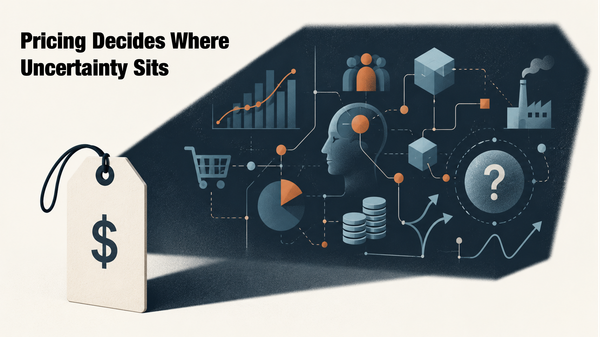

Weekend Reflections Weekend Reflections #9 | Where the AI Meter Sits When AI pricing moves from output to exploration, every prompt becomes a small purchase decision. The question is no longer only what AI costs to run, but where the meter belongs in the product experience.
Weekend Reflections Weekend Reflections #8 | The New Material Discovery is no longer only about screens, workflows, and backlog items. It is about finding the shortest path to a solved problem across software, AI, data, physical interaction, automation, and human behavior. That is the new material. Not a tool. Access.
Weekend Reflections Weekend Reflections #7 | The Absolution Machine This week I made a design decision that bothered me. A personal AI skill-readiness scanner I am experimenting with must never say the skill is safe. It took me a moment to understand why that bothered me. That is not a tool. That is an alibi.
Weekend Reflections Weekend Reflections #6 | The Daughter Test [Views are my own]. She was eight and loved to sing. I had just bought her a vocal processor and asked her to help me connect the gear. She looked at the cables. Then at the processor. Then at me. "Which one goes where?" I paused. Because I&
A Skill Is Not Just a Text File [Views are my own] "A skill is just a text file. It cannot be that dangerous." I hear this a lot. So let me ask: what exactly can a text file do? But wait, the counterargument arrives quickly: "The system processing the skill should handle that. This
Human-AI Collaboration Weekend Reflections #5 | The Speed of Doubt: When AI Outruns Trust [Views are my own] Last week I ran a competitive analysis that would normally have taken me half a day. With AI, the first version took ten minutes. That was not the strange part. The strange part was that it was good. I did not discard it. I did not
The Semantic Supply Chain: The Control Tower Part 4 of 4: Trust to Audit, Not Trust to Vibes [Views are my own. Not legal or compliance advice.] Governance can feel restrictive when it’s applied as a cage. But in enterprise GenAI, the right controls are a skeleton: constraints that enable safe speed by making behavior predictable
Human-AI Collaboration Weekend Reflections #4 | The Molting For centuries, automation stripped roles of their execution layer. The roles that survived were the ones with judgment underneath.
The Semantic Supply Chain: The Autonomy Ladder Part 3 of 4: The Autonomy Ladder [Views are my own. Not legal or compliance advice.] This is the moment where mistakes move from low-cost errors to business-impacting failures. Because now we're not just generating answers, we're executing workflows. In Part 1 and Part 2, we
Human-AI Collaboration Weekend Reflections #3 | The Fluency Tax [Views are my own] This week, I noticed something in my own habits. As an Italian living in Berlin and working mostly in English, I now default to English with AI even when it is not the language that feels most natural to me. That felt worth paying attention to.
Human-AI Collaboration Weekend Reflections #2 | The Mirror Test I tested whether I could catch myself anthropomorphizing AI. Forty-five minutes later, I had shared more than intended. The trap is not ignorance; it is fluency.
The Semantic Supply Chain: Engine and Grounding Part 2 of 4: Engine and Grounding: From Plausibility to Proof [Views are my own. Not legal or compliance advice.] In Part 1, we left off with the foundation: establishing a Capability Contract (Station 1) and building retrieval infrastructure (Station 2) for our Procure-to-Pay copilot case study. We defined what
AI Governance & Risk Management The Semantic Supply Chain: Capability Contract & Inputs Part 1 of 4: Capability Contract & Inputs [Views are my own. Not legal or compliance advice.] When you last prompted a GenAI application, did it feel like persuading a person or programming a machine? I still catch myself doing it. I start talking to it like a colleague. The
Human-AI Collaboration Weekend Reflections #1 | The Momentum Wave Most ideas don't die because they are bad; they die when momentum breaks before testing. AI shrinks the gap between thought and test, creating a Momentum Wave where natural language lets anyone prototype. But beware: speed without customer validation is just fast failure.
Innovation & Ideation Methods Stop Sketching. Start Scaling Judgment. [Views are my own] Crazy Eights isn’t just a sketching exercise – it’s a lightweight system for scaling team judgment. In eight minutes, it generates real options, equalizes voices, and models psychological safety. The sketches are not the point; the shift in how your team thinks and decides is.
AI Governance & Risk Management The Invisible Skeleton: Why Governance Is the Price of Freedom [Views are my own] I have a confession to make. I write a lot about Governance, Systems, and Process. And almost every time I do, the reaction is the same: people assume I am the enemy of fun. At every time someone suggests introducing a "process" or following
AI Governance & Risk Management Instruction Governance: The Missing Layer of Enterprise AI (Part 4 of 4) [Views are my own] Part 4 – Implementation and The Business Case In this series, we’ve covered the "Triad" (Part 1), the "Golden Set" (Part 2), and the "Federated Framework" (Part 3). Now, we answer the hardest question: How do we implement this without
AI Governance & Risk Management Instruction Governance: The Missing Layer of Enterprise AI (Part 3 of 4) [Views are my own] Part 3 – The Three Pillars of AI Governance Most enterprises are now past the “one AI pilot” phase. You have dozens of teams, dozens of models, and far more prompts than anyone can count. Each team has its own agent, its own prompt file, its own
AI Governance & Risk Management Instruction Governance: The Missing Layer of Enterprise AI (Part 2 of 4) [Views are my own] Part 2 – Why We Must Evaluate Our Instructions Before We Evaluate AI In Part 1 of this series, we diagnosed the core problem with AI evals: we often evaluate the model's answers before validating our own instructions. We also introduced Step 1: The Governance
AI Governance & Risk Management Instruction Governance: The Missing Layer of Enterprise AI (Part 1 of 4) [Views are my own] PART 1 - Stop Blaming the Model – Start Evaluating Your Instructions The Debate: Engineering Rigor vs. Enterprise Reality This article was born from a recent discussion with peers, fellow VPs and Product leaders, on how to best approach AI evaluation. The prevailing view was that we
Knowledge Management & Curation The Judgment Economy (Part 4/4): Connections vs. Collections [Views are my own] In the first three parts of this series, we built the case for a new strategic mandate. We moved from filtering Signal vs. Noise, to creating Information vs. Insight, to building an enterprise-grade framework for Credibility vs. Plausibility. In this final part, we move to the
AI Governance & Risk Management The Judgment Economy (Part 3/4): Credibility vs. Plausibility This is the central tension for every enterprise. Generic AI is built for plausibility (it sounds correct). Enterprise AI must be built for credibility (it is correct, auditable, and grounded in your business data). This requires a new, essential human function: Level 3: The Trust Broker.
Data-Driven Decision Making The Judgment Economy (Part 2/4): Information vs. Insight [Views are my own] In Part 1 of this series, we explored the foundational challenge of our time: separating Signal vs. Noise. We defined the problem of "Polished Emptiness" and introduced the Taste-Maker as the first level of curation – the disciplined judgment required to filter the field. But
Human-AI Collaboration Vibe-Coding Is a Filter, Not a Threat: How to Use It Without Wasting Your Team’s Time. AI is changing the world fast. Stop focusing on who is using what tool. Focus on why, and double down on the human skills that AI can't replicate: your judgment, your creativity, and your scars. That is the only moat that lasts.
Data-Driven Decision Making The Judgment Economy (Part 1/4): Signal vs. Noise We are drowning in information. Generative AI accelerates this, creating a flood of "Polished Emptiness" – plausible-sounding content with no substance. As AI commoditizes generation, the last true scarcity is trust. Value is shifting from creation to curation and judgment.