
About Me and The Thinking Lens
On this page My story
Hi, I'm Amodiovalerio Verde, but most people call me just Valerio. Even my parents.
When I was seven, I got my first computer, a Commodore VIC-20.
I connected it, switched it on, and typed:
HELLO
It answered:
SYNTAX ERROR
Not exactly the conversation I was expecting.
But it created a question that has followed me for most of my life:
Why?
As a kid, I dismantled remote controls, telephones, electronics and pretty much anything I thought I could put back together. I was generally more confident about that last part than my parents were.
Then came circuit boards, modems, BBSs, programming, reverse engineering and the early hacker community, back when “hacker” mostly described people driven by curiosity about what was happening inside a system.
I wanted to look inside.
To understand not just that something worked, but how and why it worked.
That instinct never really went away.
Today I’m a VP Product. The systems I take apart are different now: products, organizations, markets, metrics, decision processes, AI systems.
But the question is surprisingly similar.
What is actually happening underneath?
My route here was not particularly planned.
I started writing software and co-founded a small digital agency in Naples. Then I kept moving sideways as much as upwards: software, e-commerce, marketing, advertising strategy, startups, consulting, teaching and eventually product leadership.
Apparently I have a complicated relationship with straight lines.
For a long time, that career was easier to explain than to summarize.
In retrospect, there is a pattern.
I tend to be drawn to things that are not quite formed yet: a product hypothesis, a new capability, a team, an operating model, a problem sitting awkwardly between functions.
I like figuring out what the thing actually is, putting enough structure around it to make it work, and eventually making myself unnecessary.
Product became a natural home because it forced many of the things I had already spent years trying to understand to collide: technology, customers, markets, data, psychology, business and organizations.
I have never been particularly good at staying inside one box.
I no longer think that is a problem.

Why The Thinking Lens exists
I started The Thinking Lens because I wanted a place to work things out in public.
Usually I write when something that sounds obvious stops feeling obvious.
“Be data-driven.”
“Move faster.”
“Do discovery.”
“Use a framework.”
“AI generates, humans judge.”
These statements can all be useful.
They also hide assumptions.
I have become increasingly skeptical of advice that works perfectly once you remove the organization in which the work actually has to happen.
What happens when the data is incomplete?
When Sales has already promised something?
When Engineering disagrees with the premise?
When incentives point in different directions?
When a large customer is waiting?
When yesterday’s sensible decision has become today’s constraint?
When AI changes what is technically possible faster than the organization can decide what should be possible?
That is usually where I become interested.
I pull the idea apart. I look for the assumptions underneath it. I try to understand where it works, where it breaks, and what changes when reality becomes inconvenient.
Product is the ground I know best, so much of the writing starts there.
But increasingly I find myself writing about the systems around the product: organizations, data, incentives, memory, leadership, AI, trust and judgment.
The topics have expanded.
The underlying question has not changed very much:
How do we make good decisions when the answer is not obvious?
Writing is part of how I try to answer that.
An idea can feel perfectly coherent inside my head. Then I try to explain it and discover the missing assumptions, contradictions and convenient shortcuts.
That is useful.
Sometimes writing makes an idea worse before it makes it better.
I have changed my mind while writing articles. I have written pieces that made me uncomfortable with arguments I had made before. I have started with one question and ended somewhere completely different.
I want to keep that visible.
The Thinking Lens is not a collection of finished answers. It is closer to a record of thinking in progress.
I also have a weakness for naming things.
Discovery Debt. Prioritization Theater. The Fluency Tax. The Absolution Machine. The Speed of Doubt.
Giving something a name does not make it true. But sometimes a name gives us a handle for a pattern that was already there and difficult to discuss.
I use frameworks for the same reason.
And I am suspicious of frameworks for exactly the same reason.
A framework is useful when it helps you think. It becomes dangerous when it starts doing the thinking for you.
I like frameworks.
I just become suspicious when they start reproducing.
I do not have a methodology to sell, and I do not believe every useful observation needs to become a 2x2 matrix.
The work behind the writing
I have spent more than two decades building and leading digital products across startups, scale-ups and large enterprise environments.
I have taken products from thesis to market and inherited established products with years of customers, growth and decisions embedded inside them. I have worked on individual products and portfolios, built teams and new capabilities, changed ways of working, worked on pricing and positioning, and spent a lot of time in the friction between Product, Engineering, Sales, Marketing and the rest of an organization.
Moving from scale-up to enterprise changed my perspective considerably.
A practice that works beautifully with a small autonomous team does not necessarily survive contact with hundreds of dependencies, regulation, contractual commitments, multiple products, existing customers and organizational history.
That does not mean the practice was wrong.
It means context matters.
Professionally, I tend to be most interested in transitions.
From an idea to a product.
From a product to a portfolio.
From informal ways of working to systems that can scale.
From scale-up speed to enterprise complexity.
And increasingly, from software that helps people work to AI systems that participate in the work itself.
Those transitions are messy.
Technology, customers, economics, organizations and people rarely move at the same speed.
That is usually where I want to be.
Some decisions I have made worked well. Some did not. A few took years before I understood whether they had been good decisions at all.
Most of what I know came from some combination of curiosity, experiments, mistakes, people who knew more than I did, and eventually understanding why something worked rather than simply remembering that it worked.
My professional work inevitably feeds the writing, but this is not a company diary.
I do not write about confidential decisions, customers or results. I am interested in whether the underlying idea still holds once the company-specific details are removed.
Me and AI
Every piece on this site starts with something I am trying to understand.
Usually that means notes, fragments, a brain dump or a first draft, often longer than the article I eventually publish, before I involve AI.
After that, I use AI extensively.
I ask models to attack an argument, find unsupported claims, surface research I may have missed, offer competing explanations, identify assumptions I have smuggled into the reasoning and tell me which paragraph sounds convincing without actually saying very much.
Sometimes AI finds a hole in the argument.
Sometimes it enthusiastically digs one where there wasn’t one.
Both can be informative.
What interests me most is not AI giving me better answers.
It is AI creating more paths through a problem.
A challenge to one argument can expose a concept from another field. A research trail can undermine something I assumed was universally true. An objection can become more interesting than the original article.
Many of those trails go nowhere.
Some might become the next piece.
I write frequently about what AI changes in knowledge work, so pretending it plays no role in my own process would be strange.
But I still think there is an important difference between using AI to work on your thinking and asking AI to supply the thinking for you.
The boundary is not always as clean as I would like.
That makes it more interesting, not less.
A few less professional things
I am Italian and live in Berlin.
I studied marketing and communication, not computer science.
I actually started university in software engineering and left. At the time, I was writing C while university was teaching me Pascal, and neither side seemed particularly impressed by the other.
Years later, while already well into my career, I went back.
I studied while working, graduated, and then decided that apparently nights and weekends were still too empty, so I did an Executive MBA as well.
I have continued studying ever since, although these days I care much less about learning something than about understanding it.
There is a difference.
I also taught for several years.
Teaching is a very effective way of discovering which ideas you only half understand. A room full of students eventually finds the hole in the explanation.
Writing does something similar.
Photography has been another long-running interest. My Flickr account dates back to 2005, I have taken more photographs than anyone reasonably needs, and at one point I even had an exhibition.
I would not stretch the metaphor too far, but photography taught me something I still find useful:
Sometimes changing the angle changes what you can see.






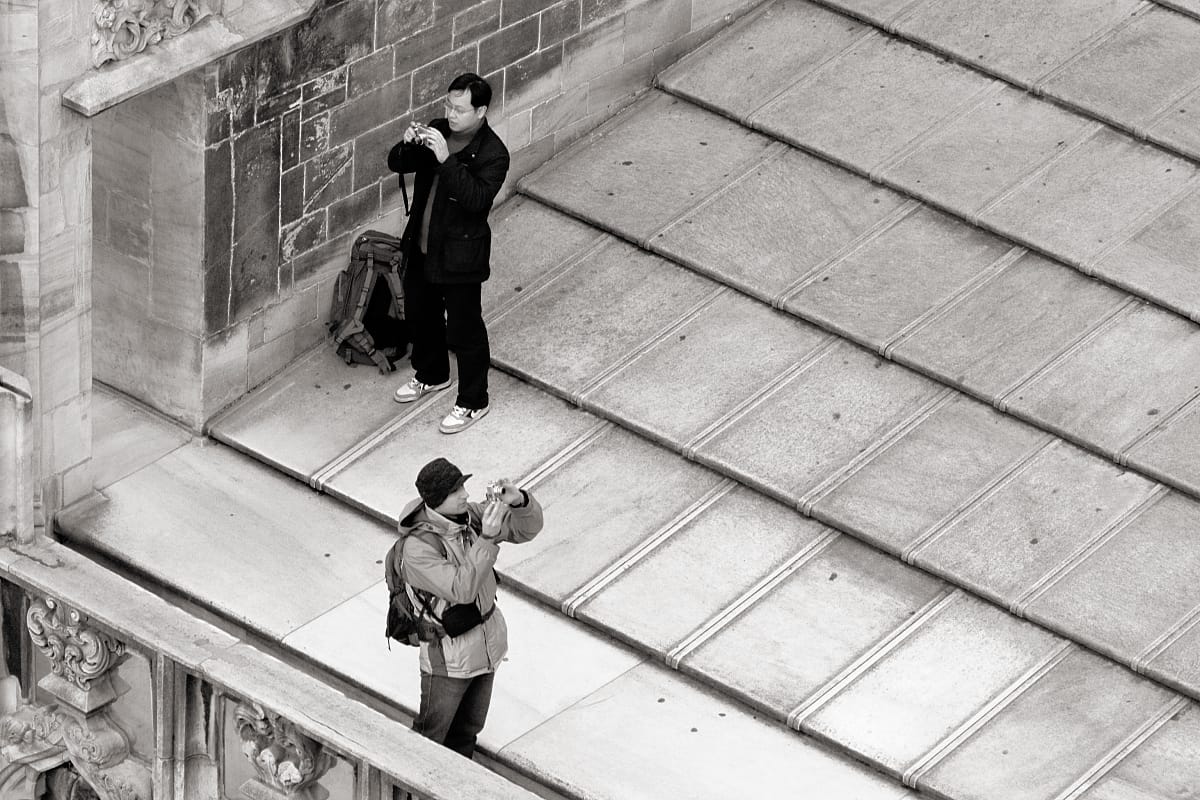


Perhaps that is also why The Thinking Lens feels like the right name.
I am a husband and a father. I still like technology far too much. I occasionally return to coding. I cook, experiment, take photographs and wander into subjects that have nothing to do with my job.
Curiosity has been a more consistent part of my identity than any title I have held.
If you are here to read
Some pieces here are long and structured. Weekend Reflections are shorter and more personal.
I write mostly about product, organizations, AI, data, decision-making and judgment, although I reserve the right to wander.
You will not find many articles promising the ten things every product leader needs to know.
There are already enough of those.
You will find arguments, models, questions, observations, things I am reasonably convinced about, and things I am still trying to understand.
And the occasional rabbit hole.
If that sounds like your kind of thing, subscribe.
Sometimes you will get three posts in a week. Sometimes two in a month. The cadence follows the thinking, not the calendar. I would rather send something when I think there is something worth reading.
And if you have read this far, introduce yourself.
Tell me what resonated. Tell me what did not. Agree with something, disagree with something, add the perspective I missed, or point me towards something I should read.
I prefer conversations to monologues.
Monologues are excellent for protecting your ideas, and occasionally your ego.
Conversations have the inconvenient habit of improving them.
And that, more than anything, is why The Thinking Lens exists.