
Stop Sketching. Start Scaling Judgment.

[Views are my own]
Crazy Eights isn’t just a sketching exercise – it’s a lightweight system for scaling team judgment. In eight minutes, it generates real options, equalizes voices, and models psychological safety. The sketches are not the point; the shift in how your team thinks and decides is.
Crazy Eights, run well, converts eight minutes into real options and a safer decision surface.
How an 8-Minute Framework Saved Our Hackathon and Revealed a Strategic Truth
A few weeks ago, I was in a high-stakes, high-energy room. We had kicked off a recent hackathon. The clock was already ticking, the air was buzzing, and the room was packed with a brilliant, diverse mix of people from engineering, design, and product with different seniority.
We had all the ingredients for success, but we also had the perfect recipe for a classic dysfunction I often call "Prioritization Theater": rapid, premature convergence on the first idea, championed by the loudest or most senior person (the "HiPPo").
We didn't have time for that. We needed a system to give voice to everyone – especially those who find it easier to show their thinking than to say their thoughts.
So, we used a tool I hadn't pulled out in a while: Crazy Eights.
If you're not familiar with it, the "operative" part is simple.
What is Crazy Eights?
- You take a single sheet of paper and fold it into eight rectangles.
- You set a timer for eight minutes.
- Each person must sketch one distinct idea in each rectangle. That's one minute per idea.
- The goal is quantity over quality. The time constraint is deliberately aggressive to force you past your internal critic.
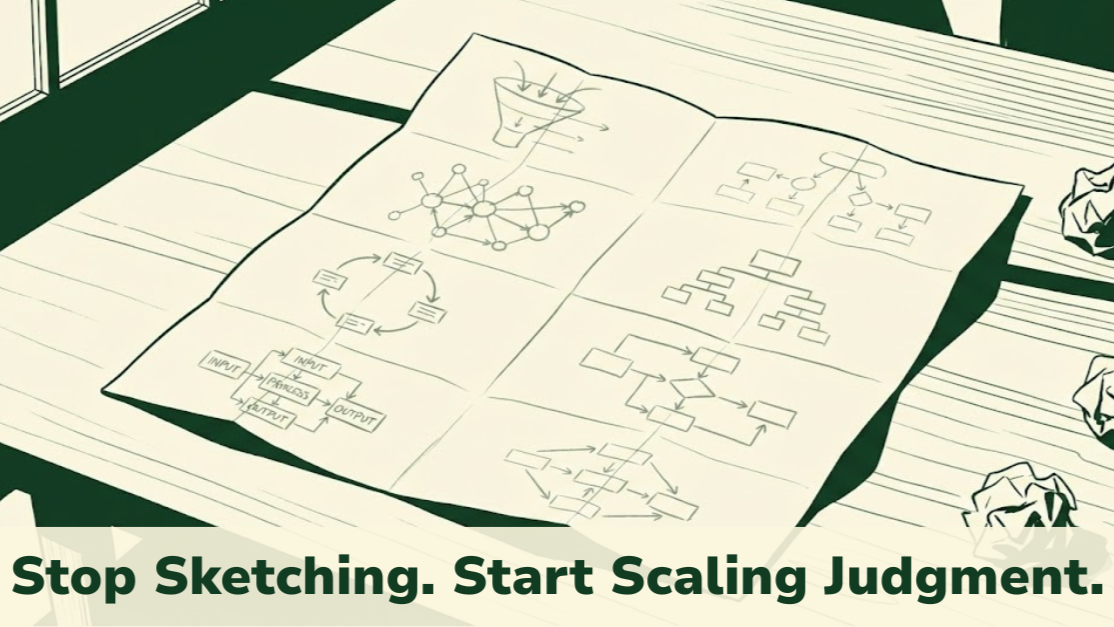
The room was skeptical at first. Eight minutes? Eight ideas? But as the timer started, a focused silence fell. People weren't talking; they were drawing. Scribbling, really. Boxes, arrows, stick figures, and UI fragments.
When the timer went off, the room erupted in laughter and energy. We had, in just eight minutes, generated over 50 distinct potential solutions.
But here’s the twist, and the real reason I’m writing this: The 50 sketches were the least valuable outcome of that exercise.
We often mistake Crazy Eights for a simple ideation warm-up. It's not. It’s a powerful thinking system for rewiring your team's entire approach to problem-solving. It's a framework used as a filter, not a blueprint.
Here are the strategic implications we unlocked:
It’s a Weapon Against "Innovation's Greatest Hits"
In business, we are addicted to a "greatest hits" album of ideas. We recycle the same solutions because they worked in the past. Even worse, we fall for groupthink and latch onto the first plausible idea that hits the whiteboard.
Crazy Eights is a strategic counter-measure.
- It forces divergent thinking. Your first idea is almost always your most obvious one. Your second is a variation of the first. But by idea #5, #6, and #7, you are in uncharted territory. You are forced to get "crazy."
- It builds a portfolio of options. You are not hunting for one perfect idea. You are creating several plausible bets, then testing them cheaply. Crazy Eights gets you to that starting set in eight minutes, before you commit engineering time.
It's the Great Equalizer
Look at your last brainstorming meeting. Who did the most talking?
The hackathon room was a mix of senior architects, new-grad designers, and seasoned product managers. In a normal discussion, a hierarchy would have formed.
Crazy Eights made that impossible.
- It is inherently inclusive. The exercise is silent and individual. The CEO's sketch and the intern's sketch are given the same space and the same 60-second time-per-idea.
- It changes the currency of ideas. The tool doesn't reward the best talker, the most charismatic presenter, or the person with the highest-paid opinion (the "HiPPo"). It rewards clarity of thought, and it gives a powerful voice to the visual and systems thinkers who often get steamrolled in verbal debates.
It models and reinforces the behaviors behind psychological safety.
The biggest barrier to innovation isn't a lack of ideas; it's the fear of having a bad idea.
The very name "Crazy Eights" is a masterstroke. It gives everyone explicit permission to be ridiculous. It's not called "Eight Perfect, Well-Reasoned Solutions." By framing the output as ‘crazy,’ you lower the stakes. The name itself grants permission to experiment. It’s not a guarantee of psychological safety, but it models the behaviors that create it – curiosity, openness, and equal voice. That’s a meaningful cultural signal.
This is a profound cultural intervention. In those eight minutes, you are running a simulation of a culture with high psychological safety. You are teaching your team, on a muscular level, that it is safe to be wrong. It's safe to explore a "dumb" idea, which is often just a "brilliant" idea in disguise. This builds the trust that is the true moat of any high-performing team.
Crazy Eights does not create psychological safety on its own. It creates a short, structured window where more voices can contribute with lower interpersonal risk. Sustained psychological safety depends on consistent leadership behaviors outside the exercise.
The Real Takeaway
Back at the hackathon, we pinned up all the sketches. The team didn't just see 50 ideas; they saw their own collective genius made visible. The "operative" part – the sketches – became the raw material for the rest of the day, setting us up for a focused session of dot-voting, rapid prototyping, and real alignment.
But the "thought leadership" part – the strategic win – was the shift in the room. The hierarchies were gone. We had a shared language. We had given ourselves permission to be bold.
Stop thinking of Crazy Eights as a sketching technique. Start seeing it as a system for building a faster, more inclusive, and braver organization – one that treats judgment as a muscle to be trained, not a privilege of the loudest voice.
A Practical Guide: Making It Work
Failure Modes and Fixes
- Shallow novelty: Add a 10-minute review to cluster and refine before selection.
- Visual bias: Allow text or system diagrams, not just drawings.
- Hierarchy returns in selection: Run a blind dot-vote first; leaders speak last.
- Too much noise: Screen on impact, feasibility, and fit to narrow focus fast.
It's a framework that, in eight minutes, scales your team's collective judgment, not just its output. The ratio of time spent to value generated is immense – it might be one of the highest-leverage eight minutes you can spend with your team.
When Not to Use This Framework Crazy Eights shines when your team needs fast divergence and visible options. Skip it when:
- The problem is highly constrained (compliance, legal, or infrastructure-heavy work).
- You’re in late-stage execution and need convergence, not exploration.
- The group lacks minimal context or data; you’ll just sketch guesses.
The tool’s value comes from pairing speed with informed input, not replacing depth.
Metrics and proxies for success
During the session
- Option count per person. Target six or more distinct options across the room.
- Participation balance. Share of participants producing at least one option. Aim for more than 90 percent.
- Anonymous selection quality. Fraction of selected options originating from non-senior contributors.
- Decision latency. Time from start to shortlist. Aim for hours, not days.
From session to pilot
- Conversion to experiments. Percent of shortlisted options launched within 14 days.
- Time to pilot start. Days from session to first live test.
- Kill rate with learning. Percent of options stopped with clear insights captured in a decision log.
Conclusions
The real lesson wasn’t about sketching at all. It was about judgment – how to surface it, distribute it, and scale it across a team.
In a world obsessed with frameworks and methodologies, it’s easy to forget that speed isn’t about moving faster; it’s about aligning faster. Crazy Eights works because it compresses the distance between individual insight and collective clarity.
What I took away that day wasn’t a set of drawings. It was a reminder that great organizations don’t out-innovate through tools. They out-learn through disciplined judgment.
💬 Question for you: Where have you applied Crazy Eights beyond UI? What constraints made it fail?
PAQs (Probably Asked Questions)
Isn't this just 'process theater'? The HiPPO will just pick their favorite idea anyway.
Fair point. A framework is a filter, not a replacement for leadership. It doesn't solve a low-trust environment culture, but it creates a structured moment to fight it. It changes the currency of ideas from charisma to clarity. The HiPPO might still choose, but now they are visibly choosing against 50 other options, not just blessing the first one. It's a tool for making decisions – and their rationale – visible.
This seems to favor visual thinkers or designers. What about engineers or PMs?
The goal is "quantity over quality." The "sketches" are often just boxes, arrows, and labels. We're not looking for art; we're looking for concepts. It's a tool for systems thinking, which is a durable capability for engineers and PMs. It forces everyone to move from abstract "what ifs" to a concrete 'how it might work,' which accelerates the entire team's alignment.
Should this only be used for sketching UIs? What about other problems?
Absolutely. This is the key. Don't limit this to 'design.' What if you used it to sketch a new process flow? A new organizational structure? A new go-to-market strategy? The tool isn't about drawing; it's about externalizing and iterating on ideas under pressure. Sketching a process map, a system diagram, or even a customer journey in 60-second bursts is an incredibly powerful way to apply this systems thinking outside the traditional design realm.