
Weekend Reflections #8 | The New Material
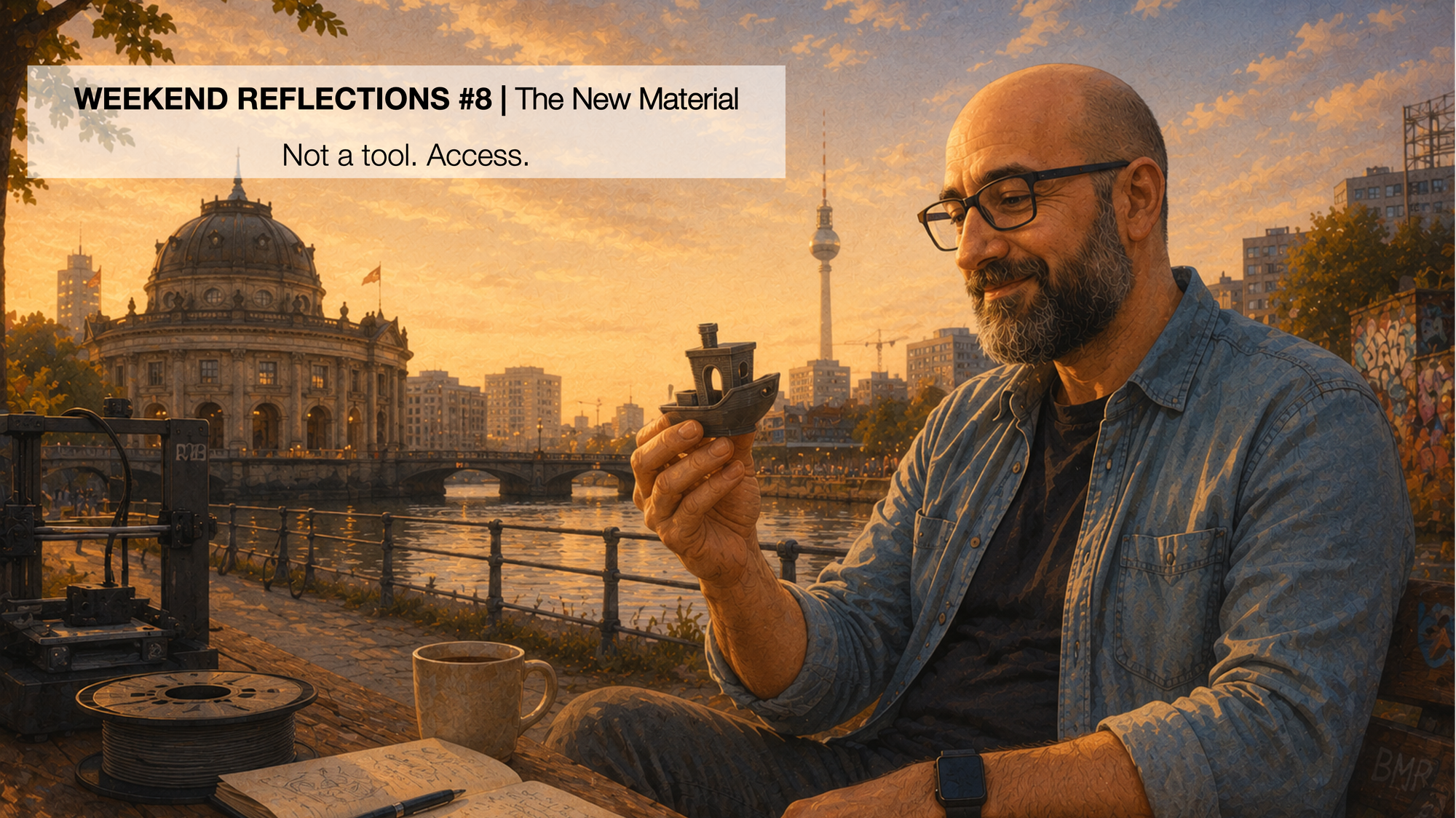
Discovery is no longer only about screens, workflows, and backlog items. It is about finding the shortest path to a solved problem across software, AI, data, physical interaction, automation, and human behavior. That is the new material. Not a tool. Access.

[Views are my own]
A few days ago I wrote this as a joke:
"If product managers are now expected to become builders and makers, I guess I finally found the perfect professional excuse to buy a 3D printer."
This weekend, I planned to write a proper reflection.
Instead, I took the excuse, and I bought a 3D printer.
That became the reflection. Because it reminded me that product work is not confined to screens.
I grew up with NE555 timers and 1N4148 diodes. With BBSs and 1200/300 modems. Building things inside plain plastic boxes with holes cut by hand, just wide enough for a switch, a LED, a connector. Not elegant. But functional. And mine. That feeling came back this weekend.
In SaaS, we tend to reduce "product" to software.
Which made sense when software was the dominant material.
But a product is not software.
A product is a problem solved for enough people, reliably enough that they come back.
Software is one way to get there. So is a circuit, a mechanical part, an AI layer, a design decision, a printed bracket holding a sensor in exactly the right place.
Sometimes the best solution is a combination of all of the above.
That surface area just got much larger.
The implication is not that everyone needs a 3D printer. It is that the boundaries of what counts as product experimentation are moving.
Discovery is no longer only about screens, workflows, and backlog items. It is which combination of software, AI, data, physical interaction, automation, and human behavior creates the shortest path to a solved problem.
And here is what I keep thinking about: this does not only work in one direction.
It is not just the software product manager who can now touch hardware. It is also the mechanical engineer who can add intelligence to what they build, the designer who can prototype electronics, the maker who can add a reasoning layer without being blocked by software as the first barrier.
The barriers between disciplines are not gone. But they have moved. And when barriers move, what becomes possible changes.
If you know nothing about a domain, AI will not make you an expert in 30 days.
But it will give you a real start. And from a real start, with curiosity and the willingness to actually learn, you can develop real skill.
That does not remove expertise, safety, or discipline. It changes how many people can reach a meaningful first prototype.
For a long time, crossing into an adjacent discipline often required formal study, access to experts, expensive tools, or the right employer.
The entry cost dropped. The learning did not disappear.
This is why the 3D printer feels bigger than a 3D printer.
It is not about plastic parts.
It is about what happens when a new material enters your loop. When a constraint you assumed was fixed turns out to be optional. When the answer to "can I build this?" shifts from "not without a team" to "let me try."
Two things changed at once: AI lowered the knowledge barrier, and the hardware became affordable enough to actually try.
AI did not make me a mechanical engineer. But it answered my questions, helped me learn enough to start, and when I could not use CAD, it helped me go from a rough description to a printable model.
Electronics is familiar territory. Mechanical design is less so. But the gap now feels bridgeable.
Software is my field. AI is my multiplier.
Put it all together: I am planning a custom three-key Bluetooth keyboard. Just to tell Claude Code what to do next.
I could buy an equivalent for less. But cheaper is not the point.
The point is that this brings back a kind of building I had missed: direct, phygital, slightly messy, and immediate.
This weekend, I am simply a curious person with a printer, a circuit board, an AI, and a reminder that learning still starts by trying.
I do not know what I will prototype next.
But I know the set of things worth understanding just got larger.
That is the new material. Not a tool. Access.
What's the idea you've been keeping in a drawer, and what are you finally trying, or trying again, now that the tools caught up?