
The Missing Control Layer
Enterprise AI cost control is not only a finance question. It is a workflow design question. Hard caps protect budgets, but they can break legitimate work already in motion. The next control layer must decide what should stop, slow, queue, or complete, and which trade-offs users need to see.

[Views are my own.]
Many companies spent the last phase encouraging AI adoption, experimentation, and upskilling. It worked.
Usage grew, and inference costs followed. Nobody should be surprised by that. When people find tools that help them work, they use them more.
The next phase is cost discipline, and rightly so. Inference is a real operating cost; not every role needs the same allowance, and not every workflow justifies premium capacity. Some tasks should run on cheaper models, lower priority, or stricter limits.
Cost controls are necessary. The harder part is designing them so they do not interrupt the work that justified the investment.
Cost controls, model routing, and tiered access all have a role. But enterprise AI also needs controls designed around work, not only around users.
Sometimes that work is a formal workflow. Sometimes it is direct employee usage: a simple draft, a multi-step analysis, a coding agent, a research task with retrieval, or an exploration that accumulates context over time.
In both cases, the control model should understand the value and context of the work, not only the identity of the user or the size of the invoice.
The pattern is broader than any one company, product, vendor, or pricing model. Across the market, adoption increases, usage becomes material, the first generation of controls appears, and those controls are often designed around users and invoices rather than around work and value.
The issue is the operating model: how to govern AI consumption without breaking the work.
This is consistent with the broader shift described in Microsoft’s 2026 Work Trend Index: as AI agents move from isolated tasks into workflows across functions and systems, leaders have to redesign work, accountability, governance, and the infrastructure for agent operations. That is why AI cost control cannot stay at the level of seats, users, or invoices.
In this context, capacity does not only mean physical model capacity. It can mean a purchased entitlement, a budgeted token envelope, a throughput allocation, or a runtime limit.
Many enterprise AI conversations move too quickly from adoption to restriction. The missing step is operating-model design: distinguishing emergency controls for abnormal demand from continuity controls for legitimate work whose full consumption cannot always be known upfront.
The complication is that AI work is not always easy to size before it starts.
Platform usage data points in the same direction. Anthropic reports that Claude sessions increasingly include long-running agentic tasks, and that more complex artifacts and work mapped to higher-wage occupations tend to consume more tokens. Higher consumption is not always waste. Sometimes it is the cost profile of more valuable work.
With probabilistic LLMs and agentic workflows, token consumption can depend on context length, retries, tool calls, retrieval, intermediate reasoning steps, and the path the task takes while running. Two requests that look similar to the user can consume very different amounts of capacity underneath.
That means a hard limit can be reached in the middle of legitimate work, not because the work was wasteful, but because the true cost of completion only became visible during execution.
Legitimate does not mean critical. A short rewrite and a multi-agent analysis can both be legitimate, but they should not receive the same continuity protection by default.
A request can be allowed and still be cheap to interrupt. Another can look ordinary but become expensive to stop halfway through. The control model needs to know the difference.
Controls borrowed from the wrong context
Limits are not wrong.
Consumer tools use them to protect capacity, prevent abuse, or encourage users to move to a higher tier. Enterprise platforms use them for different reasons: budget discipline, fairness, governance, and system protection.
The problem starts when the person hitting the limit cannot do anything meaningful about it.
An employee cannot upgrade the company plan. They can only stop, wait, request an exception, or absorb the delay.
In consumer software, that is frustrating. In enterprise work, the same interruption becomes coordination cost, delay, and lost momentum.
The goal is cost control; the risk is interrupting valuable work at exactly the moment AI is creating value.
Imagine a contract review workflow that has already ingested a long agreement, extracted risks, and started producing a redline summary.
At 80% completion, the quota is exhausted. The invoice may look controlled. The workflow has absorbed the cost elsewhere.
Hard caps
Hard caps still have a place.
They are useful for stopping anomalies: unplanned peaks, configuration mistakes, runaway agents, or agent swarms consuming capacity unintentionally.
A hard cap works well as an emergency brake, but it performs badly as the default operating model for normal, valuable work.
When usage is legitimate and the task is still worth doing, stopping the workflow is not cost control. It is value leakage.
User tiers
User tiers solve the average case, but not the important exception.
A light user can still have a high-value task. Differentiated access is right (not all roles need the same allowance), but differentiating only by user category misses the real variable: the task, its urgency, and its expected value.
AI leverage becomes a function of tier, not task.
Limit-triggered downgrade
The subtlest failure is limit-triggered downgrade.
Once you hit the ceiling, the system switches you to a cheaper model. Work continues. Cost is contained.
But this is not intelligent model routing.
Good routing matches the model to the task. If the task is simple, a cheaper model may be the right choice from the start. That is sound design.
A cheaper model may be the right choice. But that decision should come from task fit, not from hitting a ceiling.
The task did not change. The required quality did not change. Only the system state changed.
That turns routing into hidden degradation.
The output may still look complete, so the user may not realize that a quality decision has been made underneath them.
All these patterns carry the same assumption into a workforce context where it no longer holds: that the user can respond to friction by upgrading, waiting, or choosing differently.
In an enterprise context, none of those levers belong to the person doing the work.
Where user-level controls run out of answers
The pressure is already visible.
As AI usage grows, enterprise consumption is becoming harder to forecast and govern. Reuters has reported that usage-based AI economics are making bills less predictable even as per-token prices fall.
KPMG’s Global AI Pulse Q2 2026 found that only around one-third of organizations have full visibility into AI operating costs, while fewer than half have usage or token budgets in place. Nearly half have already rephased AI deployments when expected costs began to outweigh anticipated value. The issue is no longer whether AI is being adopted. It is whether organizations can see, govern, and manage consumption as AI becomes part of real work.
Gartner forecasts that AI coding costs could surpass the average developer salary by 2028 as token consumption from agentic workflows compounds.
The responses so far mostly fall into two categories.
Some companies are introducing token limits, spend caps, and employee usage restrictions. Others are taking a more architectural path: model routing, caching, leaner context, and spend visibility.
Both approaches are useful. Neither is quite the same as what I am arguing for here.
In many enterprise discussions, the budget owner, the platform owner, the workflow owner, and the person doing the work are not the same.
That is where user-level controls run out of answers.
Work-aware control becomes stronger when the organization can classify work by ownership, budget, priority, risk, and policy. But waiting for perfect classification is unrealistic.
Many organizations will not have clean work classes at the moment capacity becomes constrained. Continuity controls matter precisely because they create a controlled middle ground while governance matures: slow, queue, preserve, expose the trade-off, and avoid turning uncertainty into hidden interruption or silent downgrade.
Finance should define the economic envelope. Risk and platform teams should define the guardrails. But workflow owners need to help decide how capacity is spent.
If the people who understand the work are not part of the control design, the organization may optimize the invoice while damaging the output.
Vendors can provide the primitives, but only the organization can decide which workflows deserve continuity, which trade-offs are acceptable, and whose budget should carry the cost.
McKinsey makes the architectural requirement explicit: agentic AI needs a controlled way to run agents and applications through a shared execution layer that enforces enterprise rules and guardrails. But architecture alone does not answer the business question. It cannot decide which workflows matter most, what quality bar applies, or whose budget should carry the trade-off.
Enterprise AI cost control is not only a finance question. It is a workflow design question.
The mature model will not ask only how much AI each user gets. It will ask which work should complete, at what quality, at what speed, and with whose budget ownership.
Compared with many traditional SaaS or API workloads, agentic AI work, especially coding-agent workflows, is harder to estimate upfront because cost can vary with context length, retries, tool calls, retrieval, and the path the task takes.
A 2026 arXiv preprint on agentic coding tasks found that token consumption can vary up to 30x across runs, and that models may underestimate their own token costs.
Controls that look efficient in the budget can undermine value in the workflow.
Continuity throttling: slowing work before failure
A consumer hitting a token limit can wait until tomorrow.
An enterprise task mid-execution may be left with broken state, lost context, and someone deciding whether to reconstruct the work or start again.
There is a control that fits the enterprise context better, and it is borrowed from network engineering: throttling.
The underlying primitives are not new. Rate limits, queues, priority classes, reserved capacity, and throughput shaping have existed for decades.
The new part is not throttling itself. The new part is connecting it to the continuity of approved AI work: state, quality expectations, user transparency, priority, and budget ownership.
Here, throttling means continuity throttling: slowing approved AI work before it fails, without quietly lowering the expected quality of the result. The work may take longer or wait behind higher-priority tasks, but the system should not silently switch to a weaker model just because capacity is tight. Nor should it stop the task mid-execution without a clear reason. The quality bar should still be defined by the workflow, the risk of the task, and evidence that a cheaper option is good enough.
Throttling does not reduce cost by itself. It reduces the rate of consumption and creates a decision point; the savings come only when lower-value work is deferred, cancelled, queued, or routed differently.
Infrastructure rate limiting protects the platform by asking how to prevent one consumer from exhausting shared capacity.
Continuity throttling protects the work by asking which approved work should continue, at what speed, with what visibility, under whose budget, and with what quality expectations.
Instead of cutting access when a threshold is reached, the system reduces the rate at which AI capacity is consumed: per user, per workflow, per service, or per task class.
In the right use case, the default becomes slower, visible, resumable execution rather than stop or silent downgrade.
That requires more than making the response slower.
If users cannot tell whether work is delayed, queued, resumable, or still progressing, throttling will feel like failure rather than control.
For live work, rate shaping may be enough. For deferred or long-running work, the system needs a clear continuation model: should the task keep running more slowly, move to a queue, ask for confirmation, or be restarted later?
The point is not to protect work simply because it has already consumed capacity. Continuity protection applies only when the remaining value of completion still exceeds the remaining cost, delay, and risk.
A hard cap controls spend by stopping work. Continuity throttling controls the rate of spend first.
That is why visibility matters: when the fuel warning light comes on, you change how you drive; when the tank is empty, you just stop.
The same applies to employee AI usage. People do not need a perfect forecast to adapt, but they do need a visible signal. Visibility into consumption creates a feedback loop: people can batch lower-value requests, defer non-urgent work, switch simpler tasks to cheaper models, or preserve a buffer for later.
This does not make it universally better or automatically cheaper. If the same task still runs to completion on the same model with the same context, throttling may only shift consumption over time. It has to earn its complexity.
Continuity throttling is not a replacement for better estimation, context engineering, or task decomposition. It is the fallback layer for the uncertainty that remains after those controls are in place.
It is most justified where interruption itself is expensive: long-running tasks, accumulated context, human-initiated agentic work, governed workflows, compliance-sensitive work, or processes where silent degradation creates unacceptable risk.
For simple, low-risk, easily repeatable tasks, existing constraint models may be more economical: hard caps, cheaper-model routing, quotas, budget alerts, or explicit user choice.
Where continuity throttling fits
Continuity throttling does not fit every use case.
For real-time customer interactions, incidents, and time-critical decisions, speed is the value. A slow answer may be no answer.
But for many internal uses, slower is still a gain: financial close analysis, contract review, compliance summaries, deep research, document generation, coding-agent support, synthetic-persona analysis, market analysis, learning exercises, experimentation, prototyping, and repeatable background work.
They share one thing: interruption can destroy task state, momentum, or learning value, while slower execution may still preserve the benefit.
Throttling makes speed the scarce resource instead of quality or access.
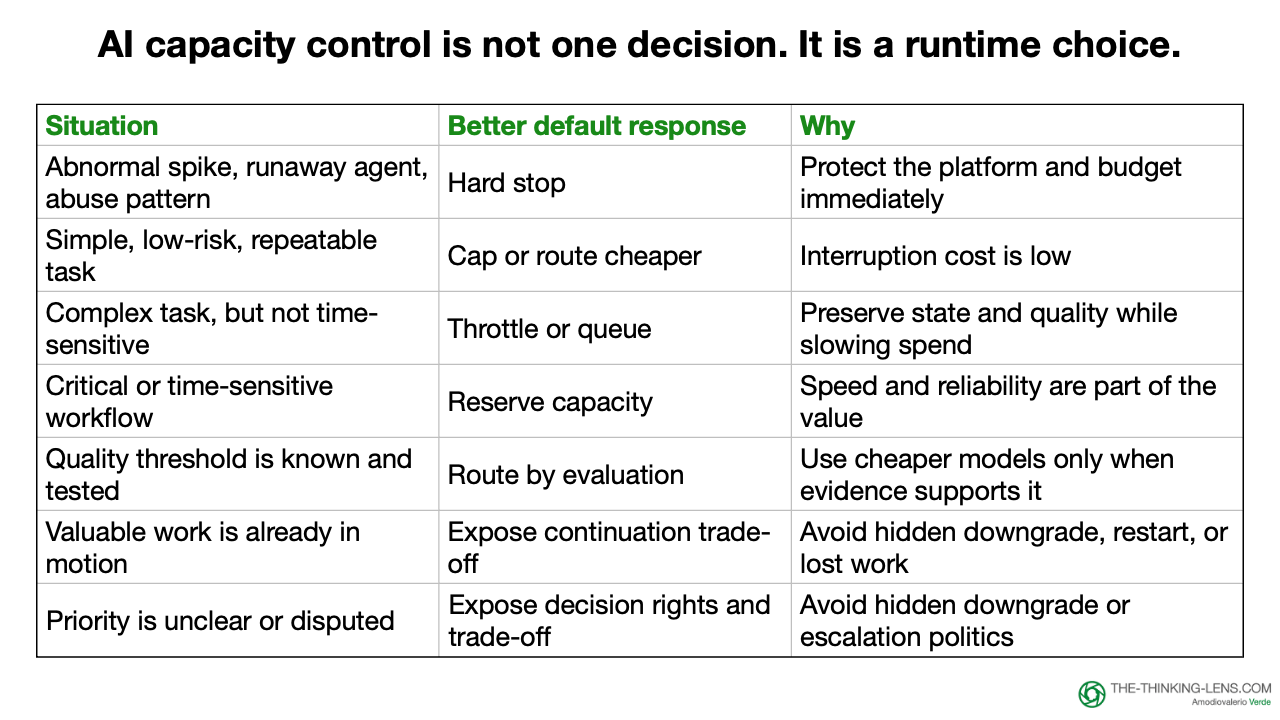
Hard caps stop abnormal consumption. Routing matches model capability to task complexity. Reserved capacity protects critical workflows. Task, team, or workflow budgets create accountability.
Continuity throttling preserves legitimate work when capacity is constrained.
Task-based budgets complement continuity throttling well: a team-level budget sets the envelope; a throughput policy governs how consumption within that envelope is distributed over time.
High-value, approved workflows should not default to stopping simply because aggregate consumption is elevated, as long as they remain within the agreed budget, risk, and priority envelope.
They should be interrupted only when there is a genuine anomaly, abuse pattern, misconfiguration, or system-protection event.
In constrained but normal conditions, for legitimate work that is resumable and not time-critical, the better trade-off is often to slow execution rather than stop it.
Users should not have to guess whether quality changed underneath them.
The mature control model combines these responses instead of treating one of them as the universal answer.
The hard cap feels like control.
Exhaustion-triggered routing feels like continuity.
Throttling makes a different trade-off: speed instead of quality, access, or transparency.
Enterprise AI cost control needs emergency controls for abnormal demand and continuity controls for legitimate work.
The mistake is using the emergency brake as the operating model.
PAQs – Potentially Asked Questions
Doesn't throttling just delay cost rather than reduce it?
Partly, and the answer depends on where the throttle engages.
If throttling activates only at the full limit, it does not reduce total consumption. Every request that was going to run still runs, just more slowly. The cost is the same; only the timing changes.
The mechanism is different when the throttle engages before the ceiling (at 90% of capacity, for example). At that point, the user receives a visible signal that throughput has been reduced while capacity still remains.
Some users may deprioritize their next request. Some lower-value demand may never materialize.
In those cases, total consumption can come down, not just the timing of it.
The threshold is the design decision.
Set it at the limit and you change the experience without changing the bill. Set it below the limit and you give the user or workflow policy a chance to make a trade-off before capacity is exhausted.
When is a hard cap still the right answer?
Hard caps are good emergency brakes: useful for runaway agents, configuration mistakes, and unplanned consumption spikes.
They are also right for low-stakes, self-contained use cases where interruption cost is low (experimental tools, sandboxes, short discrete tasks).
The case for throttling grows as AI becomes embedded in longer workflows, where context accumulates and interruption cost compounds.
Stopping a task mid-execution is not a neutral pause; it carries a real productivity cost that does not show up in the IT budget.
What does good throttling look like in practice?
Good throttling has three visible properties.
It communicates clearly: the user knows throughput has been reduced, understands approximately how completion time is affected, and can decide whether to continue or deprioritize.
It differentiates by workflow priority rather than by user tier: time-critical work runs at full rate, while background and asynchronous work runs at a reduced rate.
And it makes burn rate more predictable: the organization can manage near-term consumption by controlling AI-capacity throughput, rather than discovering the problem only when users hit hard caps.
The worst outcome is a throttling system that slows work down without explaining why.
A user who receives no communication about throttling may not wait two hours for a compliance analysis to complete; they may cancel the request, paste the data into an unmanaged consumer AI tool, and get their answer immediately.
That solves their problem and breaks governance entirely.
Transparency is not a UX nicety here; it is the mechanism that keeps throttling from driving work into shadow IT.
Is this about AI pricing models?
Only indirectly.
Commercial pricing models and internal runtime controls solve different problems.
Pricing defines the commercial envelope: what a company buys, how usage is measured, and how spend is governed over time.
Runtime controls define what happens inside the enterprise workflow when approved work approaches a limit or capacity becomes constrained.
A company may buy AI through seats, credits, tokens, requests, consumption units, or bundled packages.
The operating-model question remains the same: when legitimate work is already in motion, should the system stop it, downgrade it, queue it, slow it, or preserve it?
That is the control-layer question. It matters regardless of how the commercial model is packaged.
Who decides whether work is legitimate or high-value?
This is the right question, because without a clear answer, throttling becomes priority theater: every team claims urgency, every workflow is mission-critical, and capacity goes to the noisiest stakeholder rather than the highest-value work.
The governance answer requires separating three roles that are often collapsed into one: who owns the intent, who owns the risk, and who owns the budget.
Intent means what business problem this work solves. Risk means what happens if quality or continuity degrades. Budget means whose envelope the consumption runs against.
But continuity throttling does not require perfect governance before it can be useful.
It can start with coarse classes: protected work, normal work, background work, experimental work, and emergency-stop conditions.
That is less precise than a mature workflow catalog, but better than treating every user request the same until a cap is reached.
The goal is to make priority explicit before pressure turns into escalation.
As governance matures, those coarse classes can become more specific: by workflow, team, risk class, budget owner, or task type.
References
Reuters. "Cheaper AI is better: Soaring bills are reshaping how businesses choose models." June 29, 2026. https://www.reuters.com/business/retail-consumer/cheaper-ai-is-better-soaring-bills-are-reshaping-how-businesses-choose-models-2026-06-29/
Gartner. "Gartner Predicts AI Coding Costs Will Surpass Average Developer's Salary by 2028 as Token Consumption Surges." June 24, 2026. https://www.gartner.com/en/newsroom/press-releases/2026-06-24-gartner-predicts-ai-coding-costs-will-surpass-average-developer-salary-by-2028-as-token-consumption-surges
Bai, L. et al. "How Do AI Agents Spend Your Money? Analyzing and Predicting Token Consumption in Agentic Coding Tasks." arXiv preprint, 2026. https://arxiv.org/abs/2604.22750
KPMG International. "Global AI Pulse Q2 2026: From deployment to value realization." June 2026. https://assets.kpmg.com/content/dam/kpmgsites/xx/pdf/2026/06/global-ai-pulse-q2.pdf
McKinsey & Company. "Building the foundations for agentic AI at scale." April 2, 2026. https://www.mckinsey.com/capabilities/mckinsey-technology/our-insights/building-the-foundations-for-agentic-ai-at-scale
Microsoft. "2026 Work Trend Index Annual Report: Agents, human agency, and the opportunity for every organization." May 5, 2026. https://www.microsoft.com/en-us/worklab/work-trend-index/agents-human-agency-and-the-opportunity-for-every-organization
Anthropic. "Anthropic Economic Index report: Cadences." June 26, 2026. https://www.anthropic.com/research/economic-index-june-2026-report