
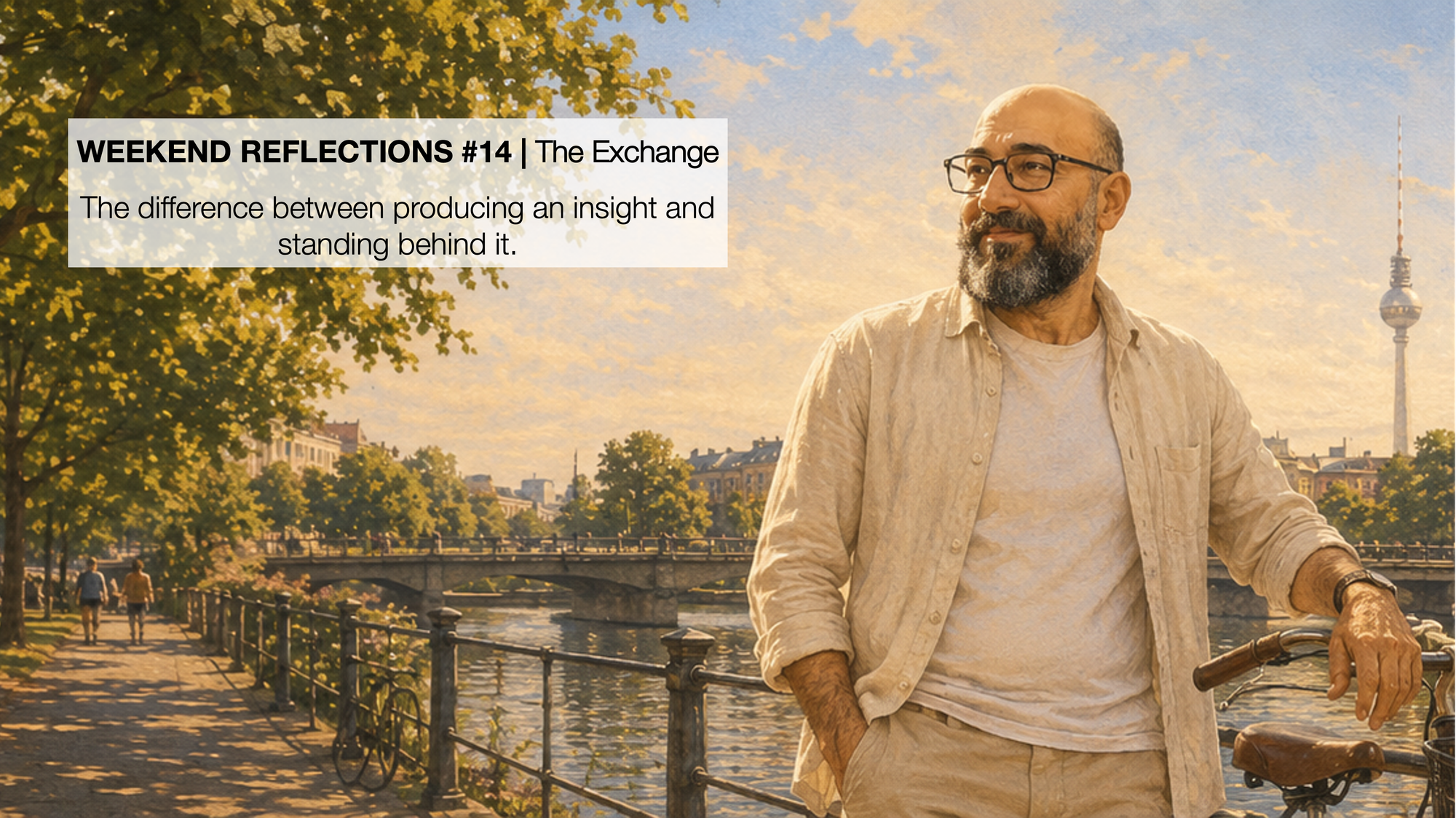
Weekend Reflections #14 | The Exchange
Someone read two pieces I had written months apart and named the connection I had never made explicit. That exchange stayed with me. The writing was the occasion. The question it surfaced was something else entirely: what it means to stand behind a contribution.

[Views are my own]
Emily Hartstone who works on runtime authority in AI systems, had already reached a closely related conclusion through her own work. After reading two pieces I had written months apart, she mapped her own framework onto both and made explicit the relationship between them.
One describes a failure mode: when the pace of production outruns the pace of verification, the human who remains present stops being meaningfully present. The other describes the design response: scale the required human presence to the reversibility of the action. The less reversible the action, the more human presence you require.
The second piece sets the standard. The first explains why compliance with that standard collapses under load. Throughput turns meaningful human presence into a rubber stamp before anyone lifts a pen.
Then she added something else. She had arrived at the same place herself, but from a different direction. Not through product design and autonomy frameworks, but through her own professional domain.
“We got to the same floor through different doors.”
I sat with that for a while.
People sometimes ask why I spend so much time writing. Two hours, sometimes more, for something someone reads in five minutes.
Part of it is that slow writing produces structure. Fast thinking produces impressions. The page forces the thought into a shape where its weaknesses become visible. The clarity is a consequence of the slowness.
But there is something else underneath it, and the exchange brought it into focus.
I write because I need to put structure around what is in my head. Whether a reader can follow is the test of whether that structure worked, not the reason I built it.
But readers do something writing alone cannot do. They reflect the argument back from the outside. Sometimes I discover that I was not clear enough. That I left an assumption implicit when I should have surfaced it. That what looked like a complete argument contained a gap I had stopped seeing because I already knew what was supposed to be underneath it.
That is what happened in this exchange. Her Runtime Authority Control (RAC) framework gave operational force to the relationship between my two pieces: runtime enforcement is what keeps an autonomy model honest when throughput begins to overwhelm human verification.
AI systems can already generate comments. They can synthesize, add angles, and make connections across sources. What happened in that thread, reading across two pieces and naming the structure underneath them, is something a capable agent could approximate. The form would be recognizable.
But I keep returning to one thing.
She brought a professional frame shaped by her own work and experience. By placing her synthesis next to mine, she was saying: we named the same thing.
She attached her professional judgment to the synthesis. Had it been weak, the weakness would not have floated free of its author. It would have reflected on the judgment and professional frame she brought to the discussion. She had something at stake.
Current agents have no demonstrated equivalent of that first-person stake. Their outputs can create consequences, and the people deploying them may be accountable for those consequences. But there is no professional identity, relationship, or body of work that the agent has demonstrated it regards and risks as its own.
The output can look identical. The relationship to the output is entirely different.
Whether agents eventually become indistinguishable from humans in these exchanges may be the less important question. The deeper one is whether an agent can ever have something of its own at risk. Whether being wrong can cost it something it values, rather than merely trigger a consequence designed by someone else.
Until agents can bear that kind of stake, they may reproduce the form of contribution. They cannot stand behind it in the same way.
AI-assisted synthesis can be valuable in its own right. The distinction here concerns the value of a contribution and what it means for someone to stand behind it.
That distinction sits apart from questions of enterprise accountability, including audit trails, escalation rules and human-in-the-loop design. Those require concrete product, design, engineering and governance solutions, regardless of where this argument lands.
The exchange had weight because we were both answerable for the models we put forward. Two people arriving from different directions and finding that their models shared the same floor.
Engaging is not the same as standing behind a contribution. To stand behind it is to risk something that is yours: your judgment, your reputation, your name.