
The Invisible Skeleton: Why Governance Is the Price of Freedom

[Views are my own]
I have a confession to make. I write a lot about Governance, Systems, and Process. And almost every time I do, the reaction is the same: people assume I am the enemy of fun.
At every time someone suggests introducing a "process" or following a "framework," the immediate reaction is usually resistance. There is a pervasive belief in our industry that structure is the enemy of speed, that every new rule is a tax on creativity and a bottleneck for innovation.
This knee-jerk reaction helps explain why we have such a massive branding problem with the word Governance.
In the modern enterprise, governance is often viewed as a Cage – a set of restrictive rules designed to slow us down, kill creativity, and force compliance. It is the "Department of No."
On the other side, Startups and Scaleups view it as an Anchor. To them, governance is a bureaucratic luxury they cannot afford yet. They believe that speed requires a lack of structure.
Both views are wrong.
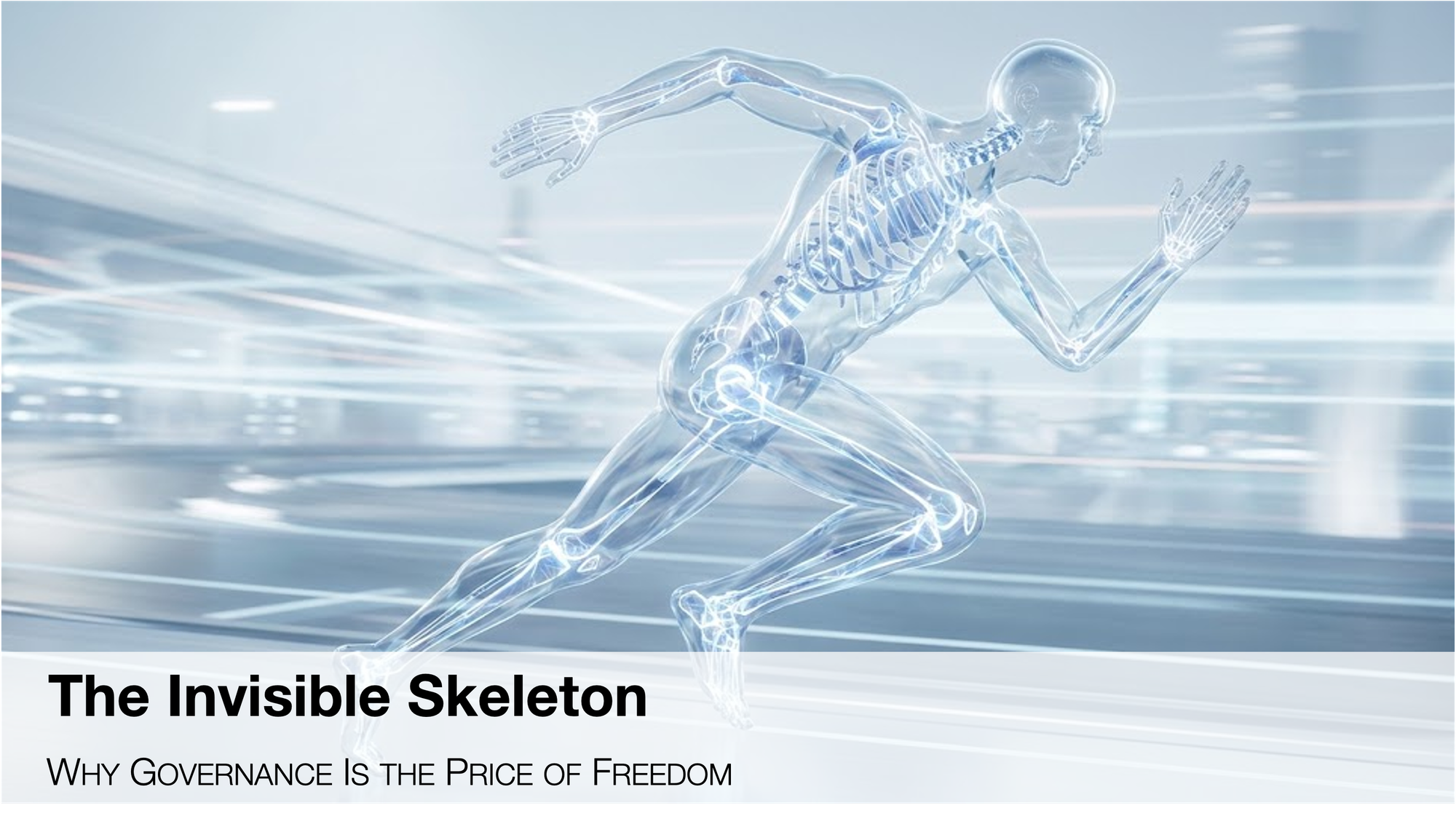
True governance isn't a cage, and it isn't an anchor. It is a Skeleton.
We need to stop debating "Process vs. Freedom" and start distinguishing between the Cage and the Skeleton.
One traps you. The other allows you to stand.
We often conflate the two, fearing that any structure is just 'Command and Control' in disguise. But there is a massive difference between scaffolding (which helps you build) and red tape (which ties your hands). Good governance is invisible until it saves you; bad governance is visible every step of the way.
Here is why the invisible structures of our lives, and our businesses, are the only reason we can move at all.
The "Invisible" Governance of Daily Life
We submit to strict, non-negotiable governance every hour of the day. If we didn't, society would dissolve into a Mad Max reenactment before lunch.
Consider Traffic Laws.
When you drive to work, you stay in your lane. You stop at red lights. This is a rigid, bureaucratic process. It restricts your freedom to drive on the sidewalk. But you follow it because the alternative isn't freedom; it's a head-on collision. The governance of movement is the only reason traffic moves at all.
Consider Recipes.
Baking is chemistry, not jazz. And even Jazz – the ultimate metaphor for freedom – requires a mastery of scales and time signatures before you can improvise. Without that underlying structure, it isn't jazz; it's just noise. Similarly, you cannot 'disrupt' a soufflé by refusing to turn on the oven because you want to be agile.
Consider The Morning Routine.
Wake up --> Coffee --> Brush Teeth --> Shower.
This is a script. You don't wake up and hold a strategic summit about the pros and cons of dental hygiene. The decision is already made. This "Governance of Self" frees your mind to think about the day ahead, rather than the mechanics of staying alive.
The "Hidden" Safety Nets at Work
In the enterprise, we complain about red tape. But if these processes disappeared tomorrow, the "innovators" would be the first to panic.
- Payroll (The Governance of Value): There is a strict, boring deadline for submitting hours. But it ensures you get paid the correct amount, on time, every month. No one wants "Agile Payroll" where the amount you get paid is an MVP subject to iteration.
- Aviation Pre-flight Checks (The Governance of Safety): Pilots read a checklist before takeoff. Every time. Even if they have flown 5,000 times. Even if they are late. This isn't a lack of trust in their skill; it is a systemic defense against human error. The strict governance of the checklist is the price we pay to land safely.
- Software Version Control (The Governance of Quality): Developers cannot just push code to a live global instance without review. This friction is intentional. It ensures the banking app doesn’t crash when you try to transfer money.
The Skeleton vs. The Cage
The debate in our companies shouldn't be "Process vs. Freedom." It should be Good Governance vs. Bad Governance.
Bad governance is a Cage. It restricts movement for no reason. It is bureaucracy for the sake of bureaucracy.
Good governance is a Skeleton.
Without a skeleton, a body is just a pile of jelly on the floor. You cannot run, you cannot lift, and you certainly cannot be "agile".
Yes, a skeleton restricts movement – you cannot bend your arm backward at the elbow (unless something has gone terribly wrong). But that restriction is precisely what allows you to run, stand, lift, and move forward. The structure provides the leverage required for motion.
When we know the rules – when the skeleton is strong – we can stop worrying about the structural integrity of the business and focus on the art of building.
The Biology of Growth: From Cartilage to Bone
This connects directly to a concept I discussed in The Foresight Gap: the dangers of debt at different stages of growth. As I wrote previously, success creates hidden fragility, and nowhere is this more obvious than when a company tries to grow its skeleton.
Nature knows that governance must evolve.
- A Startup needs the cartilage of a young organism – flexible, fast-growing, but structured enough to not collapse. It needs "Minimum Viable Governance". You need just enough structure to ensure you aren't reinventing the wheel every Monday morning. If you have zero process, you aren't a startup; you're just a project.
- An Enterprise needs bone. As you scale, you must calcify that cartilage into solid bone to support the massive weight of the organization.
If a global enterprise tries to run on the cartilage of a startup, it will snap its legs the moment it tries to sprint.
If a startup tries to install the heavy skeletal structure of a global bank, it will be crushed by its own weight.
We often worry about chaos, but premature calcification is just as fatal. If you harden your cartilage into bone before you’ve actually found your shape (Product-Market Fit), you don't build a business; you build a fossil.
The Exception: The Medical Cage (Governance as a Cast)
There is one exception to the "Cage vs. Skeleton" rule.
When a bone is broken, you cannot just ask it to support weight. You need to put it in a cast (a temporary cage).
In business, this looks like Crisis Governance. When a project is failing, trust is broken, or a system is critical, we often need to impose strict, heavy constraints. We introduce daily standups, intense reporting, and triple-checks.
This restriction is necessary to align the fracture. But here is where we fail: We forget to take the cast off.
A cast worn for six weeks heals the bone. A cast worn for six years causes the muscles to wither and die.
If you are applying strict governance to fix a problem, you must define the removal date. If you leave a crisis process running during peace time, you aren't protecting the organization; you are inducing atrophy.
Final Thought
We need to stop blaming the concept of governance for the failures of bad implementation.
You cannot improvise a jazz solo if you don't know how to play your instrument.
You cannot disrupt a market if you can't ship a reliable product.
Governance isn't there to stop you from working. It's there to stop you from collapsing.
But remember: unlike biology, business skeletons do not grow by accident. If you leave it to nature, you usually end up with a Cage built of accumulated bad habits.
Building a skeleton is infinitely harder than building a cage. A cage is the default state of bureaucracy – if you stop paying attention, rules accumulate like sediment until movement stops. A skeleton requires precise engineering; it must be rigid enough to bear weight but jointed enough to sprint. If you aren't intentional, gravity will pull you toward the cage every time.
We must stop trying to kill process and start intentionally designing it. We need architects for our systems just as much as we need architects for our code. In the modern product organization, this is the true mandate of Product Ops/Excellence. They are not there to police the team; they are there to engineer the scaffolding so the team can climb.
Innovation doesn't happen in chaos; it happens on the edge of order.
Don't tear down the scaffolding. Climb it.