
When Your Network Has the Wrong Shape
Why institutional capital is real, valuable, and local.

[Views are my own]
Networks have shapes.
Not sizes. Shapes.
The distinction matters because you can spend twenty years building a strong network and still find yourself, at a critical moment, holding the wrong one.
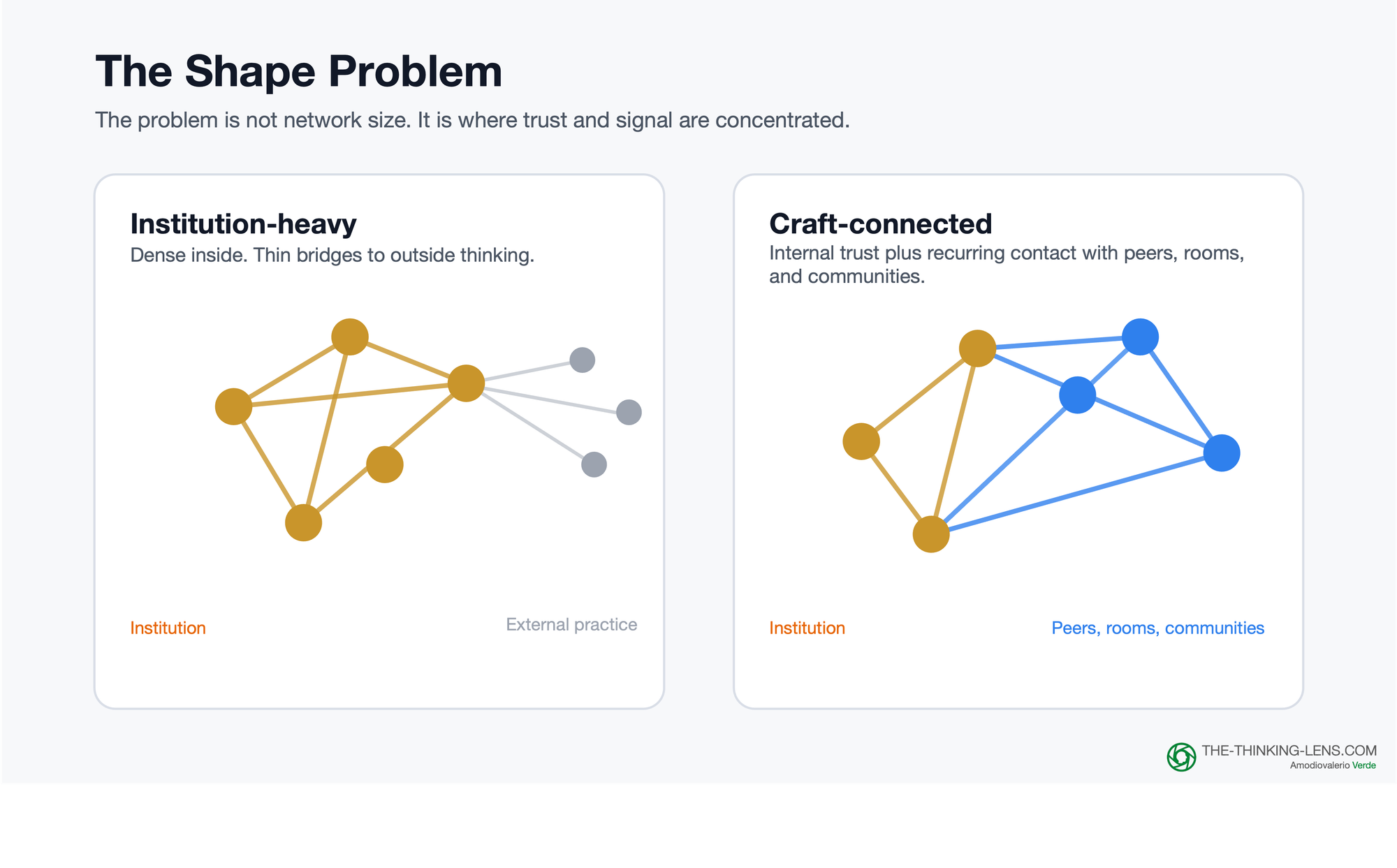
A network built for institutional influence looks like deep internal trust: colleagues across functions, stakeholders who move when you move, organizational capital accumulated over years. It is real, it is valuable, and it compounds reliably inside the institution that generated it.
In practice, it looks like knowing exactly who in Finance can unblock a budget question, which Legal partner will give you a pragmatic read, or which senior sponsor will defend your work in a room you are not in. That kind of capital is powerful. But it travels less than we like to believe.
It does not transfer automatically to external visibility, cross-company conversations, conferences, communities, and the informal spaces where market narratives start forming.
This is what I call network debt: the gap between the network you have and the network your next questions require. The problem is shape, not size: a network that over-represents the institution you already understand and under-represents the evolution of the craft your role requires you to lead.
The debt does not announce itself. It surfaces when the work needs to travel, and you discover that the trust you built does not travel with it, that the capital which opened every door inside the institution opens very few outside it.
This is not the same problem as an echo chamber. An echo chamber narrows the information that reaches you. Network debt is different: it is about where your trust, credibility, and presence live. You can read widely, follow diverse voices, and still discover that your presence is missing from the rooms where the field is moving. You can be intellectually open and still hold the wrong network shape.
The wrong shape accumulates by default, not by negligence. Inside a large institution, access is frictionless: colleagues, shared context, daily contact. External presence requires deliberate effort against a steeper gradient. The imbalance is structural. The debt builds quietly because the default is always weighted toward the institution already in the room.
This is not, then, an argument against institutional trust. Internal capital matters. The point is that it is local capital, and local capital should not be mistaken for field presence. The goal is not to replace institutional trust with external visibility. Senior leaders need both. The risk is letting one compound while the other quietly atrophies.
How I walked into it
I walked into it slowly.
In my mid-30s, in Italy, I was part of several communities. I held talks. I lectured. I was in the rooms, digital and physical. I knew the protocols and I enjoyed them.
Then came a sequence: a move to Berlin, a new role, a local language I still barely speak, a pandemic, a small daughter. The Italian community I left was smaller and more bounded. The communities I discovered from Berlin were bigger, more international, and completely unfamiliar with who I was.
The feeling was strange. I knew how to participate, but I no longer felt like an insider. I felt like a guest in rooms that had already found their rhythm, in a city where I had not yet earned a place.
The language was not the real barrier. Time was. And the quiet assumption that if I focused hard enough on the work, the rest would follow.
In other words, I fell into the trap I am describing. I concentrated on the internal demands of a new role and the practical demands of a new city, and assumed the credibility I had built elsewhere would keep travelling on its own. It did not.
What I had forgotten (slowly, without noticing) is that work does not happen only inside the building.
I had three gaps at once. I was present in the wrong digital channels (active, but in the wrong places for the conversations that were forming). I was absent from the physical rooms where ideas get stress-tested before they go public. And I was geographically disconnected from the community where my credibility had compounded.
Not no network, but the wrong shape of network for what comes next.
The geography was specific to me. The mechanism is not.
Two compounding curves
There are two compounding curves here, and they behave differently.
The first is depth: the quality of the work itself. The second is presence: whether the relevant community knows how you think, where to find you, and why your perspective matters.
A body of work compounds quietly. It rewards depth and patience.
You can have decades of published thinking and still walk into a room as a stranger.
Depth does not generate belonging. It may earn respect, occasionally recognition; but belonging requires showing up before you have something to say. Being in the corridor before you are on the panel.
Community presence accumulates across channels and rooms, and it does not pause while you are building the work.
For senior leaders and executives who want their thinking to travel further than their org chart, this asymmetry is rarely named. The assumption is that seniority generates visibility. It does, inside.
Outside, you are starting from the network shape you actually built, not the one your title implies.
The cost of distance from the craft
That compounding gap, the depth accumulating while presence erodes, reaches further than career visibility. It is a craft proximity problem.
To be clear, this is not about being near customers. That is a given. Any serious product organization needs customer proximity, field input, partner conversations, analyst perspectives, and research.
The gap I am pointing to is different.
It is proximity to the informal rooms where the craft itself is being redefined: peer communities, practitioner debates, small forums, independent thinkers, conference corridors, domain-specific circles, and the recurring conversations where new language forms before it becomes a framework, a keynote, or an analyst category.
Large institutions are usually good at formal sensing: customer councils, partner networks, analyst relations, advisory boards. Those channels are necessary. They help read customer needs, competitive moves, and trends already visible enough to be named.
But they capture a different kind of signal. They are less effective at reading how the craft itself is changing before that change becomes formal.
That gap was always there. AI is making it harder to ignore. The speed at which operating models, tooling, and expectations are changing means this is no longer a slow drift. In many fields, the cycle is now measured in quarters, not years. The signal often appears first among practitioners: people doing similar work in different contexts, arriving at different conclusions before anyone has named the pattern.
The earliest version of those conversations rarely arrives through formal channels. It shows up as friction peers are naming before it has a word, patterns communities are rejecting before enterprises adopt them, and practices that feel marginal until they suddenly become obvious.
By the time the shift has become a framework, much of the shaping has already happened. The people who shaped the conversation were present when it was still a question, not an answer.
Any network shaped mostly around one institution can filter those signals before they reach you. You may be well-informed internally while growing progressively slower to read what is forming outside.
The cost of the wrong network shape is not lower visibility. It is slower sensing.
The hard part is noticing when the network that once served you no longer covers the work you are trying to do, and being willing to name the gap precisely enough to close it.
The shape problem is a different diagnosis than no network. It requires a different response. And it is far more common among experienced leaders than anyone admits.
The response is to rebuild deliberately, and that means accepting that relevance requires contact, not just output.
Presence compounds on its own clock. So does absence.
The conversations shaping your work are not waiting for you to catch up.
Naming the gap precisely does not close it. It makes closing it possible.
You do not need a formal framework to begin. Rebuilding does not require mindless networking activity. It starts with sitting with the uncomfortable questions: Where does my trust actually live? Where does my field now think? Which conversations am I only consuming but not joining? And which rooms have gone quiet because I stopped showing up?
Presence is not a reward for having the right thinking. For work shaped by a changing field, it is the condition for it.