
The Judgment Economy (Part 4/4): Connections vs. Collections

[Views are my own]
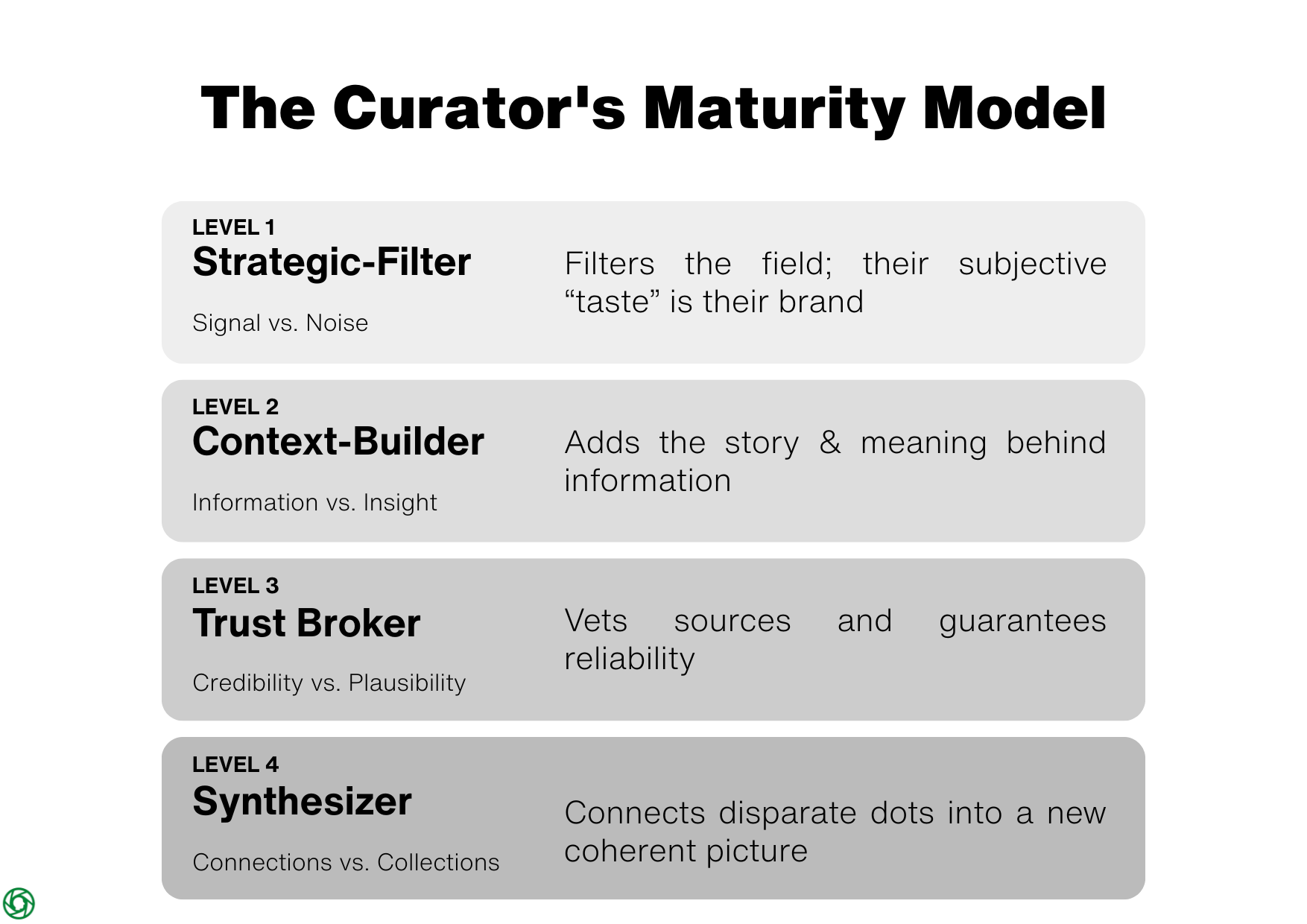
In the first three parts of this series, we built the case for a new strategic mandate. We moved from filtering Signal vs. Noise, to creating Information vs. Insight, to building an enterprise-grade framework for Credibility vs. Plausibility.
In this final part, we move to the apex of the model. We stop being just a filter or a broker of trust and become a creator of new, defensible value. We move from building Collections to building Connections.
Level 4 – The Synthesizer (Connections vs. Collections)
This is the apex of the curator's craft, where the transparent discipline of curation merges with the act of creation. The Synthesizer does not just 'collect dots' (a collection); they 'explicitly build with them' (a connection). They use their publicly vetted, curated materials from Levels 1-3 as the accountable building blocks for a new, coherent picture. Their starting point is the external, attributed world, and their output is a net-new intellectual asset that shows its work.
This act of transparent synthesis is the "creation twist". It moves beyond the "sage on the stage" to the "guide on the side", transforming curation from a service into the most defensible form of thought leadership: one built on a verifiable trust. At this apex, such curation can outperform pure creation on trust and decision impact precisely because the new asset shows its work.
The Synthesizer's Operating System
This level of strategic curation cannot function without a clear operating model. It requires a defined workflow for integrating AI and a clear place in the organization.
The Workflow: Human-in-the-loop, AI-underneath
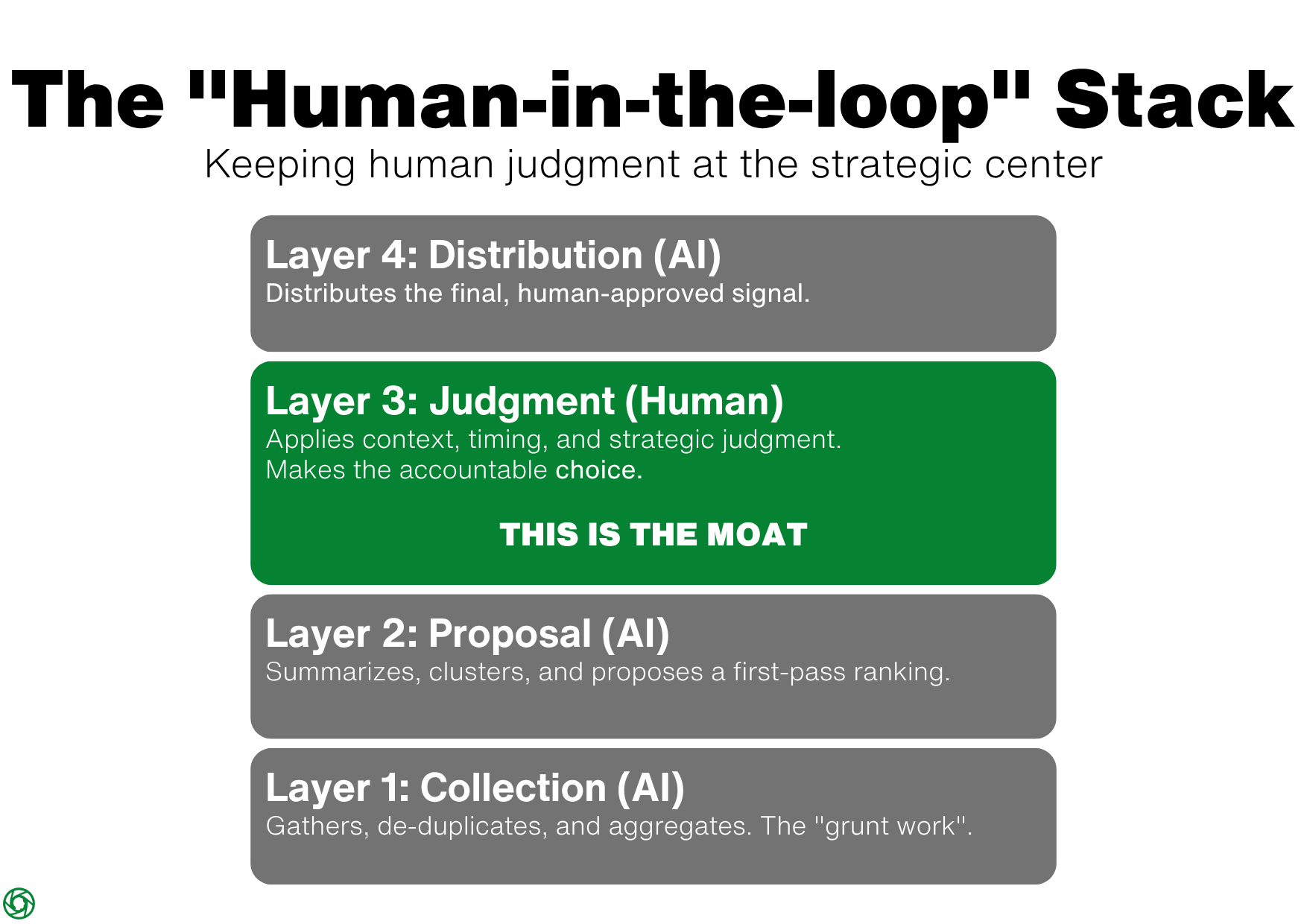
Let's be clear: AI should not replace curators. AI should be used by curators. Let AI do the first-pass work: gathering, summarizing, and even executing routine, codified tasks. Let the human do the strategic work: curating the goals, curating the business context, and making the final, accountable judgment on the exceptions.
This addresses the critical issue of scale. Many argue that AI is the only solution that can scale, and they are correct; manual curation alone cannot keep pace with the zettabyte-scale challenge. The 'Human-in-the-loop' model is the essential solution, as it uses AI for what it does best – industrial-scale processing – while reserving the human for what it does best: applying high-stakes, accountable judgment in the cases that matter.
So the stack looks like this:
- AI: Collects everything plausible.
- AI: Proposes a first-pass ranking.
- Human curator: Applies context, timing, and judgment.
- AI: Packages and distributes the final signal to the right people and channels. AI handles the channel, the human handles the politics of landing the message.
This keeps the work strategic, and it keeps the cost low. The accountability for the decision is 100% human, which means the accountability chain begins and ends with people.
Who owns the signal?
Whether inside a massive enterprise or as an individual expert, the curation function must sit close to the decisions it is meant to accelerate.
In a modern enterprise, 'The Curator' is not a new box on the org chart; it is a new competency for existing leadership.
- For the Head of Strategy: You are no longer just planning; you are the Chief Architect of the Narrative, responsible for connecting disparate internal signals into a coherent narrative.
- For the Product Lead: You are the curator of market reality, filtering customer noise into clear product requirements.
- For the Head of Sales: You are the curator of field intelligence.
The principle is simple: The 'seat' for curation belongs to whoever currently owns the cost of confusion.
For an individual thought leader or domain expert, the principle is identical. The curation function "sits" at the core of their personal brand. If an individual's goal is to influence industry strategy, their curation must serve that outcome; if their goal is to build a community of practice, it must serve the needs of that community. The curator – whether an individual, a distributed team, or a formal Center of Excellence – aligns their work with the highest point of leverage.
From "The Org Chart" to "The Competency Model"
You likely do not have the budget for a full-time "Chief Curator." That is fine. In a modern enterprise, curation is not a new department; it is a new competency for existing leadership.
Just as "digital literacy" moved from a specialized IT role to a general requirement for all employees, Strategic Curation is following the same path. The "Human-in-the-loop" stack must be distributed to the specific leaders who own the signal for their domain.
The question isn't "Who is the curator?" It is "What are you curating for the rest of us?"
- Product Managers are Curators of Market Reality. They stop being order-takers and become Synthesizers. Their job is to filter thousands of customer signals, feature requests, and sales objections into a coherent, defensible roadmap. They connect the dots between "what customers say" and "what the business needs."
- Design Leaders are Curators of Coherence. In a world generating infinite screens and content, Design must curate the journey. They protect the user from organizational complexity, synthesizing the output of ten different teams into a single, unified experience. They filter out the friction.
- Customer Success is the Curator of Retention. They are the frontline filter between "noise" (isolated complaints) and "signal" (systemic churn risks). A CS leader acts as the "Trust Broker", vetting which customer problems require immediate engineering escalation and which require better education.
- Strategy & Ops are the Curators of Focus. They own the "cost of confusion". Their role is to curate the metrics that matter, stopping the flood of dashboard noise and ensuring the executive team makes decisions based on insight, not just volume.
The New Mandate
The organization doesn't need a "Department of Curation." It needs a culture of curation, where the "Human-in-the-loop" is the standard operating model for every department head.
If you are a leader in Product, Design, or Success, you are no longer just responsible for doing the work. You are responsible for connecting it for everyone else.
As a leader, your role as "Chief Curator" is to protect your team from noise. You do this by curating three things:
- Curate Data: Stop forwarding every dashboard. You are the filter. You identify the 3-5 metrics that truly matter and shield your team from the rest.
- Curate Strategy: Stop adding "new priorities." You are the synthesizer. You connect every new request back to the core mission and have the judgment to say "no" to things that dilute focus.
- Curate Knowledge: Stop letting insights vanish after a project ends. You are the one who implements a system – like a 'reusable decision asset' library – to turn every decision and experiment into a "reusable decision asset" that makes the entire organization smarter.
Closing: The Future is Human-Refined
The rise of AI does not devalue human skill; it redefines it. As AI automates the mechanics of generation, it forces us to elevate our focus. We must move to the uniquely human tasks: judgment, synthesis, and trust-building.
We are at the beginning of a major reordering of professional value. The flood of AI-generated content will not subside; on the contrary, it will only grow. In this new reality, organizations and individuals who continue to compete on volume will lose. Those who compete on clarity, insight, and trust will win.
The future of work, of leadership, and of expertise belongs to the curator. It’s time to start building your library.
The fact that true curation is difficult and time-intensive is precisely what makes it a scarce and defensible professional skill. The market is flooded with low-friction, Al-generated 'Polished Emptiness' precisely because it is easy and fast. Competing on volume is a race to the bottom. Competing on judgment is a race to the top. The barrier to entry for creation is zero; the barrier to entry for trustworthy curation is exceptionally high.
That barrier is the moat. This scarcity of time and judgment is what creates the economic value for the few leaders, strategists, and creators willing to do the work.
The rise of AI does not devalue human skill; it redefines it. We are moving from an economy of Collections (who has the data?) to an economy of Connections (who can make sense of it?).
The future belongs to the Synthesizer. It’s time to start building your library.
PAQs (Probably Asked Questions)
Won't AI just get better at this? Can't a "Curation-GPT" be trained to be a 'Strategic-Filter' or 'Synthesizer'?
Yes, and it's a critical part of the solution. AI will and should get better at the mechanics of curation: aggregation, summarization, and first-pass synthesis. This is a feature, not a threat, as it automates the "grunt work" described in the "Human-in-the-loop" Stack. AI is the only way to handle the scale of information.
But this confuses the task of curation with the responsibility of it. The human curator's moat is not a temporary skill gap; it is permanent, structural accountability. This is especially true for generative systems. While codified, rules-based AI is highly accountable to the human-defined rules it was given, generative AI operates on plausibility. For these new systems, a human must be the final, answerable party.
When a decision based on curated information goes wrong, who is responsible? AI systems are being built with systemic accountability (like audit trails) to satisfy regulators, but these regulations simply formalize what we already know: a tool cannot be held responsible; only a person or organization can. Standards and regulation place liability on organizations and their human officers, not the model.
Your argument seems to favor a centralized, top-down approach. What about the 'wisdom of the crowd' and decentralized networks as a better form of curation?
This is an excellent point, and the two models are not mutually exclusive. They serve different purposes. Decentralized networks and the 'wisdom of the crowd' are incredibly powerful engines for discovery and for surfacing novel ideas. However, the platforms designed to harness this wisdom are often driven by monetization models that undermine true curation. Their algorithms are typically optimized for maximum engagement – clicks, likes, and shares – not necessarily for quality, nuance, or truth. This can lead to a dynamic where popular or provocative content is amplified over what is actually important or correct.
In a high-stakes business environment, or for a thought leader building a brand on trust, accountability is paramount. A crowd cannot be held accountable for a poor strategic decision based on flawed information. The formal 'curator' role is about creating an accountable source of truth – ensuring that the information used for strategy is not just popular, but vetted, contextualized, and reliable. It complements the discovery power of networks with the accountable judgment required for execution.
This sounds great, but my company doesn't have a budget for a dedicated 'Curator' role. How can we apply these principles without a formal headcount?
Frame curation as a capability or a discipline, not just a formal role. It is a set of responsibilities that can, and should, be distributed. The marketing lead can be the designated curator of competitive intelligence. The head of engineering can be the curator of emerging technology trends. The head of sales enablement can curate win/loss stories and best practices. The leader's job as "Chief Curator" is to orchestrate this network, ensuring each function is responsible for filtering the noise in its domain. The immediate goal is to build a culture of curation.
You warn against the 'curatorial echo chamber.' What are the concrete ways a curator can actively fight their own confirmation bias?
This is the single greatest risk of the role. The antidote to becoming a gatekeeper is accountability, which requires both transparency and a deliberate effort to seek dissent. First, as we covered, you must publish your sources and show the edges of your work, explicitly stating what your view doesn't cover. Beyond that, three concrete practices are essential:
- Mandate a "Red Team" source: Actively seek out and include the single best argument against the prevailing view in every curated summary.
- Curate for surprise: Dedicate a specific percentage of curated content (e.g., 10%) to ideas or data points that are unexpected or challenge core organizational assumptions.
- Rotate curators: For key strategic topics, periodically rotate the responsibility of curation between different qualified team members to introduce new perspectives and challenge established patterns.
This sounds great, but isn't this just a modern job description for a Product Manager?
That's an excellent observation, and it's partially correct. An empowered Product Manager is a curator. The argument is not that only PMs are curators. The argument is that the GenAI-driven information flood has made curation a new strategic imperative for every other function. While this discipline is inherent to a modern product team, functions like Sales, Marketing, or Strategy are now also drowning in noise without a formal framework to manage it.
This also applies directly to individuals. The 'Four Roles' maturity model is the ladder for an individual to build authority. They can start as a Strategic-Filter' (filtering) and grow into a 'Synthesizer' (creating new, trusted insights). It's the path from curating value to creating it. So, no, this is not just for product people. It’s a discipline for anyone – in any role or as an individual – who needs to build trust by bringing signal out of the noise.