
The Judgment Economy (Part 1/4): Signal vs. Noise
We are drowning in information. Generative AI accelerates this, creating a flood of "Polished Emptiness" – plausible-sounding content with no substance. As AI commoditizes generation, the last true scarcity is trust. Value is shifting from creation to curation and judgment.

“We are drowning in information, while starving for wisdom.”
– E.O. Wilson
That was in 1998. Almost 30 years later, the world is now producing well over a hundred zettabytes of data annually – the reason this era is also called The Zettabyte Era. This digital torrent, accelerated by the frictionless, zero-cost production of generative AI, is a profound economic and cognitive challenge.
This overload creates the conditions under which, despite massive investment, reports indicate that companies are struggling to scale AI value, with many pilots failing beyond individual productivity. Companies have invested in generation engines but have no curation and judgment framework to find the signal in the new noise.
This challenge extends beyond any single role. As professionals, we are all struggling to stay updated in a world flooded with 'Polished Emptiness' – content that offers no genuine ideas, thoughts, or critiques, only plausible-sounding text. AI can assist with data and feedback, but it does not, by default, manufacture a credible point of view without human direction. This makes our professional duty of finding sources we can actually trust, more difficult and time-consuming than ever.
Here is the paradox of our time:
As the volume of content rockets toward infinity, our ability to find meaning within it trends toward zero.
For decades, we prized the role of the creator. The concept of a 'Curation Economy' is not new; thinkers like Brian Solis and others have discussed it for over a decade. However, it remained a relatively niche concept, relevant mostly to media and information science, because the barrier to entry for creation was still high.
Public-available Generative AI is the catalyst that changes everything.
By commoditizing the act of undifferentiated generation and flooding the world with 'Polished Emptiness', AI has finally and urgently elevated curation from a 'nice-to-have' discipline to the central strategic mandate for every modern business.
In this new economy of noise, the last true scarcity is trust. And the curator is the new broker of that trust.
From Generation to Judgment: The Rise of the Curation Economy
To understand this shift, we must stop seeing "Creation" and "Curation" as two different jobs and instead see them as two essential disciplines on a Spectrum of Judgment:
• Generation (or Creation): This is the traditional discipline of broadcasting expertise. It's an act of internal synthesis where the creator's research, influences, and internal models are internally curated, but the process is often kept implicit. The resulting net-new asset is presented as a complete work, asking the audience to trust the creator as the "sage on the stage", a term coined by Alison King, with value placed almost entirely on the final output. To be clear: true, 'zero-to-one' novel creation – in science, engineering, or the arts – remains a pinnacle of human value. Our focus here is on the vast majority of professional work that exists between that novel act and easily commoditized output.
• Curation: This is the complementary discipline of building clarity. It is the act of external filtration and contextualization where, unlike generation, the curator's process and sources are kept explicit and transparent. It starts with the "external world of content" to build a vetted, clarified collection that functions as an accountable guide. The value is placed on the judgment used to create it, asking the audience to trust the curator as the "guide on the side”.
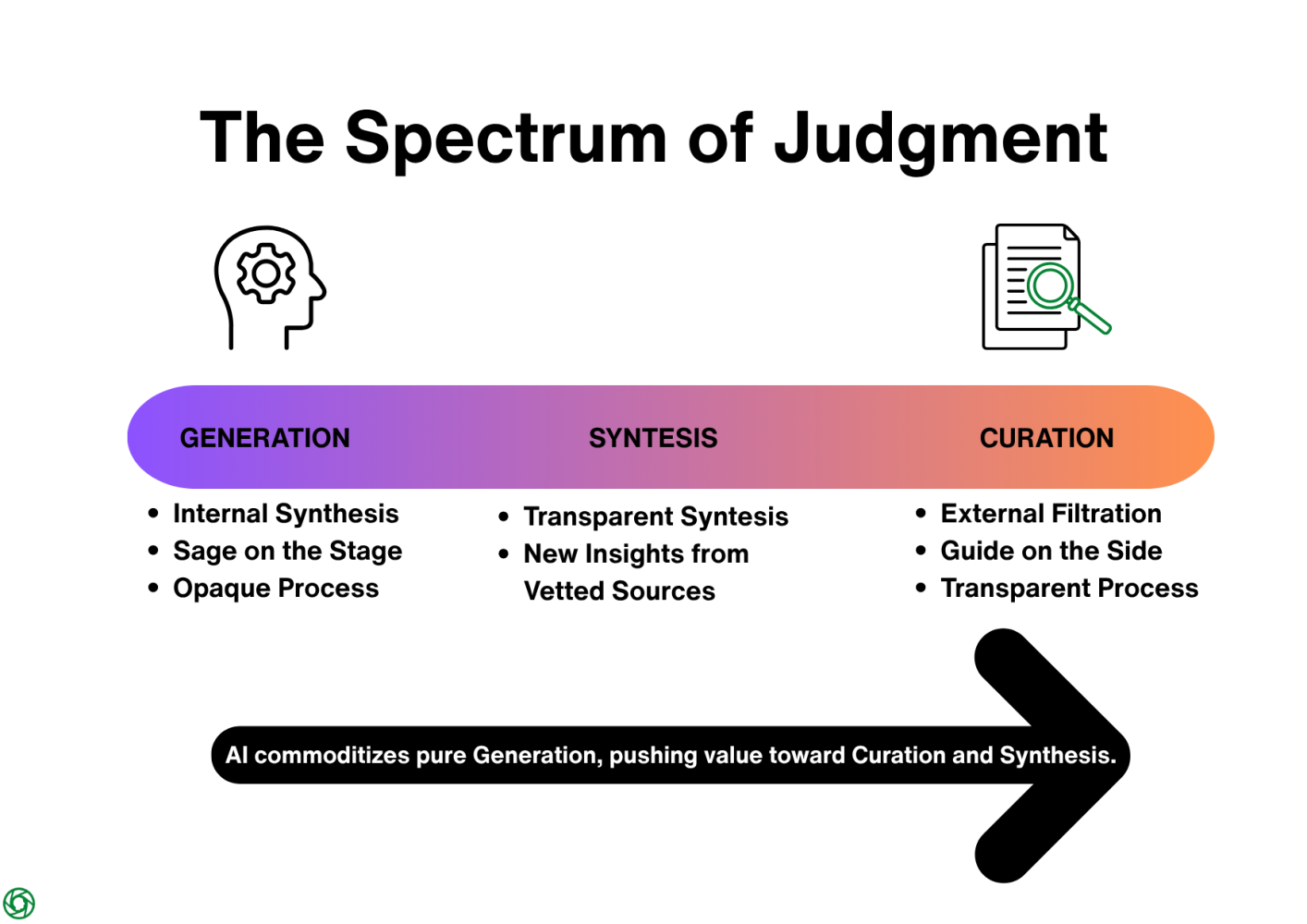
For decades, we have over-valued Generation and ignored Curation. The AI revolution is forcing a market correction. These two disciplines are not mutually exclusive; they are symbiotic. No great "Creator" starts from a true vacuum – they are constantly curating their own research and influences. Creation and curation are parallel tracks. Creators curate mostly internal research while Curators begin outside-in, then blend external and internal. At the highest level, the tracks converge: transparent synthesis produces net-new ideas that show their sources. Curation does not replace original research where novelty is the value, but it does beat undifferentiated creation when transparent synthesis improves trust, speed and decision quality.
The Foundational Skill: The Strategic Filter (Level 1)
This new mandate requires a new set of skills. I've broken them down into a 4-level maturity model, which we will explore throughout this series.
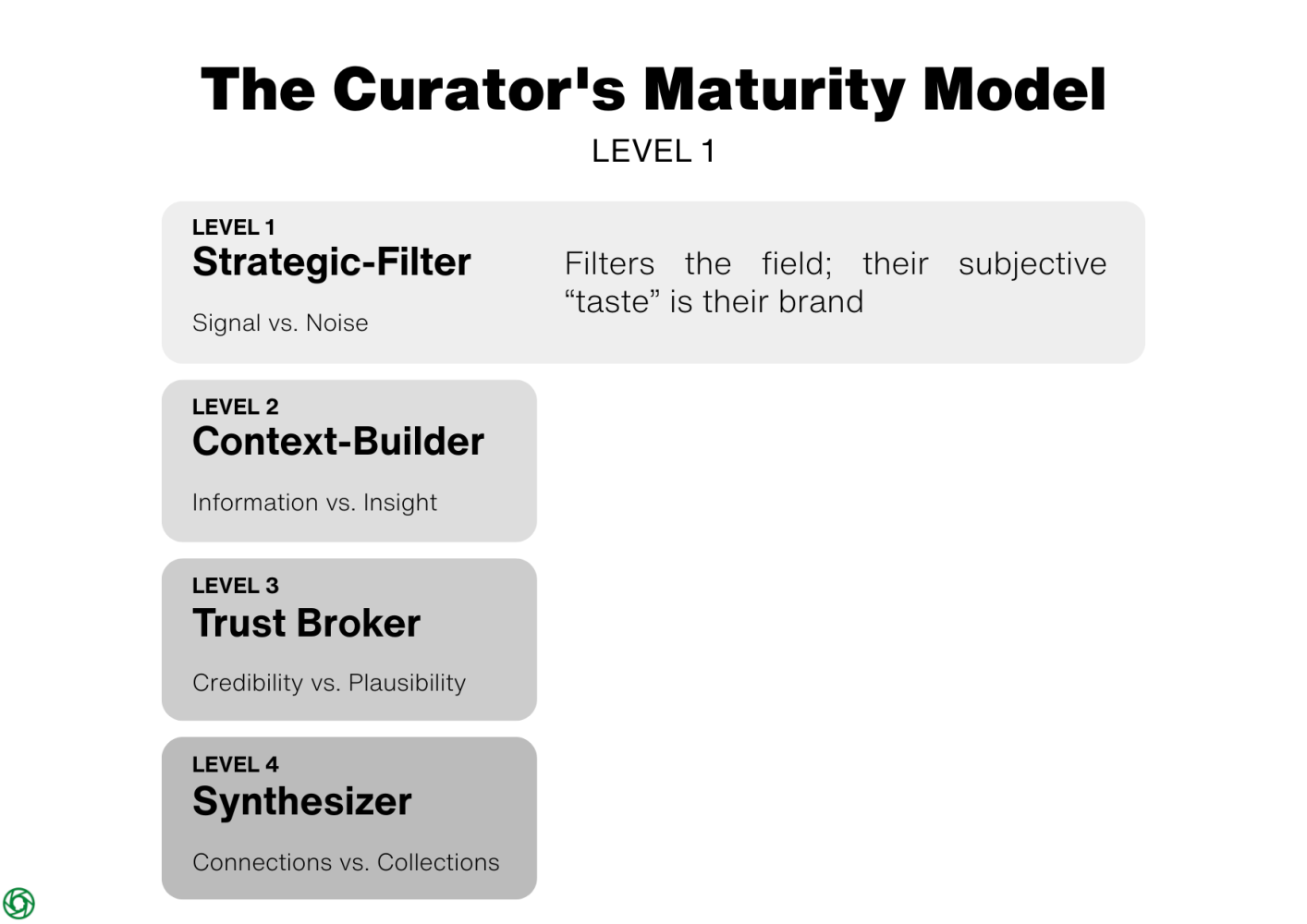
The first and most fundamental role is that of the Strategic-Filter, whose function is to solve the Signal vs. Noise problem by exercising disciplined judgment – a deep, earned understanding of quality and relevance within a specific domain.
This judgment manifests as a defined set of principles that operate in two distinct ways depending on the context:
• For an individual expert, this filter is defined by their unique, explicit point of view and domain expertise. It is their unique signature and principles that build their brand and attract an audience seeking that specific, trusted perspective.
• For a corporate curator, this filter is not personal. It is a set of explicit, shared principles defined by the organization. Their job is to be a custodian of the company’s strategic filter – its quality standards, strategic narrative, and ethical guidelines. Unlike an individual's filter, a corporate filter must be a governed and published set of principles that reflect the company's strategy and brand, not an individual's preference.
In both cases, the curator immerses themselves in a niche, consuming vast amounts of content so that others don't have to. This act of filtering is an enormous service. It saves cognitive bandwidth and directs attention to what truly matters.
It is tempting to assume that an 'AI Strategic Filter' will eventually automate this role. This confuses the task of curation (filtering) with the responsibility of it. We should expect and use AI to automate the 'grunt work' of first-pass filtering. But the human 'Strategic Filter' provides the one thing an algorithm cannot: permanent, structural accountability. When a strategic decision based on that curation fails, a tool cannot be held responsible; only a person or organization can.
The Diagnostic Tool: How to Spot the Signal
The Strategic Filter's first job is to diagnose content. Using the 'Matrix of Thinking and Writing', the Curator filters the "noise by identifying:
• The Muddled Mess (Low Thought, Low Polish): Easy to spot, easy to ignore.
• The Polished Emptiness (Low Thought, High Polish): This is the most dangerous form of noise, hard to spot. It looks credible but has no substance, and its proliferation has been massively accelerated by generic, undifferentiated generative AI. This is not a critique of thoughtful creators or content teams; it is a critique of undifferentiated output that looks right but says nothing.
• Diamonds in the Rough (High Thought, Low Polish): Valuable insights hidden in poor formatting or obscure sources.
• Crafted Mastery (High Thought, High Polish): The true signal.
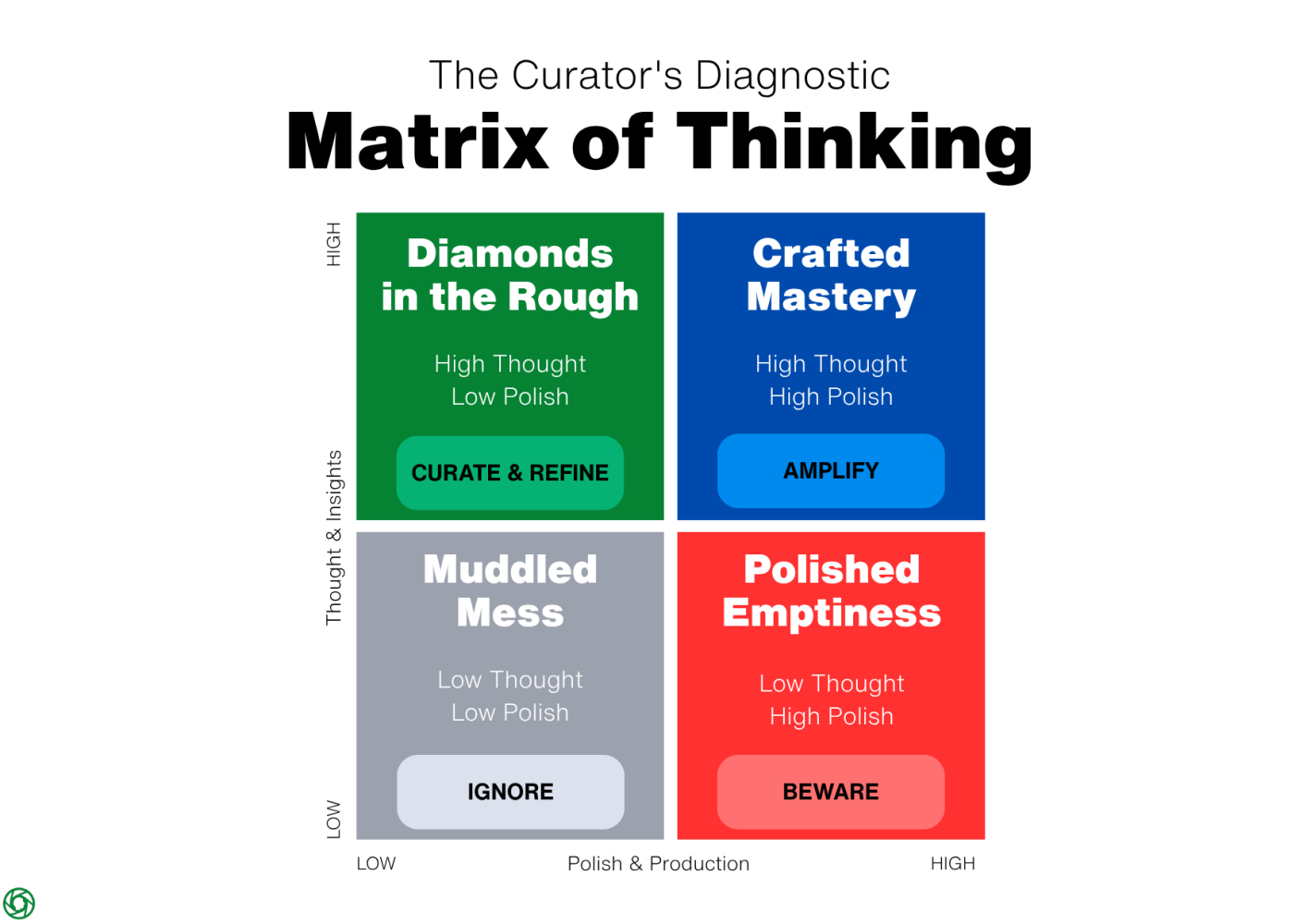
The Curator's work is to discard the 'Muddled Mess' and 'Polished Emptiness' while seeking out, amplifying, and contextualizing the 'Diamonds in the Rough' and 'Crafted Mastery'.
Coming in Part 2: Finding the signal is the crucial first step. But signal alone is just raw data. In Part 2, we'll explore the critical next step: how to turn that raw information into actionable insight.
Sources:
- Wilson, E.O. (1998). Consilience: The Unity of Knowledge.
- King, A. (1993). "From Sage on the Stage to Guide on the Side." College Teaching.
- Solis, B. (2011). "The Curation Economy and the Three 3 C’s of Information Commerce." (https://briansolis.com/2011/04/the-curation-economy-and-the-three-3c%E2%80%99s-of-information-commerce/)
- Spira, J. B., “Overload!: How Too Much Information Is Hazardous to Your Organization”
- Wikipedia, "Zettabyte Era" (https://en.wikipedia.org/wiki/Zettabyte_Era)
- BCG, “The Widening AI Value Gap” (https://www.bcg.com/publications/2025/are-you-generating-value-from-ai-the-widening-gap)
- McKinsey, “State of AI 2025” (https://www.mckinsey.com/capabilities/quantumblack/our-insights/the-state-of-ai)
- Verde, A. (2025), "We’ve Reached the Point Where Good Writing Looks Suspicious" (https://www.linkedin.com/pulse/weve-reached-point-where-good-writing-looks-suspicious-verde-cfhwe/)