
The Judgment Economy (Part 2/4): Information vs. Insight

[Views are my own]
In Part 1 of this series, we explored the foundational challenge of our time: separating Signal vs. Noise. We defined the problem of "Polished Emptiness" and introduced the Taste-Maker as the first level of curation – the disciplined judgment required to filter the field.
But finding the signal is not the end goal. It's the starting line.
Information without context is meaningless. A list of facts is not a strategy. A dashboard of numbers is not a decision. The next, critical step is to turn that raw information into actionable insight.
Level 2 - The Context-Builder (Information vs. Insight)
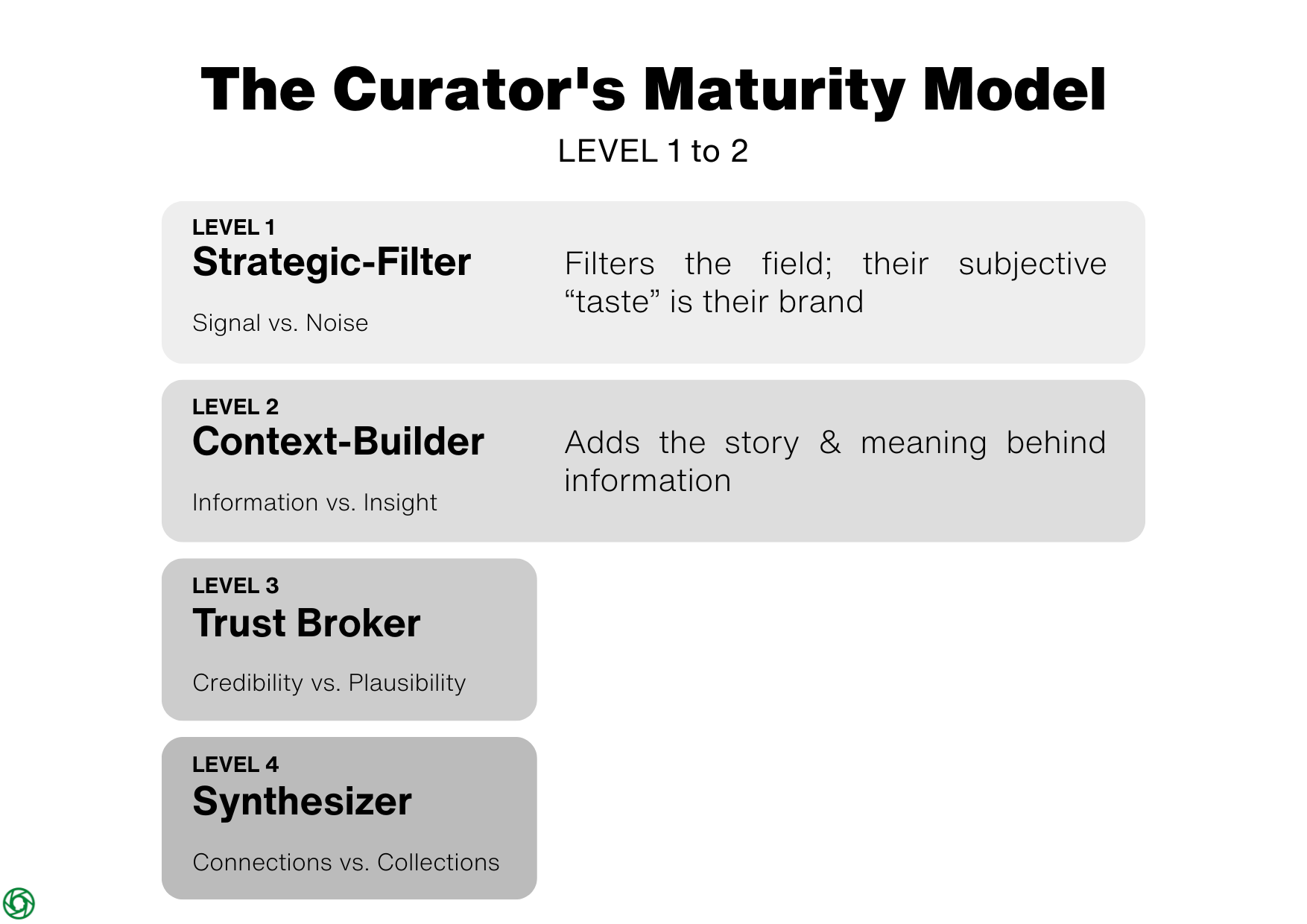
If the Taste-Maker's job is filtering, the Context-Builder's job is sense-making – adding the story and meaning behind the information.
Think of a museum. A random piece of art is just an artifact. But the museum curator is the Context-Builder. They don't just display the art; they write the plaque next to it. That plaque, that context, is what connects the piece to a movement, a historical event, or the artist's life, transforming a passive object into an active, meaningful insight.
Many assume this is the traditional work of an analyst, and they are correct. This highlights a key truth: a great analyst must first be a curator (a Taste-Maker) to find the gem before they can build context and explain why it's a gem (Level 2).
A curator’s role is to "humanize" data by adding layers of interpretation, analysis, and perspective. They can recognize cultural subtleties, connect a new trend to a historical pattern, and explain why a piece of information is significant for a particular audience. AI can be a powerful partner in this, summarizing patterns. But it cannot, by itself, understand the strategic context or empathetic nuance of why a piece of information matters to a specific customer. That remains an accountable, human judgment.
Curation as a Core Product Capability
This curation mandate is not just a theory; for a product team, it is a core discipline.
A product function is the organization's epicenter of noise, inundated by a flood of customer feedback, telemetry, market analysis, and internal stakeholder 'priorities.' Curation is the discipline of managing this chaos.
Crucially, this is not the job of a single "Chief Curator" but a distributed capability. In a modern product organization, every member of an empowered product team (EPT) or "product trio" is a curator for their specific domain.
The product leader's role shifts: they are not a gatekeeper to the signal, but the curator of strategic business context. Their job is to "shield" the team from strategic noise (conflicting corporate priorities, 'P0' demands, market changes ) so the team can immerse itself in the customer noise (feedback, telemetry) to find the true signal. This aligns with a culture of continuous discovery.
This team-based curation maps directly to the Scorecard:
- Time-to-signal becomes: How long does it take an empowered team to get from raw customer feedback to a validated, prioritized problem in the backlog?
- Version drift becomes: The competing and conflicting 'P0' demands from stakeholders that dilute the team's focus.
How to know it is working
Curation isn’t a “nice to have.” It shows up in the numbers. In a business context this means tracking a new Curation Scorecard:
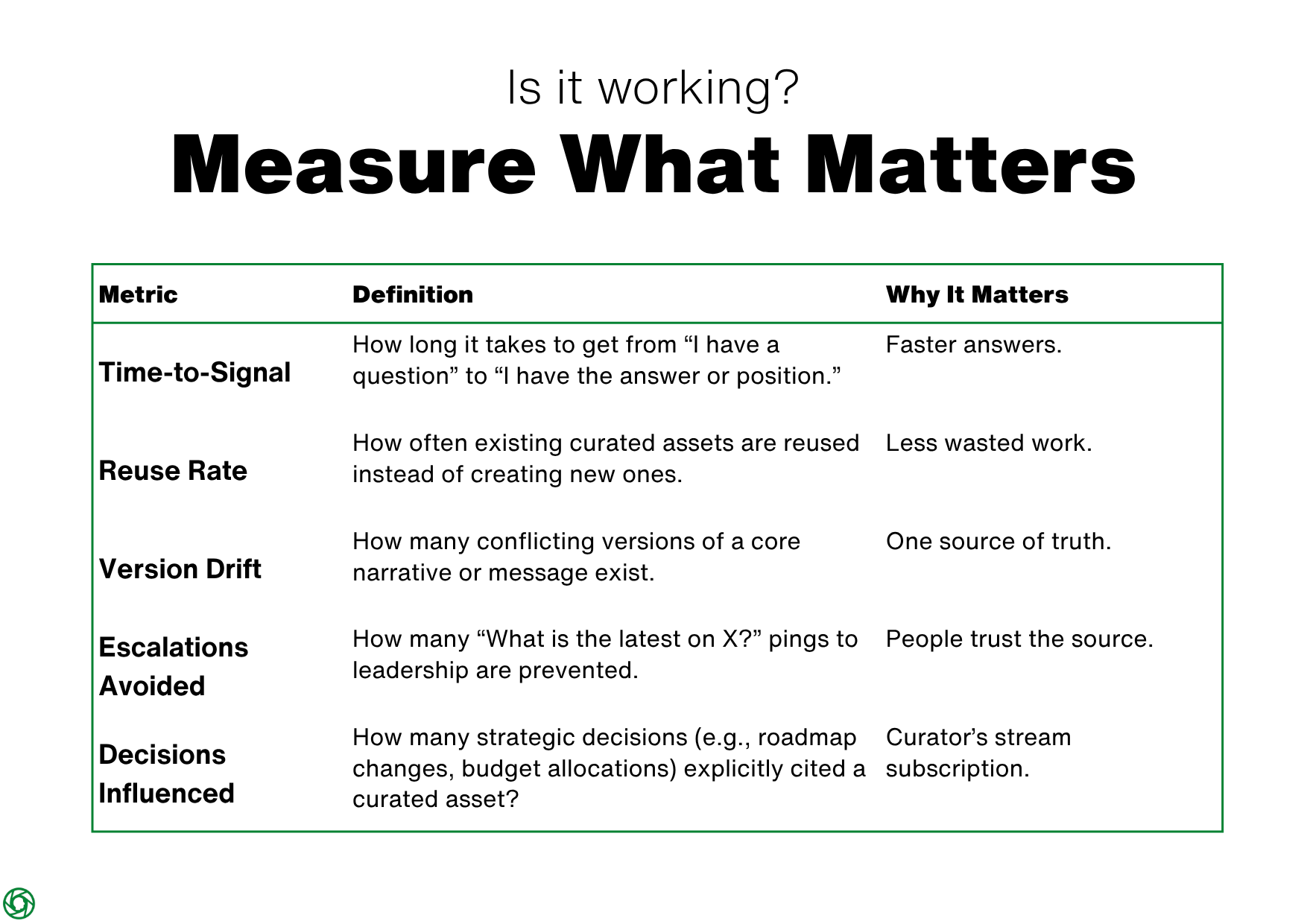
- Time-to-signal. How long does it take a leader or a team to get from “I have a question” to “I have the three best sources and the current position”? Lower is better.
- Reuse rate. How often are existing curated assets used again – in new decks, in enablement, in customer answers? Higher is better.
- Version drift. How many conflicting versions of a core narrative are floating around in circulation? Fewer is better.
- Escalations avoided. How many “what is the latest on X?” pings to leadership stop happening because people actually trust the curated source? More is better.
- Decision Influenced. How many strategic decisions (e.g., roadmap changes, budget allocations) explicitly cited a curated asset? More is better.
Ultimately, these internal efficiencies translate directly into customer value: faster, more relevant product updates and clearer, more consistent communication from a single source of truth.
Coming in Part 3: Turning information into measurable insight is how you build value. But in the age of AI, that insight is worthless if it can't be trusted. In Part 3, we'll tackle the central tension of the modern enterprise: Credibility vs. Plausibility.
Sources:
- Cagan, Marty. "Empowered Product Teams": https://www.svpg.com/empowered-product-teams/
- Torres, Teresa. "Product Trio": https://www.producttalk.org/2021/05/product-trio/