
The Credibility Score
I found a file in my LinkedIn data export I could not explain. Ten categories. A credibility score. A notability tier. Twenty-one dated snapshots, all identical. I published throughout that period. Nothing moved.

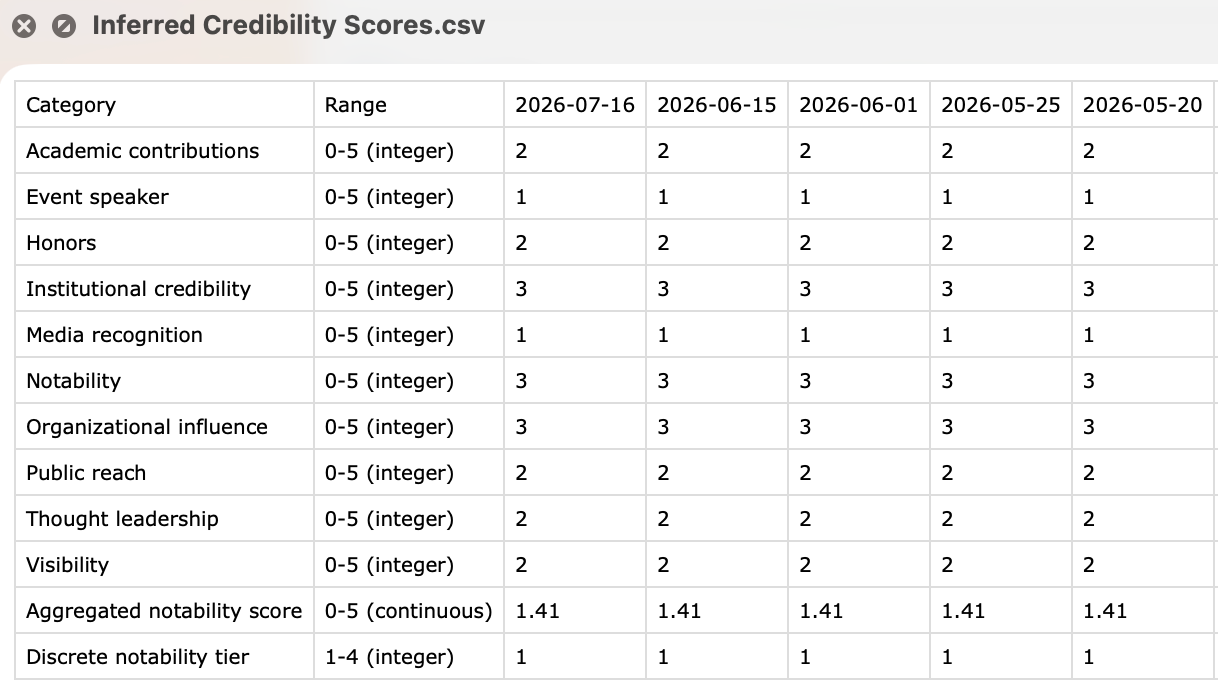
I found a credibility score in my LinkedIn data export. I could not find an explanation for it.
One account, 21 identical snapshots, and questions LinkedIn should answer.
I downloaded my Complete LinkedIn data export last week. Not the standard one but the larger archive LinkedIn says may include information inferred from your profile and activity.
I expected the usual: posts, connections, messages, advertising data.
I did not expect to find a file called Inferred Credibility Scores.csv.
I searched the exact filename across Google, LinkedIn, Reddit, Hacker News, and major technology publications. I found no indexed public reference to it. I do not know if this file appears for everyone, a subset of accounts, or only certain regions. I have no formal documentation to reference, because none appears to exist.
What I have is the file. And a lot of questions. I requested a second export to verify. The file appeared again, with the same values.
What it contains
Ten categories. Each scored from zero to five.
Academic contributions. Event speaker. Honors. Institutional credibility. Media recognition. Notability. Organizational influence. Public reach. Thought leadership. Visibility.
Then two aggregate measures: a continuous notability score from zero to five, and a discrete tier from one to four.
There is a related file publicly discussed since at least 2022 (Inferences_about_you.csv) documenting inferred interests, skill clusters, demographic guesses. LinkedIn acknowledges it creates inferences from your activity and uses them to personalize content, jobs, and advertising.
Inferred Credibility Scores.csv is different. It is not an inference about your interests. It is a structured assessment of your professional standing. I searched LinkedIn's Help Center, Privacy Policy, and publicly indexed search results. I could not find documentation naming this file, defining these ten categories, or describing what the four tiers represent. That does not prove documentation does not exist. It means I could not locate it.
The part that stopped me
The file included 21 dated snapshots, from February 6 to July 16, 2026. Every single value was identical across all 21 dates.
My Thought leadership score: 2/5. Unchanged. My Institutional credibility: 3/5. Unchanged. My aggregated notability: 1.41 out of 5. Unchanged. My notability tier: 1 in a field ranging from 1 to 4; the numerically lowest value, with no definition of what the tiers mean.
During those months, I published consistently.
Nothing moved.
Several explanations are plausible. The dates may represent recalculations, stored observations, or batch-export timestamps. The values may be cached, thresholded, or genuinely unchanged. Publishing may not be an input, or its effect may be too small to move these coarse scores. The file does not let me distinguish among these possibilities.
One more detail worth noting: the aggregated notability score of 1.41 does not correspond to a simple average of the ten category scores, which would produce 2.1. The calculation method is itself undocumented, which is consistent with the broader problem.
A hypothesis, not a conclusion
My working hypothesis: the categories that scored highest (Institutional credibility, Notability, Organizational influence, all at 3/5) are consistent with signals from a senior title at a recognized company. The categories that scored lowest, Thought leadership and Media recognition, may depend more heavily on independent external validation such as press coverage, conference pages, or citations outside LinkedIn.
That is one account. One data point. It may not generalize at all.
But if the hypothesis holds, the implications are worth thinking through.
Any system can only measure what it can see
If these category names mean what they appear to mean, they favor evidence that is publicly documented and machine-readable.
Media recognition: work that appears in publications. Event speaker: appearances that are publicly documented. Academic contributions: work expressed through academic channels. Institutional credibility: association with recognized organizations.
These are useful signals. They are not neutral signals.
Any system built from publicly legible signals will measure what it can see, and risk treating visibility as a proxy for credibility. A practitioner whose work shapes thinking inside companies, inside private networks, without a trail of press mentions and conference pages, may score differently from someone with equivalent impact who happens to be more publicly visible.
I wrote about this gap in When Your Network Has the Wrong Shape, the distance between institutional capital and actual field presence. This model, if my hypothesis holds, may be encoding that gap as a score. And in The Engagement Paradox I argued that deep work gets the quietest applause; senior readers rarely like publicly, precisely because they are cautious with their reputation. If Public reach is scored from platform-visible engagement, the model may be blind to the audience that matters most.
If the score uses public visibility as a proxy for credibility, the problem stops being a cultural bias. It becomes part of the platform's infrastructure.
If the score becomes visible, watch what happens
I wrote about this in The Filter Was Running the Whole Time: systems that measure proxies end up producing proxies. The broader principle is related: once a system rewards a proxy, behavior begins adapting to the proxy rather than the underlying value.
Goodhart's Law: when a measure becomes a target, it ceases to be a good measure.
Once a metric like this becomes widely known, people will start forming theories about what moves it. A person who writes to develop thinking will keep writing. A person who writes to move a credibility score will start pitching journalists, submitting to conference CFPs, angling for the employer logo that might bump their tier. The work becomes instrumental, a means to visible credentials rather than the thing itself.
A system intended to approximate expertise could instead end up incentivizing the performance of expertise.
That is the real cost of a metric that is visible but unexplained.
How to check your own archive
Step 1. Settings & Privacy → Data privacy → Get a copy of your data.
Step 2. Select the larger data archive option, the one including inferred information. Interface wording may differ by region.
Step 3. Wait up to 24 hours for the download.
Step 4. Unzip and search for Inferred Credibility Scores.csv.
You may not find it. That is information too.
Four questions I would like LinkedIn to answer
- Are these fields used by any LinkedIn product, ranking system, or internal decision process? If so, which ones?
- What inputs determine each of the ten categories, and does publishing or engaging on LinkedIn affect them?
- What do the dated columns represent, and why would all values remain identical across 21 dates?
- What does each discrete notability tier mean, and how is the continuous score converted into a tier?
Check your archive. See if the file exists.
Then ask yourself: if a score like this were influencing how your content gets distributed, built on signals that may only imperfectly reflect the quality or impact of your thinking, would you want to know?
I would. That is why I am writing this.