
The Engagement Paradox: Your Best Work Gets the Quietest Applause
Your best work may not be ignored. It may be read, shared and discussed where you cannot see it. The Engagement Paradox explains why quiet influence can matter more than visible applause, and how to tell it from content that simply did not land.

July 2025. Updated 31 July 2026 to add platform context and the role of an unclear invitation to engage.
You’ve been there. You spend hours crafting a strategy breakdown or a lesson learned. You polish every word. You hit publish.
Then… silence.
I got a single like from a colleague and one from my best supporter, my wife.
It’s a modern form of intellectual despair.
Instinctively, you blame yourself. Wrong topic. Wrong headline. Wrong time. Wrong image. You think your work simply wasn’t good enough.
Logical. Intuitive. But not always right.
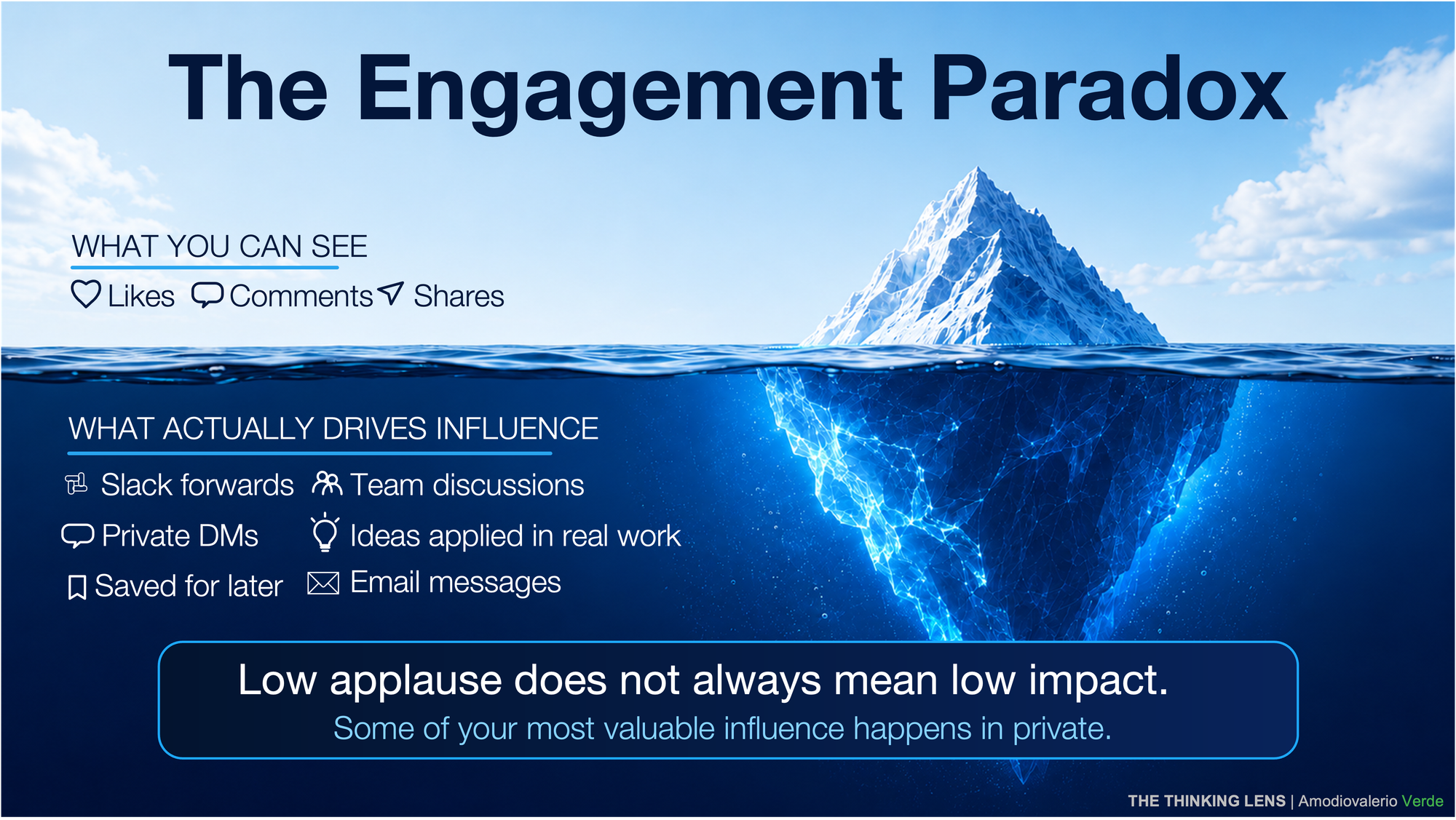
What you may be missing is this: your content may not be failing. You may simply be unable to see where some of the real engagement happens.
Your best work may not be ignored. It may be read, shared and discussed, just not where you can see it.
I call this the Engagement Paradox. Your best readers are ghosts. They’re forwarding your work in Slack, dissecting it in team calls, or using it silently to shift their thinking.
Not invisible engagement. Just invisible to you.
But remember: silence first signals disinterest. Depth comes second. Check your numbers. If views, repeat visits, replies and other trust signals are stable, you may be in the paradox. If they are not, your work may simply not be landing.
The Platform Matters
Before going further, there is an important note: these patterns depend on where you publish.
Most of what I describe in this article comes from my experience with LinkedIn. On LinkedIn, a like is attached to your name, title, employer, network and professional history. It is not only a signal to the author. It is also a signal to everyone who sees you giving it.
That makes engagement different from a personal blog, a newsletter, Reddit, Substack or a private community. In those places, the reputational weight of a reaction may be lower, or simply different.
Since first writing this article, I have also written about why LinkedIn and I need some space. After more than twenty years there, I find it increasingly difficult to separate a thought from my role, my company and the professional audience I have accumulated. Readers may feel a version of the same pressure when they decide whether to react publicly.
LinkedIn does not create professional responsibility. But it reduces the distance between the person, the opinion and the professional identity around them.
So when I talk about the high cost of a public like, I am mainly talking about LinkedIn. The Engagement Paradox may exist elsewhere, but not necessarily with the same weight or in the same form.
Welcome to Dark Social
The idea of Dark Social, where content spreads privately, isn’t new. Alexis Madrigal coined it in 2012. What’s changed is how central it’s become.
Dark Social today includes:
- Slack
- WhatsApp chats
- Microsoft Teams
- Notion docs
- Forwarded emails
- Internal newsletters
- DMs
Dark Social is private sharing that normal analytics cannot clearly track. Some private shares are still measurable, but many are not.
Some of your work may be circulating. You just can’t track all of it.
Now, this is not an excuse or permission for bad content. It’s a lens to interpret good content that looks like it’s failing.
Of course, not all deep content stays quiet. When your network is large enough, amplification kicks in. Content can surface into public view when just a few influential readers engage.
But content that is easy to agree with, or that signals clear consensus, is still more likely to receive public likes. Complex, debatable or technical content usually faces more friction, regardless of network size.
The Engagement Paradox can still apply. Amplification just exposes it on a bigger scale.
The High Cost of a Public “Like”
Here’s the problem, particularly on LinkedIn: engaging with deep professional content in public can be expensive.
Liking a meme? Easy. No risk. Low effort.
Liking a 2,000-word article? That can feel like reputational currency.
When someone publicly engages with your deep work, they may be signaling that they invested the time to read it, understood it and are willing to attach their professional credibility to it.
That’s not always just a like. It can feel like a co-signature.
This reputational friction may help explain why senior professionals, decision-makers and people in regulated industries sometimes engage more quietly. Freelancers, consultants and early-career professionals may have more incentive to engage publicly because visible participation can also help build their brands.
But do not turn these observations into universal rules. Silence from a CFO may be unsurprising. Silence from a startup founder may mean something different.
When the Invitation Is Unclear
There is another source of friction that is easy to overlook: readers may not know whether you are genuinely open to a conversation.
Publishing something does not automatically feel like an invitation. Someone may find your work useful and still avoid commenting, continuing the discussion or sending a private message because they are unsure whether the interaction is welcome.
Silence may therefore reflect uncertainty about your openness, not only reputational friction or lack of interest.
If you want people to engage, make the invitation explicit. Be clear about the conversations you welcome and honest about your boundaries.
For example:
“If your work is moving in a similar direction, feel free to add your perspective or send me a message. I read every message, although I may be slow to respond.”
You do not need to promise unlimited access, immediate replies or agreement. You are simply removing ambiguity about whether a thoughtful response is welcome.
An explicit invitation will not create interest where none exists. But it can remove one avoidable reason why an interested reader remains silent.
Your Most Valuable Readers Don’t Perform Their Engagement. They Apply It.
The person quietly forwarding your analysis to their leadership team can be far more valuable than the person dropping a quick emoji reaction.
Some of your most valuable influence is silent.
Your New Dashboard: Metrics That Reflect Trust, Not Applause
Public likes and comments are easy to track, but incomplete.
Use these signals alongside them:
- Views, read-through and repeat visits: The Initial Handshake of Attention. Stable or growing trends suggest that people continue to give your work their time.
- Open Rate Trends, where they remain reliable: Another indication that you are consistently delivering on your promise, but not proof on their own.
- Unsubscribe Rate and Follower Trends: The Barometer of Trust. A low unsubscribe rate can suggest that your audience is reserving future attention for you.
- Private Replies and Connection Requests: The Filtered Feedback Channel. Thoughtful replies are a strong signal because someone has taken the time to continue the conversation.
- Later References and Qualified Conversations: Someone mentioning an article weeks later may tell you more than the reaction count did on publication day.
None of these proves that silence means hidden influence. Together, they give you a better picture.
Watching public engagement metrics is like judging company health by how busy the reception desk looks. Real business happens in meetings you’re not invited to.
So, What Should You Actually Do?
There is no recipe here. But there are a few lenses worth using.
Be clear about what you expect from a piece of content.
Some posts are meant to create action: a click, a reply, a conversation or a lead. Others are there to build trust and authority over time. These goals can support each other, but they do not always produce the same visible signals.
Do not read every piece through the same dashboard.
If the goal is action, look for action. If the goal is authority, the signals may be slower and less visible: repeat readers, private replies, later references or better conversations.
Deep also does not need to mean difficult to enter.
A complex idea still needs a front door. I often use metaphors for this reason. They give people something familiar to hold while they approach something unfamiliar. A concrete example, a clear opening or a shorter companion post can do the same.
The point is not to make the thinking lighter. It is to make the first step into it easier.
Platforms matter too. Algorithms influence what people get the opportunity to see, but they are distribution systems, not judges of value. Understand how they work, but do not let them become the work.
Reach gives an idea the opportunity to travel. It does not prove that the idea was worth carrying.
Then look beyond individual posts. One quiet article tells you very little. It is weather. The pattern across your body of work is closer to climate.
Are people returning? Are conversations improving? Does someone refer to an idea weeks later? Those signals may tell you more than the reaction count on publication day.
Be patient, but do not romanticize silence. Influence can build quietly. Silence on its own still proves nothing.
Final Thought
It’s tempting to think the lesson is: write more lightweight posts.
But that’s incomplete.
Relatable does not mean shallow. The challenge is to make complex ideas feel immediate and human. Give people a front door into the thinking, without removing the depth behind it.
Don’t trade authority for attention. Use attention to build authority.
Likes and comments still matter. They are signals, just not the whole picture.
Thought leadership is not only about generating reactions. It is about influencing how people think, what they discuss and sometimes what they do.
And some of that influence will remain silent.
How do you distinguish quiet influence from content that simply did not land? I’d genuinely value your perspective.
Feel free to add it here or send me a message. I read every message, although I may be slow to respond.
PAQs (Probably Asked Questions)
If you're curious or want to challenge my thinking, worth a look. If you're short on time, feel free to skip.
Isn’t Dark Social just a way to excuse boring content?
Could be. But check your metrics. Stable views, repeat visits, subscriber trends or private replies may indicate value beyond public engagement. If all are falling, your content may simply not be landing.
How do I know my content is valuable if I can’t see engagement?
Private replies are gold. Ask directly for responses sometimes. Watch whether readers return, whether conversations continue and whether people refer to your ideas later. A low unsubscribe rate is useful, but it is not proof on its own.
Am I just assuming silence is success?
Possibly. That’s why you pair hypothesis with data: stable readership, occasional private responses and evidence that people return to the work. If none show up? Stop fooling yourself.
Isn’t your view of algorithms too simplistic?
Yes, if you treat it as a law. Algorithms react to human behavior, but they also determine what people get to see. Human interest creates signals. The platform decides how to interpret and distribute them.
Should I downplay likes and comments entirely?
Not immediately. For early-stage writers, they are useful signals. But over time, balance them with metrics that reflect trust and continued attention. Likes matter. They are just not the whole dashboard.