Series

Some questions need more than one essay.

Series are connected pieces that develop one argument over time. They are meant to be read in sequence, although each piece can stand on its own.

On Judgment

An attempt to take apart a word I have used too casually: what judgment is, what it is not, how to assess it, and how it relates to reasoning, authority and outcomes.

Status: Ongoing
3 pieces

I Keep Talking About Judgment. What Do I Actually Mean? [On Judgment - Part 1]
We keep saying judgment will matter more. I have been saying it too. But before we build careers, organizations and AI systems around that assumption, I think we need to understand what we’re actually talking about.
Judgment Is Smaller Than I Thought [On Judgment - Part 2]
Judgment is not one thing. It is an assessment, separate from reasoning, preference, creation, decision and authority. Making those distinctions visible makes consequential decisions easier to inspect.
Was It Good Judgment, or Did It Just Work? [On Judgment - Part 3]
If judgment is an assessment, the harder question is how to tell whether it was a good one. Outcomes help, but they can also mislead.

The Semantic Supply Chain

A four-part operating model for how enterprise AI moves from inputs and grounding to autonomy, controls and auditable action.

Status: Complete
4 pieces

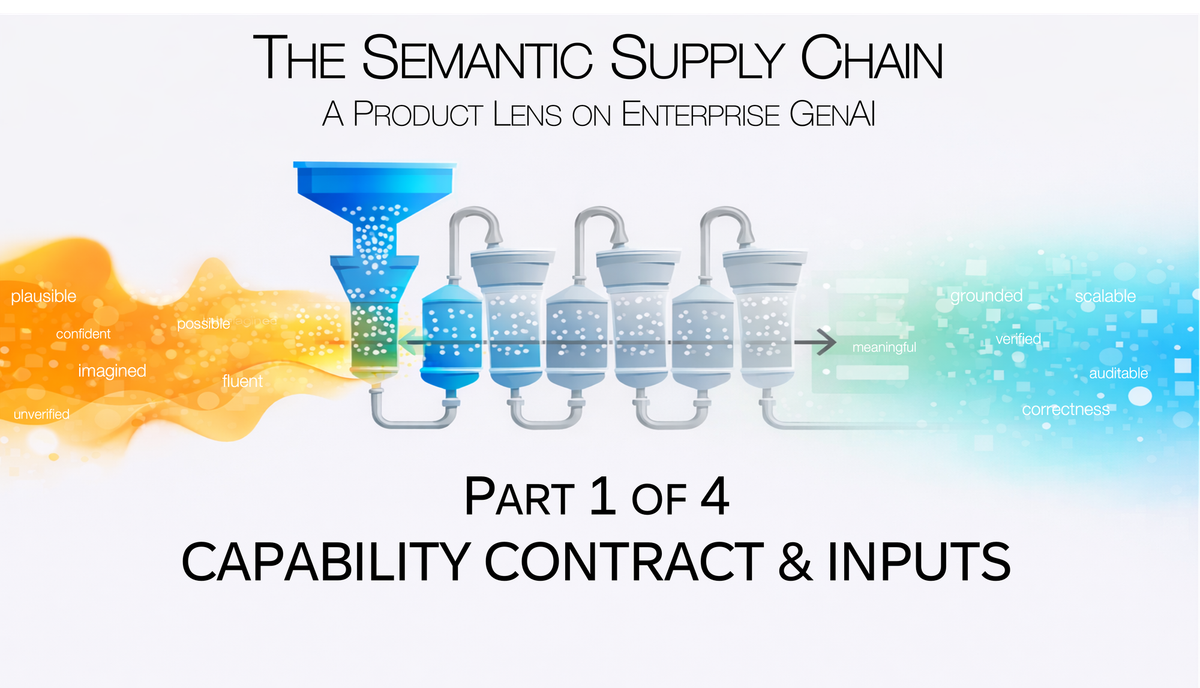
The Semantic Supply Chain: Capability Contract & Inputs
Part 1 of 4: Capability Contract & Inputs [Views are my own. Not legal or compliance advice.] When you last prompted a GenAI application, did it feel like persuading a person or programming a machine? I still catch myself doing it. I start talking to it like a colleague. The more
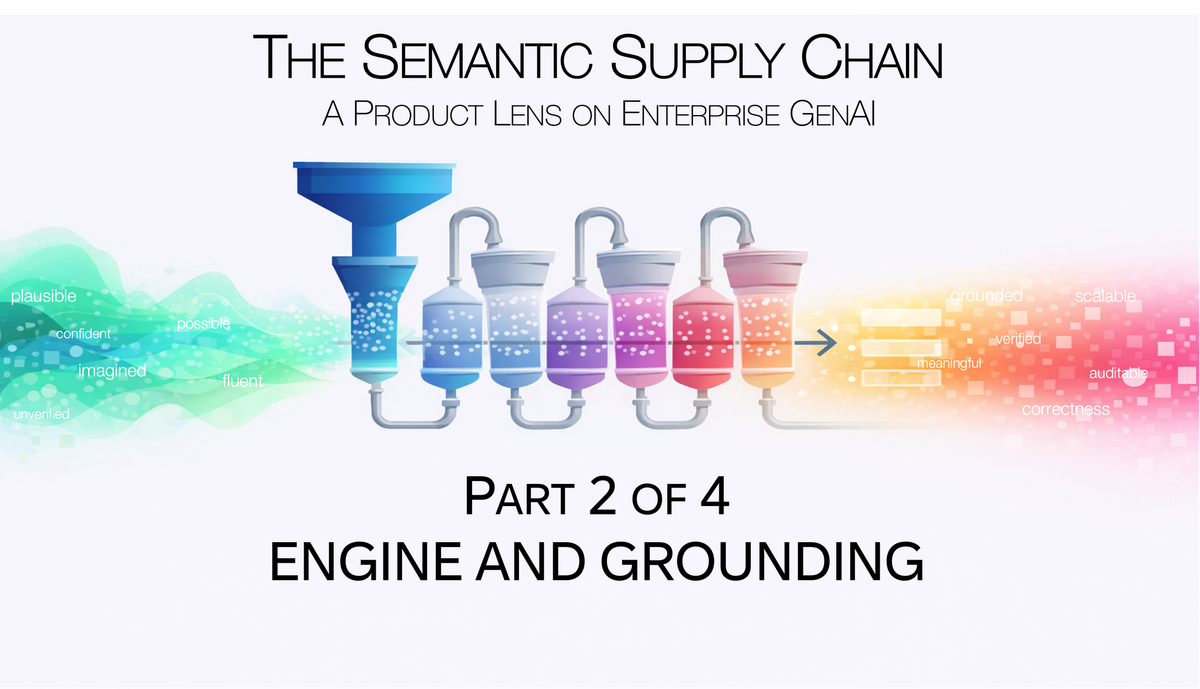
The Semantic Supply Chain: Engine and Grounding
Part 2 of 4: Engine and Grounding: From Plausibility to Proof [Views are my own. Not legal or compliance advice.] In Part 1, we left off with the foundation: establishing a Capability Contract (Station 1) and building retrieval infrastructure (Station 2) for our Procure-to-Pay copilot case study. We
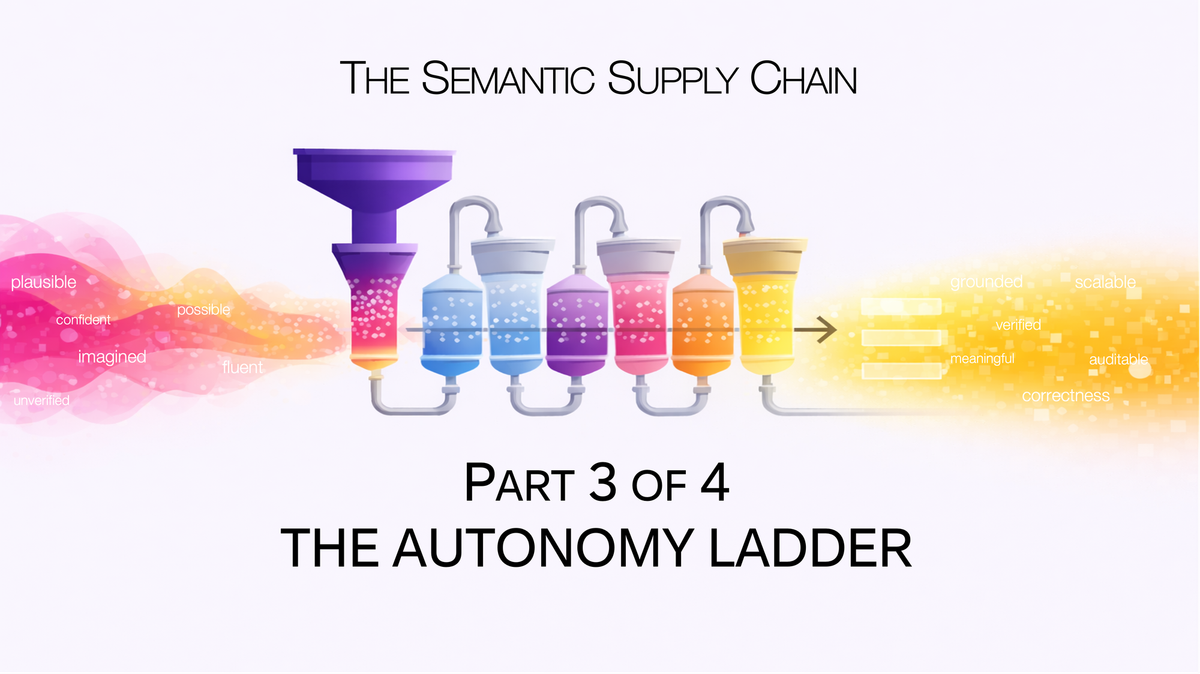
The Semantic Supply Chain: The Autonomy Ladder
Part 3 of 4: The Autonomy Ladder [Views are my own. Not legal or compliance advice.] This is the moment where mistakes move from low-cost errors to business-impacting failures. Because now we’re not just generating answers, we’re executing workflows. In Part 1 and Part 2, we
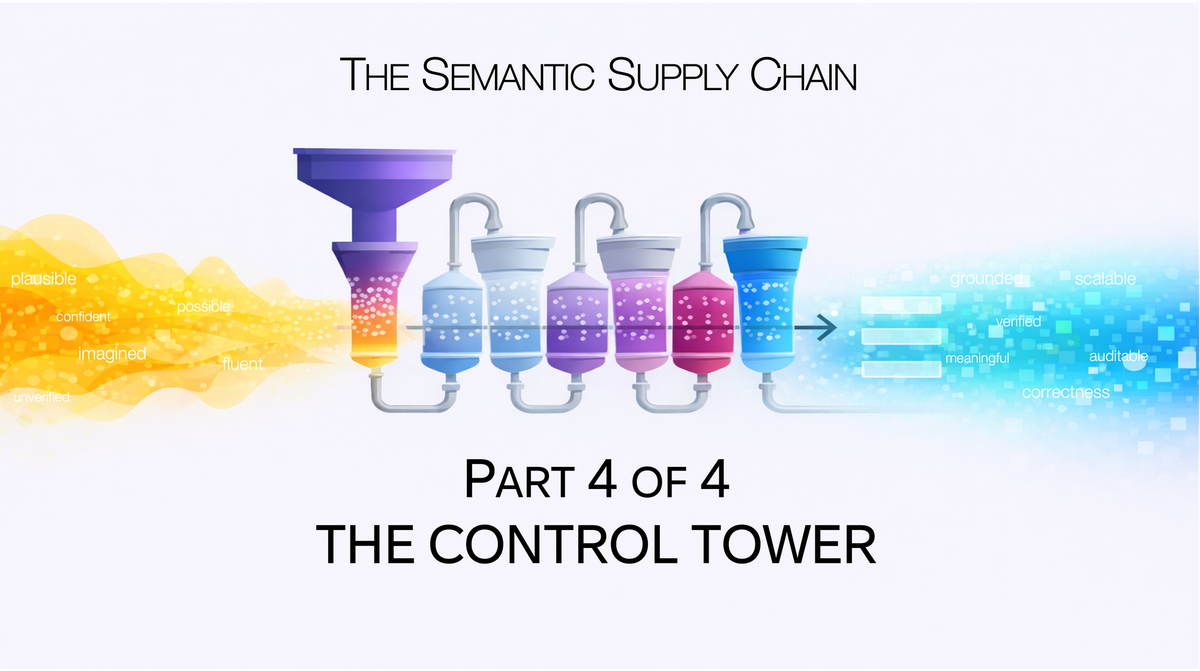
The Semantic Supply Chain: The Control Tower
Part 4 of 4: Trust to Audit, Not Trust to Vibes [Views are my own. Not legal or compliance advice.] Governance can feel restrictive when it’s applied as a cage. But in enterprise GenAI, the right controls are a skeleton: constraints that enable safe speed by making behavior predictable

Instruction Governance

A four-part framework for treating instructions, evaluation and AI behavior as governed enterprise assets rather than ad hoc prompt craft.

Status: Complete
4 pieces

Instruction Governance: The Missing Layer of Enterprise AI (Part 1 of 4)
[Views are my own] PART 1 - Stop Blaming the Model – Start Evaluating Your Instructions The Debate: Engineering Rigor vs. Enterprise Reality This article was born from a recent discussion with peers, fellow VPs and Product leaders, on how to best approach AI evaluation. The prevailing view was that we should
Instruction Governance: The Missing Layer of Enterprise AI (Part 2 of 4)
[Views are my own] Part 2 – Why We Must Evaluate Our Instructions Before We Evaluate AI In Part 1 of this series, we diagnosed the core problem with AI evals: we often evaluate the model’s answers before validating our own instructions. We also introduced Step 1: The Governance Triad
Instruction Governance: The Missing Layer of Enterprise AI (Part 3 of 4)
[Views are my own] Part 3 – The Three Pillars of AI Governance Most enterprises are now past the “one AI pilot” phase. You have dozens of teams, dozens of models, and far more prompts than anyone can count. Each team has its own agent, its own prompt file, its own
Instruction Governance: The Missing Layer of Enterprise AI (Part 4 of 4)
[Views are my own] Part 4 – Implementation and The Business Case In this series, we’ve covered the “Triad” (Part 1), the “Golden Set” (Part 2), and the “Federated Framework” (Part 3). Now, we answer the hardest question: How do we implement this without turning agile teams into bureaucrats? The

The Judgment Economy

A four-part argument that abundance shifts value away from undifferentiated generation and toward filtering, context, credibility and synthesis.

Status: Complete
4 pieces

The Judgment Economy (Part 1/4): Signal vs. Noise
We are drowning in information. Generative AI accelerates this, creating a flood of “Polished Emptiness” – plausible-sounding content with no substance. As AI commoditizes generation, the last true scarcity is trust. Value is shifting from creation to curation and judgment.
The Judgment Economy (Part 2/4): Information vs. Insight
[Views are my own] In Part 1 of this series, we explored the foundational challenge of our time: separating Signal vs. Noise. We defined the problem of “Polished Emptiness” and introduced the Taste-Maker as the first level of curation – the disciplined judgment required to filter the field. But finding
The Judgment Economy (Part 3/4): Credibility vs. Plausibility
This is the central tension for every enterprise. Generic AI is built for plausibility (it sounds correct). Enterprise AI must be built for credibility (it is correct, auditable, and grounded in your business data). This requires a new, essential human function: Level 3: The Trust Broker.
The Judgment Economy (Part 4/4): Connections vs. Collections
[Views are my own] In the first three parts of this series, we built the case for a new strategic mandate. We moved from filtering Signal vs. Noise, to creating Information vs. Insight, to building an enterprise-grade framework for Credibility vs. Plausibility. In this final part, we move to

Beyond the Dashboard

Eleven principles for moving from reporting data to building systems that help organizations think and decide.

Status: Complete
12 pieces including the introduction

  1. Beyond the Dashboard: Intro
  2. BTD Principle 1: Avoid the Data Delusion
  3. BTD Principle 2: Adopt a Data-Informed Approach
  4. BTD Principle 3: Choose What to Measure
  5. BTD Principle 4: Use Frameworks as Filters
  6. BTD Principle 5: Focus on Adoption
  7. BTD Principle 6: Know Your Tool Stack's Boundaries
  8. BTD Principle 7: Build Layered Dashboards
  9. BTD Principle 8: Manage Multi-Product Portfolios Separately
  10. BTD Principle 9: Reconcile Metric Definitions
  11. BTD Principle 10: Build Thinking Systems
  12. BTD Principle 11: Turn AI into a Judgment Multiplier