
Weekend Reflections #21 | The €16.39 Decision
Wolt kept €16.39 of a €69.39 order after delivering only the sides of two meals. The refund calculation may have been correct. But a process that follows its rules can still make the wrong business decision.


I usually do not write and complain about things that happen.
Mistakes happen. Things go wrong. Orders get mixed up. Someone makes a mistake.
That is not the problem.
The way you react to them probably is.
And a day later, I'm still struggling to understand the business logic behind what happened.
A dinner that never arrived. Almost.
Last night, I ordered dinner for my family through Wolt.
Two schnitzels, with fries and potatoes as sides.
Total order: €69.39.
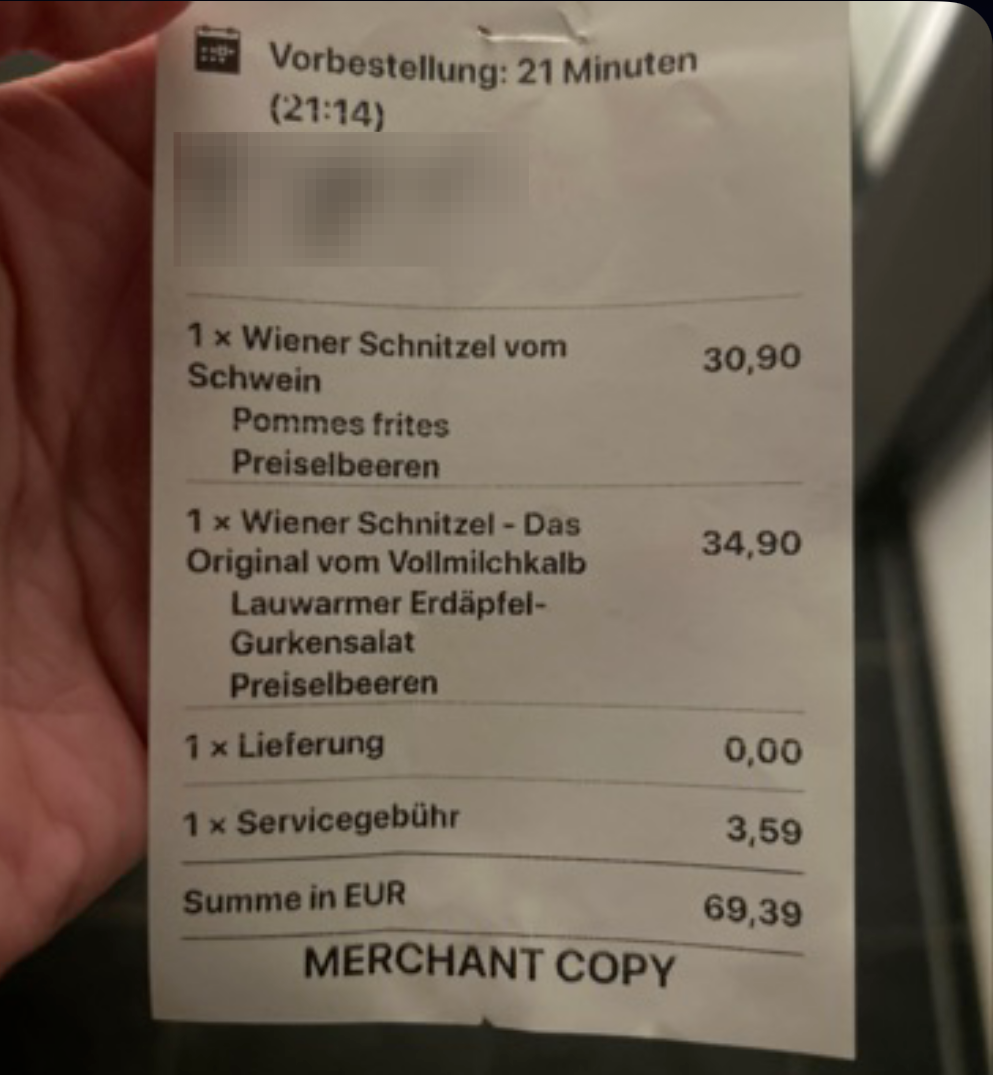
The delivery arrives. We open the bags.
Only the sides.
No schnitzels.
Basically, we received the side dishes of two meals, without the meals.
Fine. Mistakes happen.
I immediately contacted Wolt support. It was already 21:35, and the restaurant was closing at 22:00.
I explained the situation and asked for a solution. Ideally, I wanted the food I had ordered. Hot, not something that might arrive an hour later.
The support agent apologized and offered a refund.
€53.
In Wolt credits.
Wait a minute.
I paid €69.39. I did not get dinner. And the solution is to give me €53 in credits to spend again with Wolt?
I asked why.
The explanation was that the system had calculated the refund by selecting the missing items. Since the sides had been delivered, those were not included.
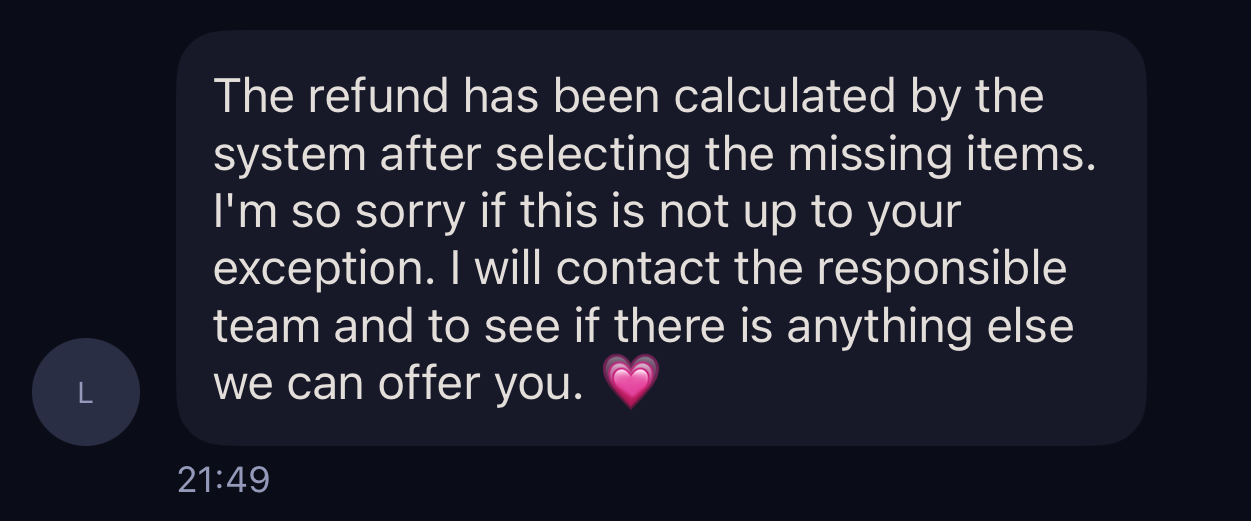
This is where I started to lose any understanding of the logic.
What exactly am I supposed to do with cold fries and potatoes without the schnitzels?
I even told them that they could come back and collect the sides.
I wanted a full refund.
Not credits. My money.
After a long conversation, and after I made it clear that I would stop using Wolt, they agreed to refund the €53 to my original payment method.
But not the remaining €16.39.
And that's where this story becomes interesting.
€16.39. The value of a customer?
I'm a regular Wolt customer. A paying subscriber.
I don't know how much I've spent with them over time, but certainly far more than €16.39.
And yet, that was the amount they decided not to refund.
Now, to be fair, I understand why refund policies exist.
You cannot refund every order in full just because someone is unhappy. You need rules. You need consistency. You need to manage costs and prevent abuse.
And technically, I did receive some of the food I paid for.
So maybe the refund calculation was correct.
Maybe there's something in their Terms & Conditions that justifies it.
Maybe their system works exactly as intended.
Maybe the support agent had no authority to do anything different.
I don't know.
But that is not really the point.
Wolt may have been entirely right about the refund, but being right about €16.39 while losing a paying customer can still be the wrong business decision.
I did not order fries and potatoes for dinner. I ordered two meals.
The main courses were missing. The restaurant was closing. And there was no realistic way to recover the dinner we had planned.
So was this really a partially delivered order?
Or a failed customer experience?
Because from where I sit, Wolt decided that keeping €16.39 was better than keeping a customer.
A customer who was clearly frustrated.
A customer who explicitly said he would leave and cancel his subscription.
And still, nothing.
I might be wrong, but I genuinely cannot understand how this could be a good business decision.
Maybe the process works. That's the problem.
This is the part that bothers me the most.
Not the €16.39.
Not even the missing dinner.
It's the complete absence of a decision that makes sense.
The support agent was polite. She apologized multiple times. She said she understood my frustration. She tried to see what else could be done.
I don't have a problem with the person.
I have a problem with the process. Or, more precisely, with the rules behind it.
The system calculated a refund. The refund excluded what had technically been delivered. The support interaction followed that logic.
And apparently nobody could, or would, challenge the outcome.
Perhaps the process worked perfectly.
Perhaps every step was followed correctly.
And perhaps the policy makes perfect sense when you look at thousands of refund requests rather than one frustrated customer.
But if the result is that you lose a paying customer to avoid refunding €16.39 on an order that failed to deliver dinner, something is wrong.
And maybe it's not the process itself.
Maybe the decision rules are completely messed up.
There is a difference.
You can have a very efficient process that consistently makes bad decisions.
You can automate it. You can measure its execution time. You can improve its efficiency. You can make it cheaper to run.
But that doesn't make the decisions any better.
In fact, you might just become incredibly efficient at making the wrong decisions.
And then you ask me why I'm not worried about AI...
This is also why I sometimes struggle with the endless conversation about how AI will replace some people.
Maybe it will.
But AI will not automatically solve a broken process.
Imagine replacing that support agent with a brilliant AI assistant.
One that understands everything I say. One that can recognize my frustration. One that responds immediately, with perfect language and empathy.
Wonderful.
But if the rule is that the refund must exclude the delivered sides, what changes?
Nothing.
Maybe the AI would explain the decision better.
Maybe it would apologize more convincingly.
Maybe it would even make the interaction faster.
But it would still make the same wrong decision.
Unless, of course, we change the rules. Or give the system the authority to make a different decision when the situation requires it.
And that is not primarily an AI problem.
It is a product problem. A process problem. A business decision problem.
Technology can execute decisions. It can also help us make better ones.
But first, we need to be clear about what a good decision actually is.
Back to the €16.39.
I'm sure Wolt has plenty of smart people.
I'm sure they have teams working on customer experience, retention, operational efficiency, customer lifetime value and all the other metrics we love to discuss in product and business meetings.
I wonder how many of those metrics would support that decision.
How much does it cost to acquire a customer?
How much is a paying subscriber worth?
What is the cost of losing that customer?
And how much is €16.39 in that equation?
I don't have Wolt's numbers.
And maybe, across millions of orders, their refund policy produces exactly the economic outcome they want.
That's possible.
But I struggle to imagine that losing a regular paying customer over €16.39 was the best possible outcome in this particular situation.
Unless, of course, the system is simply optimizing for something completely different.
And perhaps that's the real problem.
But how often do we stop and question whether the decisions themselves make sense?
Whether the rules still serve the purpose for which we created them?
Whether the outcome we're optimizing for is actually the outcome we want?
Last night, Wolt refunded €53 and kept €16.39.
And lost a customer.
The refund calculation might have been correct.
The process might have worked perfectly.
But that doesn't mean the business decision was right.
It might be a very small amount of money.
But it tells a much bigger story about how decisions are made.