
The Foresight Gap: Why Your Last Success Is Building Your Next Crisis
Success hides fragility. Each growth stage plants the next crisis. The risk isn't debt but unseen debt across tech, culture, innovation, and governance. Make trade-offs visible, manage and pay them down, and build antifragile systems. Fast is fine. Blind is fatal. Track debt, hire for adaptability.


This article reflects lessons learned across the SaaS industry and from peers in product leadership. The perspectives are entirely my own and do not reflect or reference any current or past employer. Practices vary across companies and contexts.
TL;DR – Closing the Foresight Gap
Success creates hidden fragility. Every growth stage plants the seeds of the next crisis. The key isn’t avoiding debt, but it’s making it visible, managed, and paid down before it matures.
Here’s what leaders need to know:
- The Foresight Gap: Today’s wins often hide tomorrow’s risks: technical, cultural, innovation, and governance debts.
- The Real Danger: Not debt itself, but unseen debt: trade-offs made without awareness or accountability.
- It appears across stages:
- Startups → Fragile foundations from speed-over-structure choices.
- Scale-ups → Growth masks structural drag; “activity” replaces progress.
- Enterprises → Stability brings strength, but without vigilance, it risks slipping into inertia or innovation theater.
- AI Raises the Stakes: Opaque, unguided models create a new form of debt that can erode trust and block deals.
- The Antifragile Path: Build systems that grow stronger under stress by tracking debt, hiring for adaptability, and turning crises into learning.
If you only remember one thing:
Fast is fine. Blind is fatal.
Introduction: A Leader's Paradox
Success Plants the Seeds of Crisis
Over two decades in product, I've seen a recurring paradox: the very success that defines one chapter often plants the seeds of the next strategic challenge.
- The startup nails product-market fit, often on a fragile technical foundation.
- The scale-up captures market share at speed, sometimes with a sales motion that can't be sustained.
- The enterprise delivers predictable results, which can inadvertently trade off against agility.
Each stage has a playbook that works, until it doesn’t. This piece is not a catalog of problems, but a framework for resilience. It explores these systemic forces and the conscious strategies the most durable companies use to turn them into a strategic advantage.
Beneath the surface lies what I call the Foresight Gap: the blind spot where today’s wins obscure tomorrow’s risks. While I recognize that survival often demands prioritizing speed above all else, I believe a conscious awareness of the trade-offs being made is what separates durable strategy from short-term gambling.
Why Foresight Matters
This isn’t just an internal challenge; it’s a promise to customers. Strategic debt, if unmanaged, becomes their problem. It shows up as reliability issues, slow product improvements, inconsistent experiences, or failure to solve future needs. Managing foresight isn’t just good strategy; it’s a core responsibility.
The Danger Isn’t Debt. It’s Unseen Debt
The Foresight Gap isn’t about lazy leadership. It’s a systemic consequence of success. The intensity that fuels growth in one stage creates fragility in the next. Strategic debt compounds like interest, slowing speed, stifling innovation, and eroding valuation.
The debt itself isn’t the danger. Sometimes it’s the right move to take on technical or Go-To-Market debt to win a market.
In fact, the most effective leaders wield strategic debt like a weapon, consciously borrowing against future capacity to capture a critical market, block a competitor, or hit a crucial funding milestone. The difference is they do it with their eyes open.
The real risk is unconscious debt: trade-offs made without realizing it, the interest that compounds in the dark, and the bill that arrives as a shock. Like financial debt, borrowing can be smart, but ignoring it is fatal.
What This Piece Covers
In this article, I’ll show how the Foresight Gap plays out across startups, scale-ups, and enterprises, and why success at each stage quietly mortgages the future. Then we’ll explore how to build organizations that don’t just survive stress, but grow stronger because of it.
At the heart of this, there are the Four Forms of Debt, hidden costs that silently shape your roadmap, slow your teams, and limit your ability to adapt.
The truth is this: you’re already paying interest on the debt your success created. The question is whether you’ll recognize it in time and design a system that can outlast it.
The Four Forms of Debt
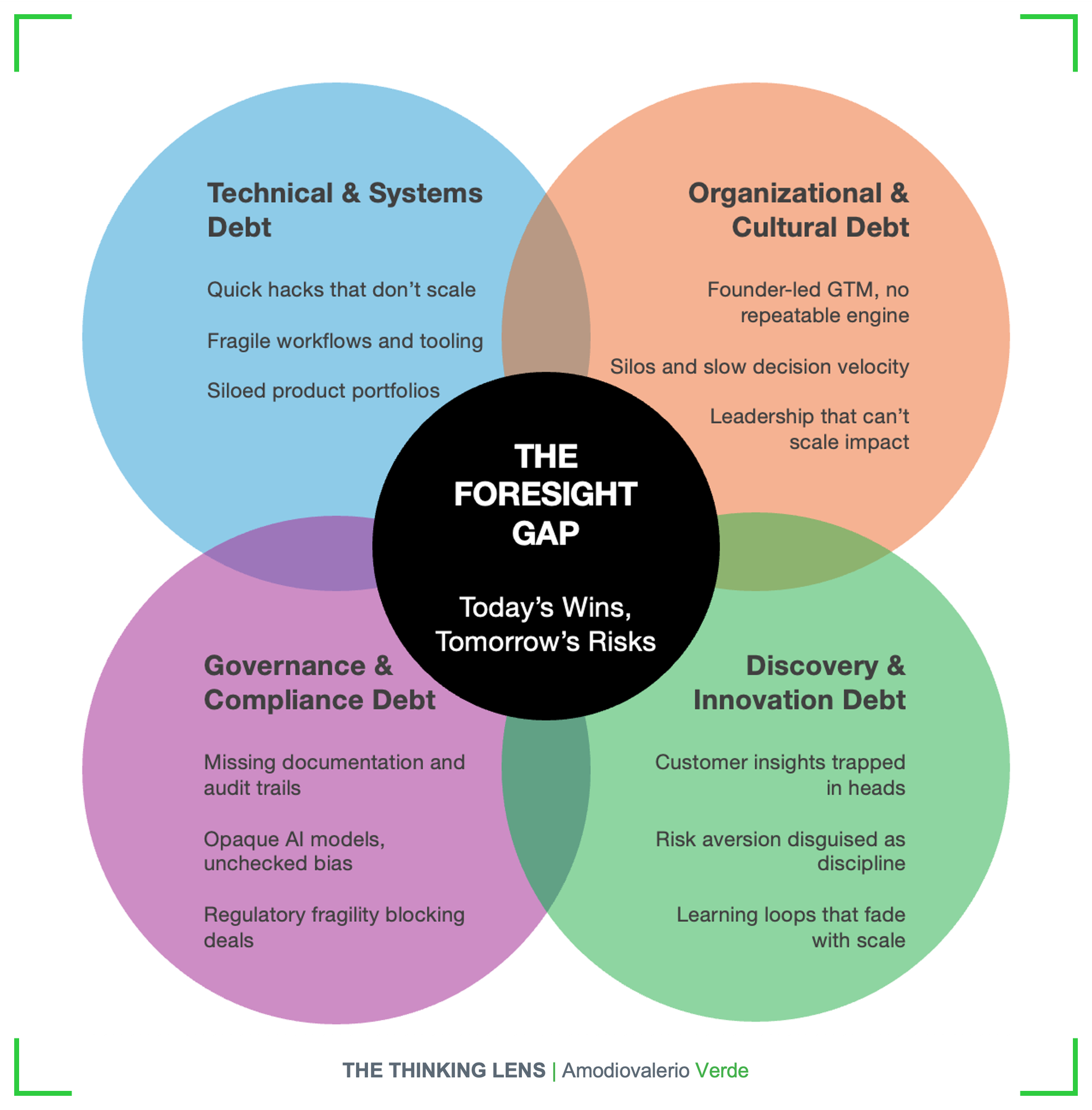
Strategic debt, the core symptom of the Foresight Gap, doesn’t show up in just one place, it compounds across four interconnected areas. They’re structural weaknesses that show up differently at each stage of growth. Under each category are specific sub-debts that silently accrue interest as your company scales:
1. Technical & Systems Debt
This includes both the visible shortcuts in code and the less visible infrastructure and tooling choices that don’t scale.
- Technical Debt: Quick hacks and fragile integrations that help ship fast but create brittleness later.
- Systems Debt: The spreadsheets, Slack threads, and duct-tape workflows that collapse under scale.
- Portfolio Debt: Product architectures and offerings that grow in silos, leading to poor integration, duplicated effort, and customer confusion.
2. Organizational & Cultural Debt
This is the cost of people, structure, and process decisions that aren’t built to last.
- Go-To-Market (GTM) Debt: Founder-driven sales or opportunistic growth motions that don’t translate into a repeatable engine.
- Cultural Debt: Rewarding urgency over resilience, creating silos, and failing to evolve the culture as the company matures.
- Leadership Debt: Early leaders who can’t scale their impact, or new hires who lack systems thinking and struggle in complexity.
3. Discovery & Innovation Debt
This is the erosion of your learning engine, when insights dry up and innovation slows down.
- Discovery Debt: Customer knowledge trapped in decks, heads, or assumptions rather than in systems that scale learning.
- Innovation Debt: Risk aversion disguised as discipline. Over-indexing on certainty. Killing bold bets before they start.
4. Governance & Compliance Debt
This is the invisible fragility behind the curtain, where you look solid until someone checks under the hood.
- Exit-Readiness Debt: Gaps in documentation, compliance, security, and process maturity that can break deals or limit partnerships.
- AI Governance Debt: The hidden risks of deploying AI without oversight, from opaque “black-box” models to unchecked bias and looming regulatory exposure.
These debts are rarely visible day to day. But they silently shape your roadmap, slow your teams, and limit your ability to adapt. The deeper problem isn’t debt itself; it’s the unseen, unacknowledged trade-offs that quietly lock in fragility.
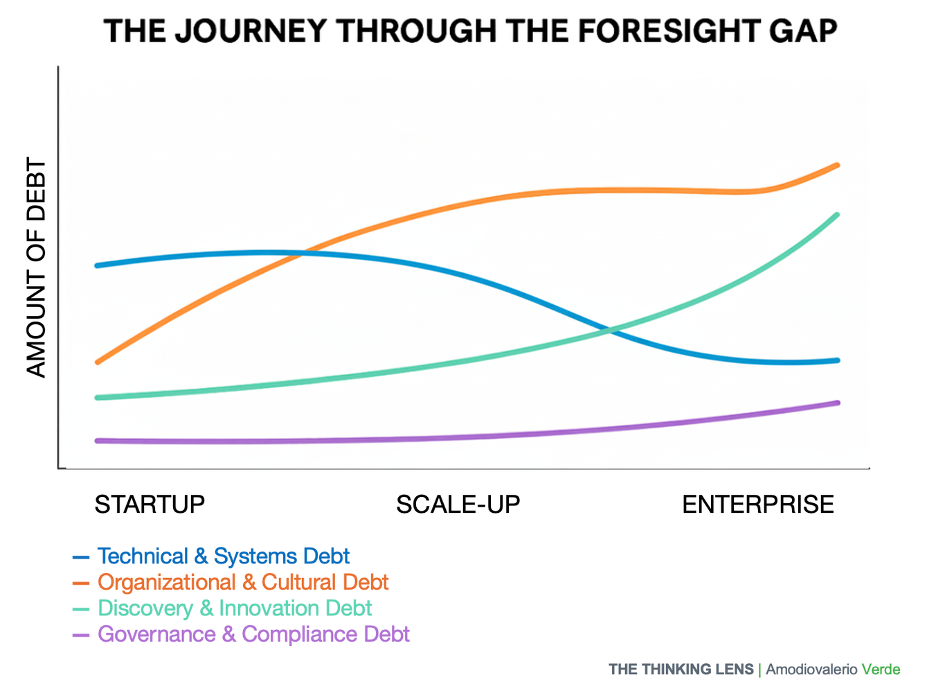
The Foresight Gap isn't static. It's a journey. As companies move from startup to scale-up to enterprise, different forms of debt rise and compound. Technical shortcuts dominate in the early days, organizational and cultural debt spikes during scale, and discovery, innovation, and governance challenges take over at enterprise scale. The key isn’t avoiding debt, but recognizing and managing it before it becomes a drag on growth.
The Startup Stage – Building on a Shaky Foundation
The Singular Pursuit of Survival
In early-stage startups, balance is a luxury. The pace makes sudden-death overtime feel like the norm. The mission is brutally simple: Find Product-Market Fit or die. That means speed over structure. Functional MVPs over scalable architecture. Heroic founder hustle instead of repeatable systems.
Landing those first ten customers feels like a win, but it's often a win built on sand, held together by patched code, founder-led sales, and a culture that learns the wrong lesson: shortcuts equal survival.
The Debts You’re Accruing
Most early-stage debt is invisible. It looks like hustle until it turns into drag:
Technical & Systems Debt
- Technical Debt: Hacks and brittle code that help you ship fast but won’t scale.
- Systems Debt: Duct-tape workflows that collapse once the team grows.
Organizational & Cultural Debt
- GTM Debt: Founder-led sales with no repeatable process.
- Cultural Debt: Speed rewarded above all else, embedding fragility.
- Leadership Debt: Early leaders operating on instinct, not scalable management.
Discovery & Innovation Debt
- Discovery Debt: Customer insights stuck in heads or Slack, not systems.
Governance & Compliance Debt
- Exit-Readiness Debt: No documentation, security practices, or audit trails.
The Trap of Early Success
Hitting PMF often locks in a system optimized for yesterday’s constraints:
- Products built for niche early adopters.
- Sales dependent on personal networks.
- A team wired to move fast, not build durable systems.
The very things that fuel survival create drag as you try to scale. And since success is being celebrated, no one sees the collapse coming.
Let's be clear: the goal for a startup is not to avoid this debt. In the race to Product-Market Fit, taking on technical, GTM, and even cultural debt is not just common; it's often a necessary survival tactic. The purpose of identifying these debts isn't to create a "to-do list" that distracts from the core mission. Instead, the goal is awareness. It’s about ensuring these trade-offs are conscious choices (strategy, not just reactive gambling) so that when the time comes to scale, you know exactly which foundations need to be rebuilt.
Are we building a product that can survive beyond the people in this room?
If the answer is no, you're already deep in the Foresight Gap.
The Scale-Up Stage – Drowning in the Wake of Growth
The Awkward Teenage Years
You've nailed Product-Market Fit. Investors push for growth. Boards demand velocity. Hiring explodes, and new processes layer over chaos. But under the surface, the system strains. The debts that fueled survival are now dragging you under.
When the Bill Comes Due
Technical & Systems Debt
- Systems Debt: Fragile infrastructure breaks under growing teams and traffic. Manual workflows collapse.
- Portfolio Debt: Disconnected products, duplicated capabilities, bloated features nobody uses.
Organizational & Cultural Debt
- Leadership Debt: Founders struggle to scale; new managers can’t lead systems, only teams.
- Organizational Debt: Silos form. Teams optimize locally instead of company-wide.
- Cultural Debt: Speed and heroics are still rewarded. Chaos is still excused. Firefighting has become a career path.
Discovery & Innovation Debt
- Discovery Debt: Research becomes reactive. Learning loops slow down or disappear.
- Innovation Debt: Risk aversion grows. Big bets are avoided.
Governance & Compliance Debt
- Exit-Readiness Debt: Due diligence surfaces compliance holes, security gaps, missing audit trails.
The Illusion of Progress
Scale-ups often look busiest right before they break. Roadmaps shift weekly. Teams sprint but deliver little. Velocity rises, outcomes stall. This is activity masquerading as progress.
Consider the tale of two scale-ups. One, 'Acme Growth,' tripled its sales team and flooded the market, hitting its revenue targets by selling features that engineering hadn’t built. A year later, its roadmap was entirely consumed by repaying technical and GTM debt, and its best engineers quit in frustration. Its competitor, 'Momentum,' hit a similar growth inflection point but paused for one quarter to rebuild its core API and create a repeatable sales playbook. Acme won the short-term race, but Momentum won the market by building a system that could sustain velocity, not just experience it.
The Hiring Trap
Too many scale-ups chase PMs optimized for short-term output: growth, AI, ops.
What they actually need are Keystone PMs: systems thinkers who learn fast, influence without authority, and can lead organizations through transitions, not just specialists for today’s fire drill.
Hiring for flavor deepens organizational debt; hiring for adaptability pays it down. This means prioritizing durable, foundational skills over perishable 'flavors', a shift that is critical for building a resilient team.
Are we building a company that can scale without burning itself out?
If decisions still rely on founder instinct, or if Agile feels more like theater than agility, you’re drifting deeper into the Foresight Gap.
The Enterprise Stage – Mastering Scale and Agility
From Stability to Lasting Strength
Enterprises excel at operating at a global scale and protecting customer value, achievements few organizations ever reach. Their stability is a fortress, built on processes that ensure the predictability and trust required to run the world's mission-critical systems. This strength is the foundation of their success.
The leadership challenge at this stage evolves. It’s not about avoiding the tensions that come with scale; instead, the most durable enterprises differentiate themselves by building sophisticated and adaptive systems to navigate these tensions consciously. They don't get trapped by the Foresight Gap; they master it, proving that scale, when managed with foresight, is an unmatched strategic advantage.
Navigating the Natural Tensions of Scale
Like startups and scale-ups, enterprises face their own version of the Foresight Gap, where predictability can inadvertently trade off against agility. Without a clear path to scale, well-intentioned innovation efforts risk slipping into "Innovation Theater", visible activity that rarely changes the business. These tensions manifest across the four debt categories:
Technical & Systems Debt
- Portfolio Debt: The natural complexity of a mature product portfolio requires active management. The challenge is to harmonize different tech stacks and legacy systems to ensure a seamless and unified customer experience.
Organizational & Cultural Debt
- Cultural Debt: Mature companies build processes designed for stability. The leadership opportunity is to balance these valuable systems with a culture that also empowers teams, encourages calculated risks, and maintains high decision velocity.
- Leadership Debt: Effective leadership at scale means sponsoring transformation while protecting the core. The goal is to evolve from defending the status quo to championing the future state.
Discovery & Innovation Debt
- It’s a constant effort to keep large teams deeply connected to real customer signals. A common pitfall for any large organization is "innovation theater", where well-intentioned experiments remain isolated in labs. The most successful enterprises bridge this gap, creating clear pathways for new ideas to influence the roadmap and reach customers. The true measure of innovation is its ability to deliver new value into customers' hands.
Governance & Compliance Debt
- AI Governance Debt: As enterprises scale AI, the challenge is to implement robust oversight. This involves moving from powerful but opaque models to systems that are transparent, accountable, and designed to meet emerging regulations, ensuring that AI is a trusted asset for the long term.
Building an Evolved Operating Model
The most durable enterprises don't avoid these debts; they build systems to master them. They’ve learned to anticipate the Foresight Gap, absorb shocks, and turn scale into resilience. They do this by evolving their operating model:
- Build Real Innovation Portfolios: R&D is linked to long-term customer value, not just isolated pilots or labs.
- Cultivate Keystone Talent: Leaders are promoted not for output alone, but for systems thinking, domain depth, and influence without authority.
- Implement Adaptive Governance: They protect the core with rigor while giving disruptive bets the air cover to grow under different rules.
- Run a Foresight Engine: Data and feedback loops are used as early-warning radars, turning hindsight into foresight.
By applying the same discipline that makes them successful to seeing around the corner, an enterprise doesn't just protect its current success but builds the foundation for its next chapter of growth. These companies prove that scale doesn’t have to mean rigidity, it’s a design choice.
How do we evolve our operating model to protect the core while actively accelerating the future, ensuring we can win not just at our current scale, but in the next paradigm?
The Human Cost: The Compounding Interest Paid by Your People
Strategic debt is a real burden, and the interest is paid daily by your people. While the business impact shows up in slowed roadmaps and system fragility, the human impact manifests as burnout, frustration, and the loss of your most valuable talent. This cost evolves at every stage.
- At the Startup Stage, the cost is burnout. The celebrated "hustle" culture, necessary for survival, exacts a heavy toll. The most dedicated team members carry the weight of the fragile system, leading to exhaustion and making it difficult to retain the very people who secured the initial wins.
- In the Scale-Up Stage, the cost is an exodus of talent. When firefighting becomes a career path and chaos is excused, your most talented systems thinkers become disengaged. They are exhausted by the constant churn and frustrated by "activity masquerading as progress". The best of them, the ones you need most for the next stage, will quietly start looking for the exit.
- At the Enterprise Stage, the cost is disillusionment. The human toll shifts from chaotic burnout to a quiet erosion of morale. When valuable processes calcify into bureaucracy, it disempowers innovators. They become deeply frustrated by "innovation theater", where their work has no real path to impact, leading to the departure of the very people needed to fend off market disruption.
This compounding human cost is often the most urgent and painful symptom of the Foresight Gap. Addressing it isn't just about building a more efficient business; it's about building a more resilient, sustainable, and humane one.
AI Governance Debt – The New Blind Spot
Artificial Intelligence rewrites the debt equation. It accelerates discovery, personalization, and scale but, unmanaged, it can introduce risk faster than legacy systems ever did: AI Governance Debt.
As a subcategory of Governance & Compliance Debt, here’s how it shows up:
- Opaque Models: AI systems make decisions that can’t be explained.
- Unchecked Bias: Models trained on skewed data embed systemic errors into products.
- Scale Without Guardrails: AI gets deployed faster than oversight mechanisms.
- Regulatory Fragility: Systems aren’t built to meet emerging AI regulations, stalling deals or exposing risk.
Just like technical debt in a startup, AI debt often feels invisible, until it compounds.
The real danger isn’t deploying AI; it’s scaling AI without visibility or control. For an enterprise, where trust and compliance are paramount, scaling AI without transparent governance isn't just a technical risk; it's a potential breach of customer trust that can have brand-level consequences.
Treat AI as both an accelerator and a liability. Govern it with the same discipline you apply to compliance, security, and due diligence. Otherwise, today’s breakthrough becomes tomorrow’s regulatory crisis.
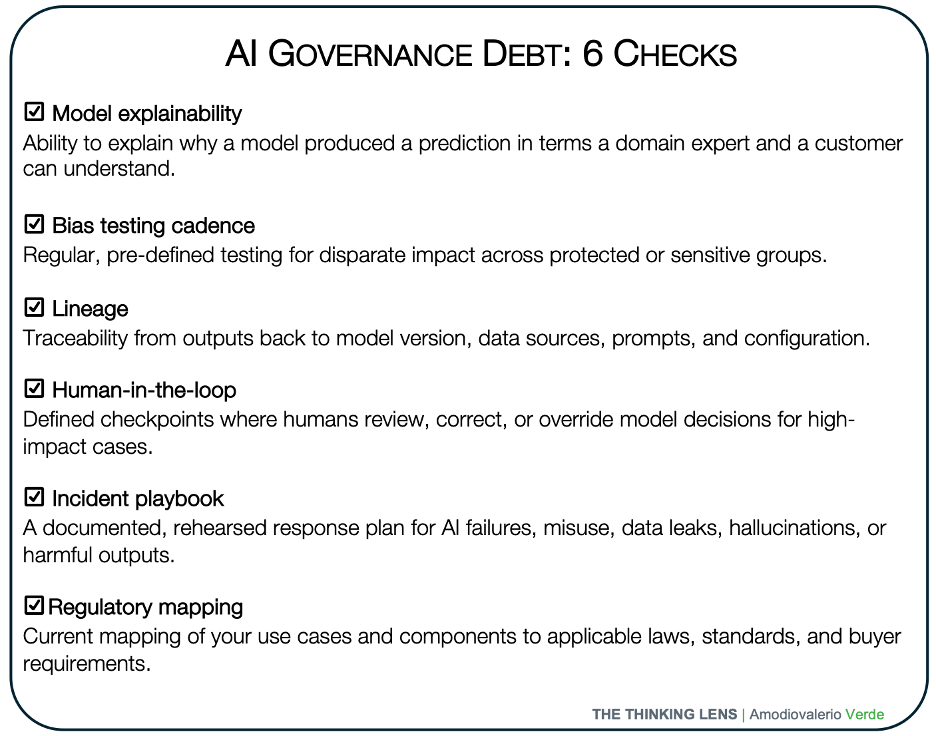
AI Governance: 6 checks to institutionalize
- Explainability you can defend to a domain expert and a customer.
- Regular bias testing across sensitive groups.
- Lineage from output back to model, data, prompts, and config.
- Human-in-the-loop for high-impact decisions.
- An incident playbook for misuse, leaks, hallucinations.
- Mapping to applicable laws and buyer requirements.
Run these as debt items with owners and review dates.
Deal impact
Enterprise buyers increasingly require evidence of explainability, regular bias testing, model lineage, and a documented incident playbook. Gaps here stall security reviews, expand liability language, and delay or kill deals even when product value is clear. Treat these as commercial requirements, not only technical hygiene
Not just: “Can we scale?”, but “Can we stay adaptable as we scale, and use scale as a strength, not a weakness?”
Building the Antifragile Product System
From Diagnosis to Prescription
At every stage, from startup to scale-up and enterprise, success creates invisible trade-offs that mortgage the future. Some debt is inevitable. The real question is whether you take it on consciously, naming it, tracking it, and paying it down before it matures into crisis.
Closing the Foresight Gap isn’t about more dashboards or tighter planning. It’s about designing systems that turn stress into strength. That’s what makes an organization antifragile, able not just to bounce back, but to grow stronger through volatility.
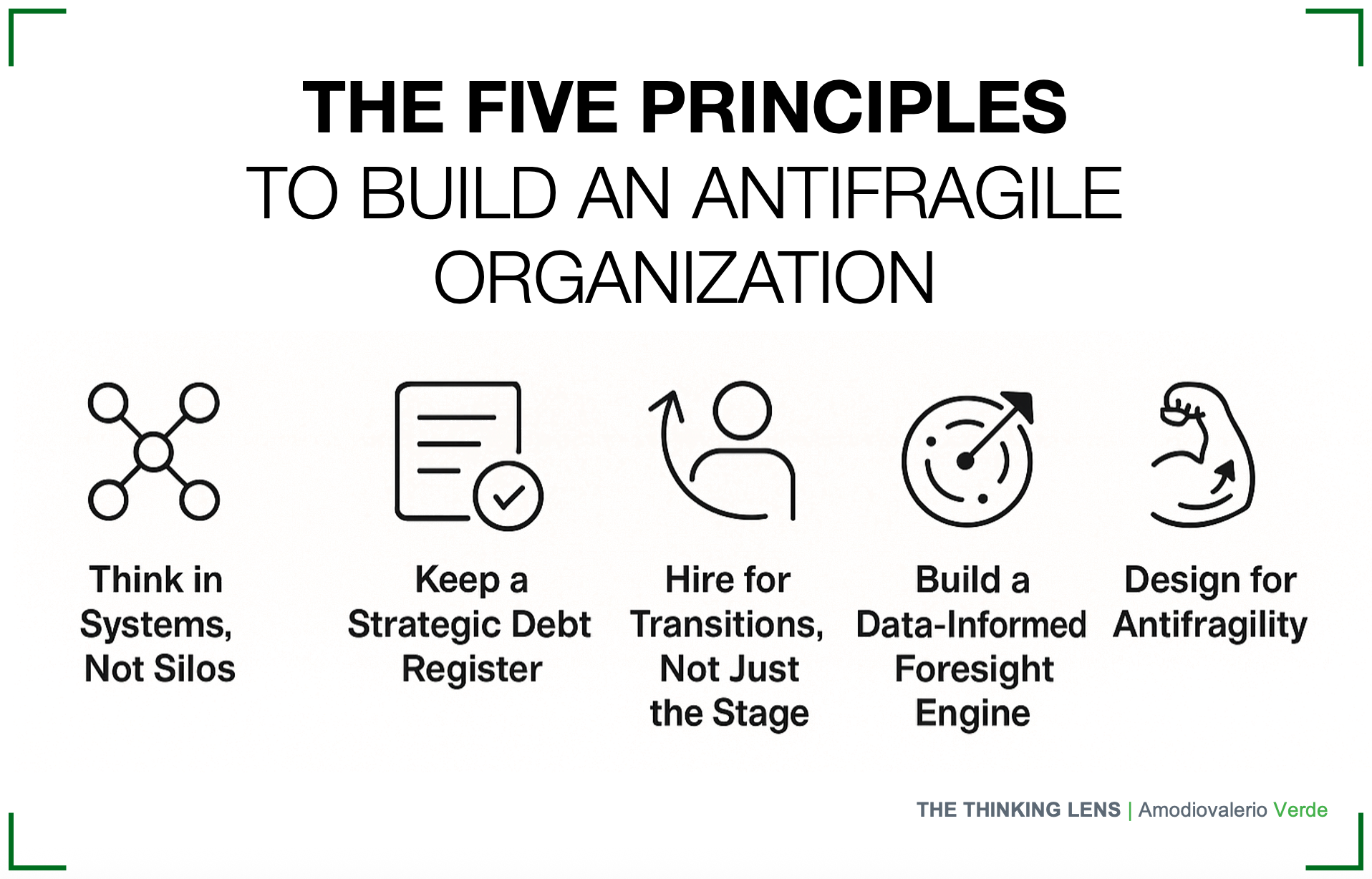
Five Principles for Antifragility
Principle 1. Think in systems, not silos
Treat backlogs, org charts, and roadmaps as mirrors of system design. If they look chaotic, the problem is not Jira. It is the underlying system. Map interdependencies, trace second-order effects, and make the backlog a decision engine, not a dumping ground.
Practices.
- Maintain a single architecture and dependency map for the portfolio. Update it as part of quarterly planning.
- During roadmap reviews ask “what are the second-order impacts” for every top item. Capture them explicitly.
- Tie bug and incident patterns back to system design, not only to teams. Fix classes of problems, not tickets.
Diagnostic signals. Your backlog reads like noise. Incident themes repeat. Cross-team handoffs create delays. These are system design issues, not tooling gaps.
Principle 2. Keep a Strategic Debt Register
The same discipline you use for technical debt, applied to strategic debt across four areas: Technical and Systems, Organizational and Cultural, Discovery and Innovation, Governance and Compliance. Keep it lightweight. Visibility over paperwork.
How to run it.
- Each quarter, name the top 3 trade-offs your teams are living with. Include AI trade-offs where relevant. If you cannot name them, you are paying hidden interest.
- For each item, document why you took it, the current impact, the risk if unpaid, and the payback plan with owner and date. Review in QBRs.
- Treat AI as both accelerator and liability. Add AI governance items the same way you would security or compliance.
Template (copy-paste).
- Debt item
- Category [Tech/Systems, Org/Culture, Discovery/Innovation, Governance/Compliance]
- Why we accepted it
- Current impact
- Risk if unpaid
- Payback plan
- Owner
- Review date
- Signals to watch
- AI notes, if applicable
This can live as one slide in QBR or a shared doc. The point is choosing, not cataloging.
Diagnostic signals. Leaders cannot clearly state the top three trade-offs right now. Reports describe what shipped, not what was learned. You are flying blind.
Principle 3. Hire for transitions, not just the stage
Most teams over-optimize for “flavors” of PMs for today’s fire drill. Durable organizations hire Keystone PMs who thrive in transitions, integrate complex systems, and influence without authority. Keep specialists, but raise the Keystone ratio during platform turns or new GTM motions.
What Keystone PMs do.
- Reduce cross-team debt by aligning incentives across functions.
- Decrease decision latency across product, eng, design, data, and GTM.
- Make hard trade-offs explicit and sequenced.
Hiring and proof.
- Interview for systems thinking and ability to lead through ambiguity.
- After two quarters, track decision latency, cross-team rework, and roadmap slip from handoffs. If these trend down, the mix is right. If not, you hired for flavor over systems.
Diagnostic signals. The PM slate is all specialists, retros cite “handoff churn,” and leaders still make the same decision three times. You are mortgaging adaptability.
Principle 4. Build a data-informed foresight engine
Dashboards show what happened. A foresight engine shows what is about to break. Lead with hypotheses, track learning not just delivery, link intent to decision to action to insight. Use AI for signal detection, paired with human judgment and learning systems. Otherwise you automate fragility.
Make it real.
- Replace “feature delivered” reports with learning objectives and decision changes.
- Add early-warning indicators: incident frequency under load, decision latency, security questionnaire cycle time, explainability gaps in AI decisions.
- Close the loop in QBRs: show what you thought, what happened, what you changed. Reward “smarter,” not only “done.”
Diagnostic signals. Your reports celebrate output and velocity while outcomes stall and risks surprise you in diligence. That is activity masquerading as progress.
Principle 5. Design for antifragility
The goal is not to avoid stress but to get stronger because of it. Make shortcuts explicit and repay them. Treat every crisis as data. Run blameless postmortems that feed the system. Track cultural resilience through psychological safety and decision velocity.
Practices.
- Crisis to capability: every Sev-1 yields a systemic fix and a playbook update.
- Portfolio paydown: keep one slot in each quarterly plan for structural debt retirement.
- Cultural telemetry: survey for safety and autonomy; correlate with incident recovery and cycle time.
Diagnostic signals. Every crisis feels like a setback. Postmortems assign blame, not design changes. Your system is fragile.
Operating Cadence
- Monthly foresight review. 45 minutes. Review early-warning signals and the Debt Register. Decide one change.
- Quarterly planning. Start with “what did we learn” and the top debts to retire. Reserve capacity for structural fixes.
- Board and exec reporting. Show learning, debt retired, risk reduced. Not just velocity.
- AI governance check. For any scaled AI use, track explainability, bias testing, and regulatory exposure as explicit debt items with owners.
First 30 days starter plan
- Name the top three trade-offs this quarter.
- Create a one-page debt register with owners and review dates.
- Add two early-warning indicators to your exec dashboard.
- Pick one structural paydown item for next quarter’s plan.
Your Mandate as a Leader: Close the Foresight Gap.
Every company will face the Foresight Gap. The difference is whether you design around it.
- Startups survive longer if they institutionalize learning early.
- Scale-ups sustain growth if they hire Keystone PMs and pay down organizational debt.
- Enterprises thrive if they adapt protective systems to reward calculated risk.
The trap isn’t debt itself. The trap is invisible debt.
Conclusion – Mind the Foresight Gap
Every stage of growth feels like progress, until you realize you’ve been trading tomorrow for today.
- Startups gain velocity on fragile foundations.
- Scale-ups show frantic activity that hides structural drag.
- Enterprises achieve predictability, sometimes at the cost of agility.
The Foresight Gap isn’t a leadership flaw. It’s a structural trap. The very choices that fuel one stage often set up the next crisis.
The solution isn’t avoiding debt, but making it visible, tracking it, and paying it down before it compounds into crisis. With AI, the stakes are even higher. Opaque models and unchecked deployments can create liabilities faster than legacy systems ever did.
As coined by Nassim Taleb, antifragility describes systems that grow stronger through volatility, not just survive it.
In this context, building an antifragile product organization means designing for adaptability, not just resilience.
That’s why the mandate for today’s product leaders is clear:
- Treat debt as a portfolio to be managed, not an accident to be discovered.
- Hire for transitions, not just stages, recognizing that the demands on every role evolve as the company scales.
- Use foresight engines that measure learning, not just output.
- Make AI both a growth driver and a governed system, not an uncontrolled gamble.
The old “move fast and break things” mantra doesn’t fit in a B2B world. Customers in our industry run their mission-critical systems on enterprise products. Reliability isn’t just a feature, it’s the foundation of trust.
This work is never finished. Diagnosis and adaptation must be constant. By making the invisible visible, we give ourselves a chance to not only survive the next stage, but to come out stronger.
💬 Your Turn
Where have you seen the Foresight Gap show up? What's the most dangerous 'unconscious debt' your organization is currently accruing, and why? Share your experiences.
Final note: The perspectives shared here are entirely my own, reflecting lessons learned and personal observations from across the SaaS industry. They do not represent the views, strategies, or official positions of any current or past employer. Practices and challenges will naturally vary across companies and contexts.
Probably Asked Questions (PAQs)
No framework survives first contact unchallenged. The Foresight Gap isn’t gospel, it’s a lens. Strong ideas earn their place by standing up to hard questions.
Isn’t this just a fancy way of saying “plan ahead”?
No. Long-term roadmaps don’t close the Foresight Gap. Planning is static. Foresight is dynamic. The goal isn’t prediction, it’s building systems that adapt under stress and surface hidden debt early.
Isn’t “strategic debt” just a rebrand of technical debt or change management?
No. Strategic debt is a systems lens that connects four debt categories:
- Technical & Systems
- Organizational & Cultural
- Discovery & Innovation
- Governance & Compliance (including AI risk)
What makes this dangerous is the compounding effect across categories, not the existence of any single one.
Isn't this framework a recipe for cautious bureaucracy? Don't winners succeed by embracing chaos and just moving fast, making this whole "foresight" idea a luxury they can't afford?
That's the core tension every leader faces, but this view mistakes the habits of a few lucky survivors for a winning strategy. Here's how to think about it:
- It's Strategy, Not Gambling. The framework isn't anti-risk; it's anti-blind risk. There's a huge difference between "conscious debt with a payback plan (strategy) and unconscious debt with no accountability (gambling)". Winners make big bets, but the most durable ones have a sense of the risks they're taking on.
- It Addresses Survivorship Bias. We all celebrate the few companies that succeeded by moving fast and breaking things. We forget the "hundreds that broke while scaling on technical, cultural, or leadership debt". This framework is designed to increase your odds of surviving the journey, not just starting it.
- It’s About Velocity, Not Just Speed. Unmanaged debt leads to the illusion of progress, what the article calls "activity masquerading as progress". You feel fast because teams are busy, but you aren't actually getting anywhere meaningful. Paying down debt is an investment in sustained velocity.
- It’s a Mindset, Not a Process. The goal is simply to make the invisible visible. Asking "what's our top trade-off this quarter?" isn't bureaucracy. It's leadership.
Isn’t “antifragility” just a buzzword?
Not here. In practice, antifragility means designing orgs that learn from every shock. That requires postmortems that feed systems, product ops that track strategic debt, and cultures that treat volatility as fuel.
Don’t big enterprises stay successful because their guardrails protect the core?
Guardrails prevent collapse, but they can also prevent change. Durable enterprises build adaptive governance: protect the core while investing in bets that reshape the future.
Aren’t Keystone PMs a luxury when the work needs specialists?
You need both. Use specialists for depth and Keystone PMs to integrate the system and steer transitions.
- Specialists unlock speed in a narrow lane. Keystone PMs reduce cross-team debt, keep incentives aligned, and make hard trade-offs visible.
- Adjust the mix by context. During platform turns, integrations, or new go-to-market motions, raise the Keystone share. During steady exploitation, lean more on specialists.
- Hire for outcomes, not titles. Track three signals: decision latency across functions, cross-team rework, and roadmap slip caused by handoffs. If these trend down within two quarters, your mix is right.
- If headcount is tight, hire the Keystone PM and rent specialist depth through advisors, contractors, or short-term pods.