
Stop Hiring PM “Flavors.” Hire Keystones.
Stop hiring PM “flavors” like “AI PM” or “Growth PM.” Hire Keystone PMs who integrate design, engineering, data and GTM, frame real problems, learn fast, and influence without authority. Durable capabilities compound; trends fade. Hire for outcomes, not buzzwords. Build missions, not titles.

We're hiring Product Managers all wrong.
We're Browse for "flavors" like we're at a gelato counter, chasing an "AI PM" or a "Growth PM" for a short-term sugar rush. This is a costly mistake.
We need to stop hiring for perishable flavors and start hiring for durable "Keystones."
In Roman architecture the keystone locks the arch. It isn’t heavier than the other stones, but without it the structure collapses.
A Keystone PM:
- Integrates engineering, design, data, and GTM
- Translates across disciplines and stakeholders
- Amplifies every other role on the team
They don’t wear one hat; they make the hat rack work.
These are the PMs with foundational skills who build resilient, compounding value.
Here’s how.
Durable > Perishable
Perishable skills fade:
- Last year’s growth hacks
- Prompt engineering tricks
- Trendy prototyping stacks
Durable capabilities compound:
- Framing the real problem in chaos
- Learning new domains in weeks, not years
- Seeing systems, not silos
- Influencing without authority
These are non-negotiable. Hire for them first.
The Perceived Speed is an Illusion
Hiring managers want to de-risk hires by finding a 'specialist' who can hit the ground running on an urgent problem.
But the specialist who solves today's problem often stumbles when it evolves in six months. You're trading short-term velocity for long-term resilience. The real risk isn't a slow start; it's a dead end.
The Tale of Two Hires
👎 The Flavor Hire (Growth PM):
- Action: Hired for "growth hacks," they immediately launch a complex, gamified referral program.
- Result: A short-term spike in sign-ups from low-intent users. Vanity metrics look great for a quarter.
- 6 Months Later: 90% churn from the new cohort. Net revenue is flat. They treated a symptom, not the disease.
👍 The Keystone Hire (Product Manager):
- Action: Hired for problem framing, they analyze the user journey and find the "aha!" moment is buried.
- Result: They lead a cross-functional team to redesign the first-time user experience.
- 6 Months Later: The leaky bucket is fixed. New user activation is up 40%, retention has doubled, and the business has a foundation for sustainable growth.
When Specialization Matters
In some domains, deep experience is required up front. The cost of ignorance is too high.
Examples:
- FinTech: KYC/AML, risk models, regulatory complexity
- HealthTech: Clinical workflows, HIPAA, patient safety
- Security/Infra: IAM, cryptography, zero-trust architecture
Here, context fluency is a prerequisite. But learning velocity still matters. It keeps specialists relevant.
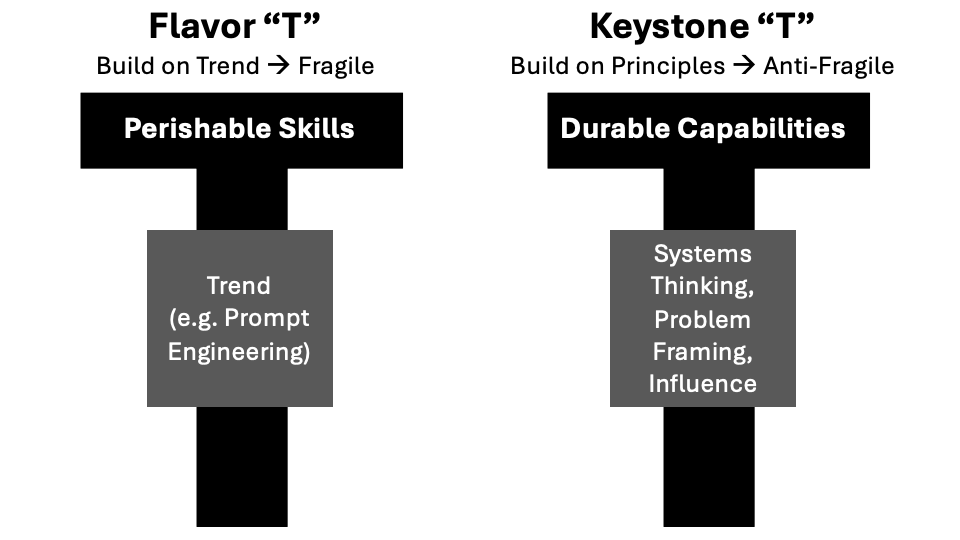
Redefining the 'T-Shaped' PM
The conventional 'T' is a trap. The deep stem is often a perishable skill.
👎 The Flavor 'T' (Fragile)
- Deep Stem: A trend (e.g., 'Prompt Engineering')
- Result: The stem rots when the trend dies.
We need to flip the model. The foundation is the stem.
👍 The Keystone 'T' (Antifragile)
- Deep Stem: Durable capabilities (Systems Thinking, Problem Framing, Influence).
- Result: The PM can build, discard, and rebuild applications on top of this foundation in any context (AI, Growth, etc.).
The takeaway: Hire for a deep stem in how to think, not just in what to know. Specialization comes later, built on top of that strong foundation.
A Better Hiring Framework
Stop writing job requisitions for flavors. Start writing them for missions.
- Instead of: "Growth PM"
- Title it: "Product Manager, New Customer Activation" Focus on: "You will own the end-to-end journey for new users, from first contact to the 'aha!' moment, and be measured on long-term retention."
- Instead of: "AI PM" Title it: "Product Manager, Decision Intelligence" Focus on: "You will identify opportunities where data and models can help our customers make faster, more confident decisions."
- Instead of: "API PM" Title it: "Product Manager, Developer Ecosystem" Focus on: "You will treat our API as a product, empowering third-party developers to build valuable applications on our platform."
This forces you to define the problem space and attracts candidates who think in terms of outcomes, not just tools.
Then, in the interview, don't ask "What PM flavor are you?" Ask these questions:
- Can you learn fast in a new space? (Listen for: A process for intentional learning, not just 'I'm a fast learner.')
- Can you frame and simplify problems? (Listen for: Examples of reframing a stakeholder's 'solution' back to the core user problem.)
- Can you influence across functions? (Listen for: Specific stories of aligning teams with conflicting priorities, without direct authority.)
- Can you deliver outcomes under ambiguity? (Listen for: How they define and measure success when the path isn't clear.)
And if they can’t answer how their last 3 roles built compounding insight, pass.
Stop Optimizing for Trends
I foresee we’re 1-2 quarters away from:
- “Autonomous Agent Architect”
- “AI Copilot Product Lead”
- “Multi-Agent System PM”
These titles may sound strategic, but often hide shallow thinking about value, user need, and feasibility.
This creates noise. The market fills with inflated titles, shallow experience, and misaligned hires. And we’ve seen this before. Do you remember the “Prompt Engineer” hype?
The result? A hiring system optimized for short-term signaling, not long-term capability. Real product talent gets overlooked. Foundations rot.
If we want to fix this, VPs and hiring leaders need to push back, upward and downward. Define problem spaces, not trends. Hire for thinking, not tool familiarity. Specialization should be earned, not claimed after a sprint.
The Chicken-Egg Problem in PM Specialization Hype
1. Top-down pressure from boards and execs
- Boards chase trends (AI, growth at all costs, “agentic workflows”, etc.)
- This cascades down to CPOs/VPs writing job requisitions optimized for buzzwords, not outcomes or fundamentals.
2. Recruiting optimizes for keywords
- HR and recruiters tune sourcing around these keywords.
- Generalist or systems thinkers without “AI” or “Growth” in their last title get filtered out even if they're better fits.
3. Candidates shape themselves to the market
- PMs chase signals: add “LLM integration” to their resume even if it was a feature flag rename.
- Everyone becomes a “Prompt Engineer,” “AI PM,” or soon, an “Agentic AI Orchestrator.”
4. Market noise increases
- Titles and resumes lose meaning.
- Shallow specialization masks weak product thinking.
- Hiring quality drops. High-churn, misaligned hires increase.
5. Eventually, the hype collapses
- “Prompt engineer” becomes “just a dev who knows OpenAI APIs.”
- Boards get skeptical. Market pendulum swings.
- But the damage is done: resumes are bloated, expectations mismatched, hiring harder.
Final Word
Specialization is fine, when it spans a value stream, not just a tool. Granularity is the real issue.
The future of product won’t be built by flavors. It will be built by adaptable, system-minded, outcome-driven Keystone PMs.
If this resonates: share it, challenge it, debate it. But stop settling for flavors.