
Where Did the Thinking Go?
Rituals are in place, delivery is steady, yet no one can answer why we're building. The logic layer has faded: discovery doesn't shape backlogs, strategy doesn't guide tradeoffs, output eclipses outcomes. Reconnect intent to action by making reasoning visible in every decision. Think with intention.

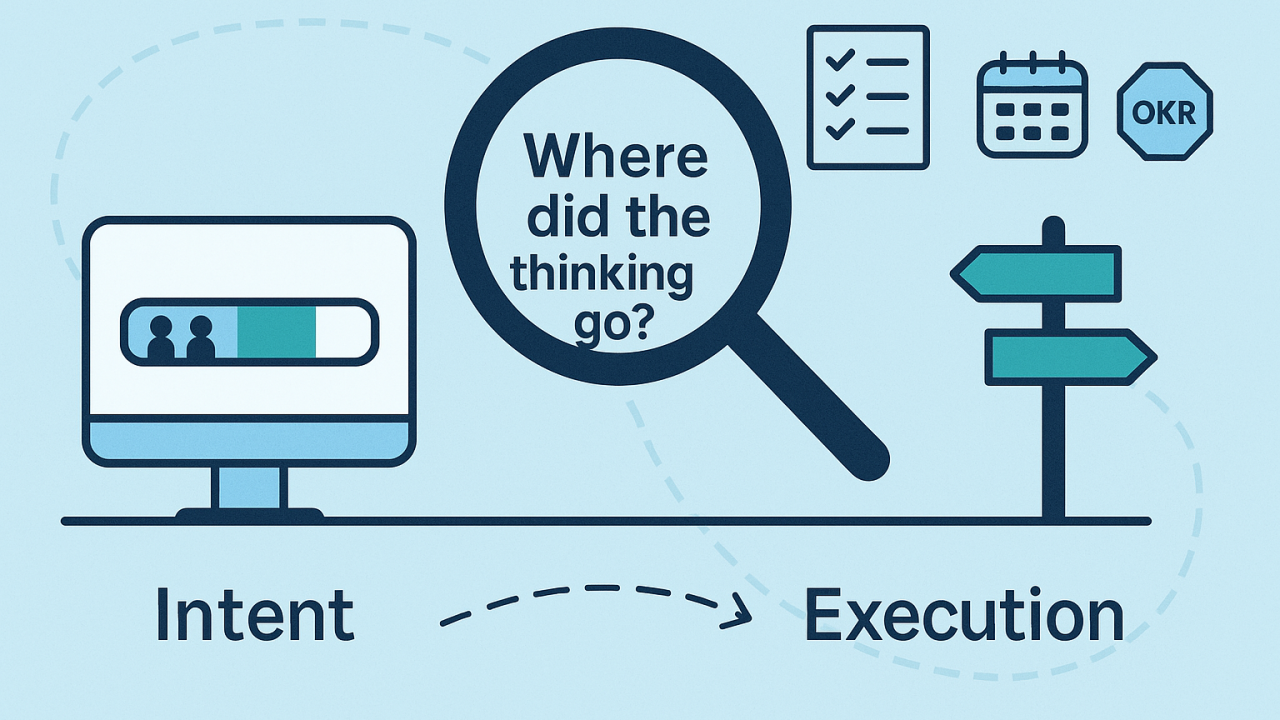
Why product teams lose clarity even when the rituals are in place
You’ve seen the pattern.
Delivery is steady. Standups are happening. The roadmap is full. Backlogs are updated. OKRs are in place.
And yet, someone asks:
“Why are we building this?”
And nobody has a clear answer.
Not because people don’t care. Not because the tools are broken. Not even because leadership is absent.
It’s something subtler and more systemic:
The thinking has disappeared from the system.
The Disappearance of Reasoning
Modern product teams are operationally efficient. We’ve mastered the how, but often lost track of the why.
What begins with clear discovery and sharp strategy… …gets lost in a growing backlog, sprint ceremonies, and shipping pressure.
We start to confuse:
- Movement with progress
- Structure with clarity
- Output with outcome
The result? Teams stay busy, but can’t explain what they’re trying to achieve. Strategy exists, but it doesn’t guide decisions. Backlogs grow, but meaning shrinks.
This is not a tools problem. It’s a product system problem.
What Is a Product System?
Let’s define it, clearly and practically.
A product system is the structure through which a team or organization turns insight into impact.
It includes:
- Discovery (how we learn)
- Strategy (how we choose direction)
- Prioritization (how we make tradeoffs)
- Execution (how we act)
- Feedback loops (how we adjust)
It’s made of tools, rituals, documents, and decisions, but it’s more than all of them. It’s the connective tissue that links intent (what we want to achieve) with action (what we actually do).
When the system works well:
- Strategy influences backlog items
- Discovery findings reshape scope
- Prioritization reflects tradeoffs, not opinions
- Delivery carries forward intent, not just features
When the system breaks down:
- Teams ship features no one understands
- Outcomes are unclear, even after launch
- Nobody remembers who decided what or why
- Decisions become instinctive or political
This is what it means when I say “the thinking is gone.”
How the Logic Layer Fails (Without You Noticing)
In most organizations, this erosion is gradual. You rarely see it all at once.
It starts with good intentions:
- "Let’s move faster"
- "Let’s be leaner"
- "Let’s simplify process"
But over time, key signals get lost:
- Discovery insights stay in Notion, never reaching the backlog
- Strategy is shared in a presentation, then forgotten by sprint 3
- Roadmaps get filled with items that no one framed
- OKRs are set, but never influence actual tradeoffs
What’s missing is the reasoning layer, the part of the system that holds logic together.
And without it, the team still moves. But it doesn’t think.
Frameworks Can’t Fix This (Alone)
This is the point where many teams try to fix things by adding:
- A new framework
- A new board setup
- A new template
These can help — but only up to a point.
Frameworks assume:
- One kind of team
- One type of product
- One model of work
But enterprise teams are complex. They shift constantly: Reorgs, tech debt, unclear stakeholders, market pivots, and team turnover.
When the reality shifts, rigid frameworks crack. What survives is shared mental models – how people reason together under pressure.
You don’t need another process layer. You need to rebuild the thinking structure.
Rebuilding the Thinking Layer: Where to Start
This isn’t about adding more meetings or checklists. It’s about making reasoning visible again.
Here are 5 ways to start:
- Make intent explicit in backlog items → Instead of “Build onboarding flow”, ask “What outcome are we supporting?” → Capture the rationale, not just the task.
- Tie discovery directly into delivery → Don’t let research live in isolation. → Let user feedback reshape what gets built.
- Ask better prioritization questions → Not “How big is this?” or “How loud is the stakeholder?” → Ask: “How does this move our outcome?”
- Review strategy as a decision surface → Strategy isn’t a plan. It’s a lens for judgment. → Ensure teams use it to resolve ambiguity, not just to align at kickoff.
- Create a culture of framing, not just tracking → Good product systems don’t just track what’s in progress. → They frame why something exists, and what success looks like.
What It Looks Like When the Thinking Comes Back
You’ll know the product system is recovering when:
- Backlog items no longer feel hollow
- Discovery conversations influence real scope
- PMs can explain their roadmap in terms of outcomes, not outputs
- Teams ask: “What decision is this item helping us make?”
- People disagree productively, because they reason from the same principles
You don’t need a full transformation. You need a system that remembers what matters.
Final Thought
If your team is moving, but the impact is unclear, pause. Zoom out.
Ask: Where did the thinking go?
And then:
- Don’t panic.
- Don’t start over.
- Don’t install a new process.
Just start reconnecting intent and action, one decision at a time.
That’s how the system starts thinking again.
Over to You
If this resonates, I’d love to hear your experience.
Have you ever found your team in this pattern? Where everything looked fine from the outside, but clarity was missing?
What helped you bring the reasoning back?