
We’ve Reached the Point Where Good Writing Looks Suspicious
A Personal Perspective on AI, "Polished Emptiness," and the Primacy of Thought.

[Views are my own]
I find this ironic: today, if you write with clear grammar, structured flow, and rhythm, people assume it was generated by AI.
The bar for what “sounds human” has dropped so low that basic literacy now feels artificial and punctuation becomes evidence.
Some people even add mistakes on purpose – breaking syntax, flattening tone – to look “authentic.” That’s not authenticity.
That’s performative imperfection. It stems from the narrative that AI inevitably dumbs down writing. Let's challenge that.
Sometimes, it does the opposite.
The Irony
AI didn’t make writing worse. It made more people write better.
It’s an equalizer for brilliant thinkers who always struggled with the craft of writing, allowing them to focus on the thinking while learning from the tool.
This 'equalizer' effect is particularly transformative for neurodiverse individuals, for whom the conventional tasks of structuring, organizing, and polishing thoughts into traditional prose can present significant barriers. By lowering these barriers to expression, AI tools can unlock valuable perspectives that were previously unheard, making our teams and our thinking stronger and more inclusive.
Modern tools are quietly teaching clarity.
- They show what structured thought looks like.
- How a paragraph builds.
- How rhythm keeps attention.
- How transitions move readers through logic.
They don’t replace thinking. They model how to communicate it.
And let’s be clear: I’m not claiming people aren’t using AI. Most are, indeed. What I’m saying is that we need to stop misclassifying how they’re using it.
There’s a big difference between asking an AI to write an article for you and using it to adjust rhythm, grammar, and proof-check.
One replaces thinking. The other refines expression.
Using AI tools isn’t evil. It’s how you use them that can make it harmful.
Used well, they can be silent teachers – quietly showing millions how to write with structure, precision, and rhythm again. (I personally learned the proper use of the em-dash from iterating with one.)
But this amplification is indiscriminate. It amplifies the human's starting point, for better or worse.
This has two profound, opposing effects.
For the brilliant, thoughtful leader – often the one suffering from impostor syndrome – AI is the final 10% of polish that provides the confidence to finally click 'Post'. It helps them bridge the gap between their great thinking and the craft of writing.
Conversely, the tool also amplifies the Dunning-Kruger effect. It empowers those with unmotivated confidence to mass-produce 'Polished Emptiness' at an unprecedented scale.
We will see, and are already seeing, a flood of mediocre, hollow content.
This, however, is where the loop closes. The burden of judgment simply shifts to the reader or to curators. Those of us interested in purpose and thinking will quickly learn to tune out the noise. We will become adept at filtering the mediocrity to enjoy the wonderful, unintended consequence: an increase in valuable, new ideas from the deep thinkers who were previously silent.
It is important to acknowledge the powerful counterargument: for a significant portion of business communications, AI-assisted 'Polished Emptiness' is, in fact, 'good enough.' The automation of routine emails, meeting summaries, and standard reports represents a massive net productivity gain. This 'good enough' revolution frees up valuable time and cognitive resources.
However, this very efficiency makes it even more critical for leaders to distinguish between low-stakes work where automation excels and high-stakes strategic communication where nuance, unique insight, and true human judgment are irreplaceable.
The Misdiagnosed Patterns of Good Writing
The irony goes deeper. Many of the so-called “AI fingerprints” people cite are not signs of automation at all – and they do not discuss the content but the construction.
They’re the return of classical writing techniques that have existed for centuries.
Example: Clarity, structure, and rhythm.
This is one of the oldest rhetorical devices, used since Aristotle and Cicero, the “rule of three”.It creates rhythm, balance, and memorability (this was a “x,y, and z”).From Caesar's "Veni, vidi, vici" and the French motto "Liberté, égalité, fraternité" to Lincoln’s “of the people, by the people, for the people” and Apple’s “simple, powerful, and intuitive,” it’s not AI. It’s good rhetoric.
The Em Dash (—)
Used for emphasis and pause, the em dash dates back to 18th-century printing and appears in Dickens, Dickinson, and Didion. It mirrors natural speech. If your writing uses it, you’re following literary tradition, not machine output. (I still haven’t gotten used to the em dash – it feels too long – so I often replace it with an en dash.)
Binary Contrast (“Not X. Y.”)
Example: Not complexity. Clarity.
This is classical antithesis – a tool of persuasion since Greek and Roman oratory. The rhythm of opposition makes ideas stick. It’s used in political speeches, branding, and philosophy alike. Who doesn’t remember Shakespeare's "To be, or not to be"?
Sequential Imperative (“Do this. Then that.”) Born from procedural writing and military brevity, this structure exists to drive clarity and action. It’s how people have written instructions, UX copy, and leadership guidance for decades. IKEA has done this with pictograms for decades.
Short Declarative Sentences.
Example: It works. It matters. It lasts.
That’s Hemingway and journalistic modernism – short, clean, confident. Simplicity as persuasion. Short and sweet.
These are not signs of AI. They’re signs of craft – patterns rediscovered, not invented.
To be clear, one could argue it’s the abuse of these forms – the unnatural density and overuse when not needed – that truly signals a machine. I agree, but this misses the point.
It doesn’t matter if you use AI to polish your prose or accept a suggested em-dash because it makes grammatical sense. That is simply good editing.
The key is to keep your uniqueness.
When an AI suggests a change, you decide. If you write your first draft, the AI builds on your foundation.
As an example, if you read my writing, you'll notice I use a lot of analogies and metaphors, and I often write at great length. I write long articles, sometimes too long, against the suggestions of AI tools that are trained to be concise.
But this isn't an AI-generated tic; it's a human fingerprint.
These are the rhetorical and structural devices that are part of my way of thinking, the easiest way for me to make a complex concept simple and thorough.
Is it a fingerprint of AI? No, it is a fingerprint of me.
The Real Signal
The real signal of automation isn’t the presence of these classical devices; it’s the absence of a unique perspective behind them.
Good writing isn’t machine-like. It’s intentional. Rhetoric, pacing, contrast – these are human tools. They’ve existed for millennia.
What makes your writing yours isn’t imperfection. It’s perspective – it's your judgment.
The Matrix of Thinking and Writing
Not all uses of AI are equal.
The question isn’t if you use it – it’s what you let it replace.
Think of it like music: The melody is your thinking. The production is your writing.
AI is the studio engineer – it can’t compose the song, but it can tune the sound.
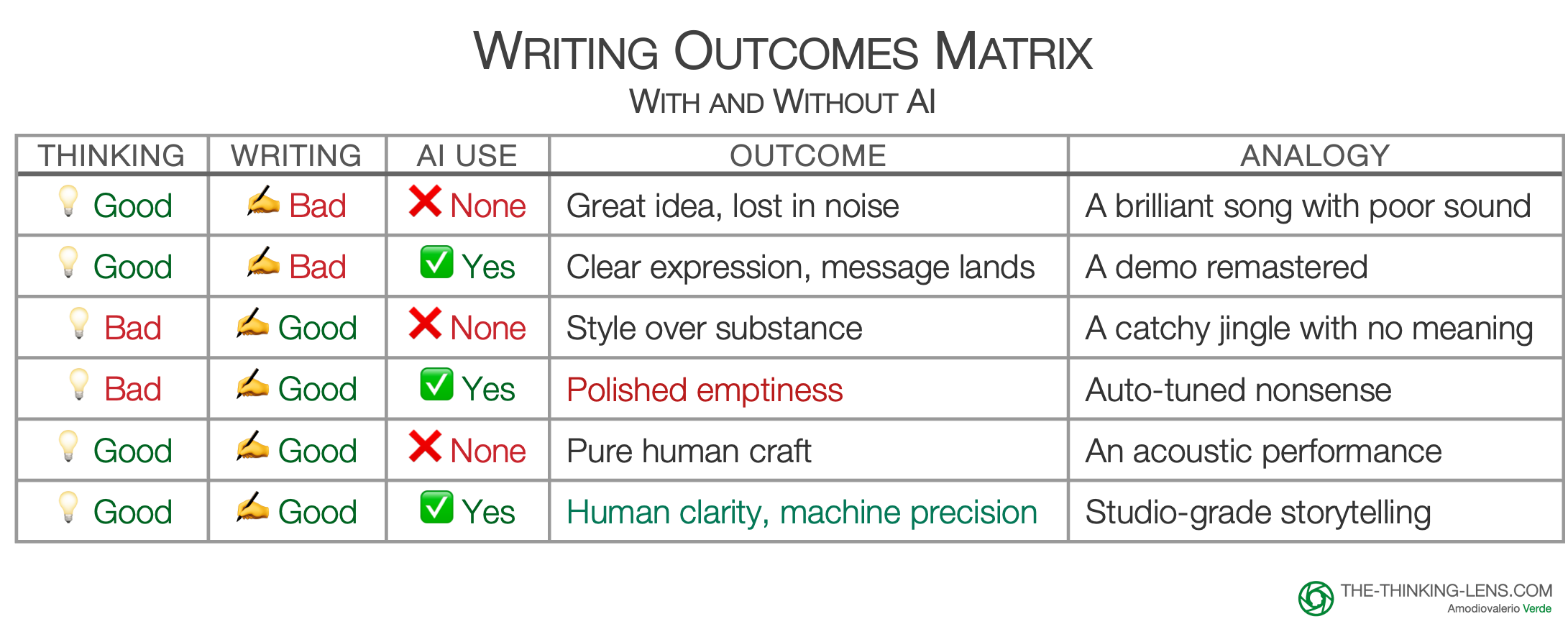
AI can amplify your voice – or replace it. The difference is authorship of thought.
The danger isn’t in the tool. It’s in forgetting who’s holding the instrument.
In product terms: AI is like automation in a delivery pipeline. It doesn’t define the strategy – it just ensures the outcome runs smoother. The thinking still belongs to you.
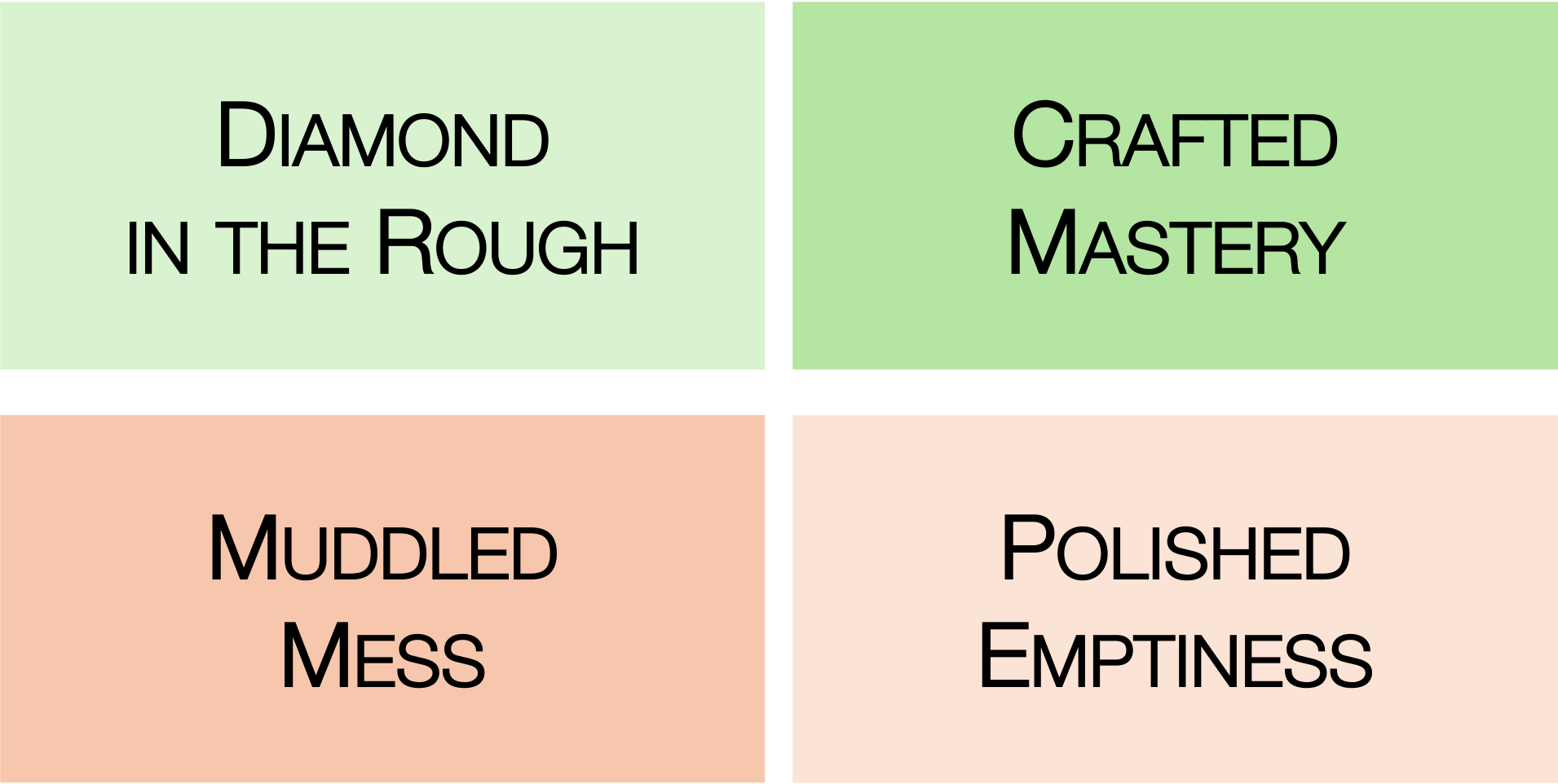
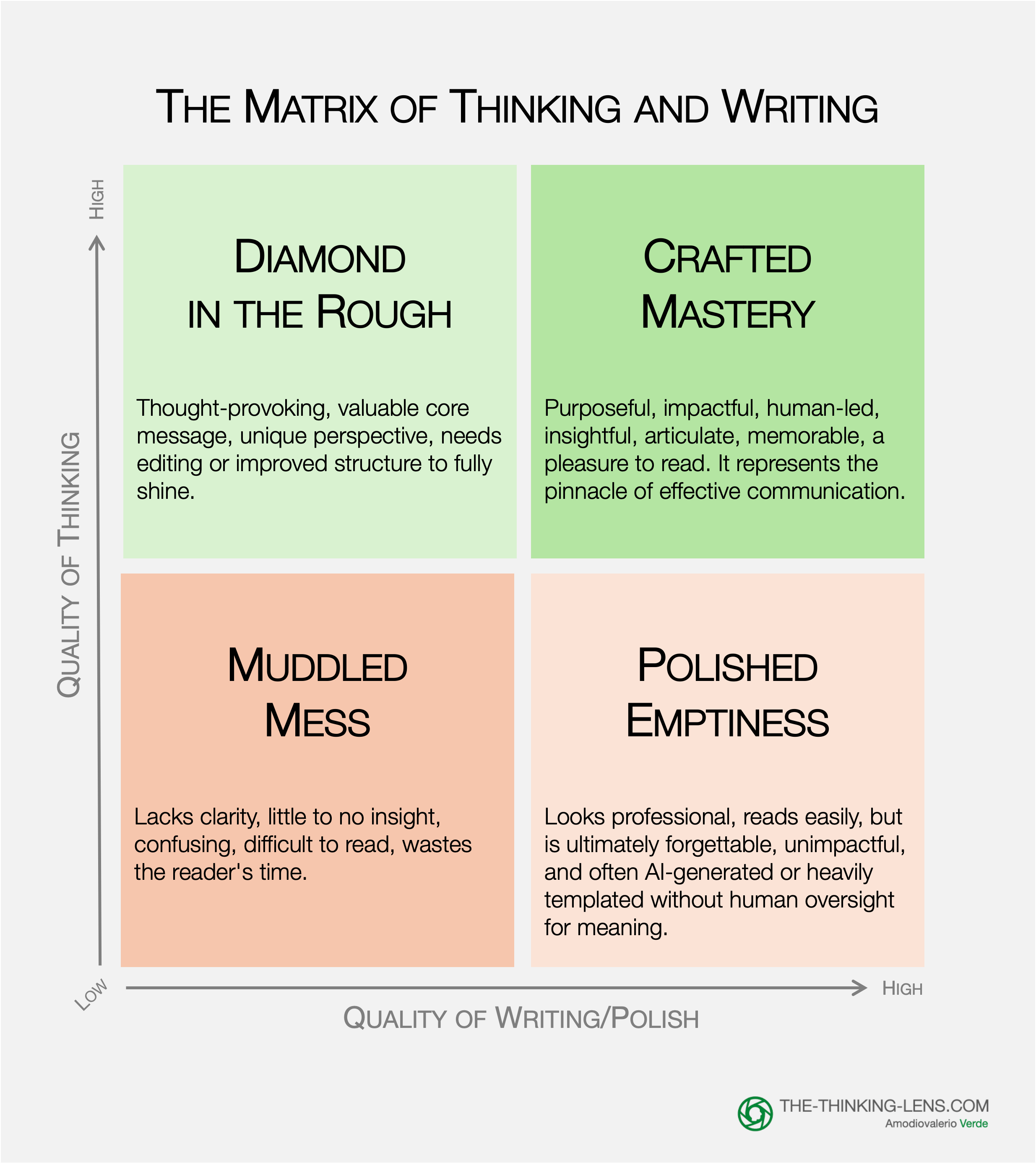
This simple map plots quality of thinking against quality of polish to reveal four states, from Muddled Mess to Crafted Mastery. Use it to self-diagnose your draft and decide the next move.
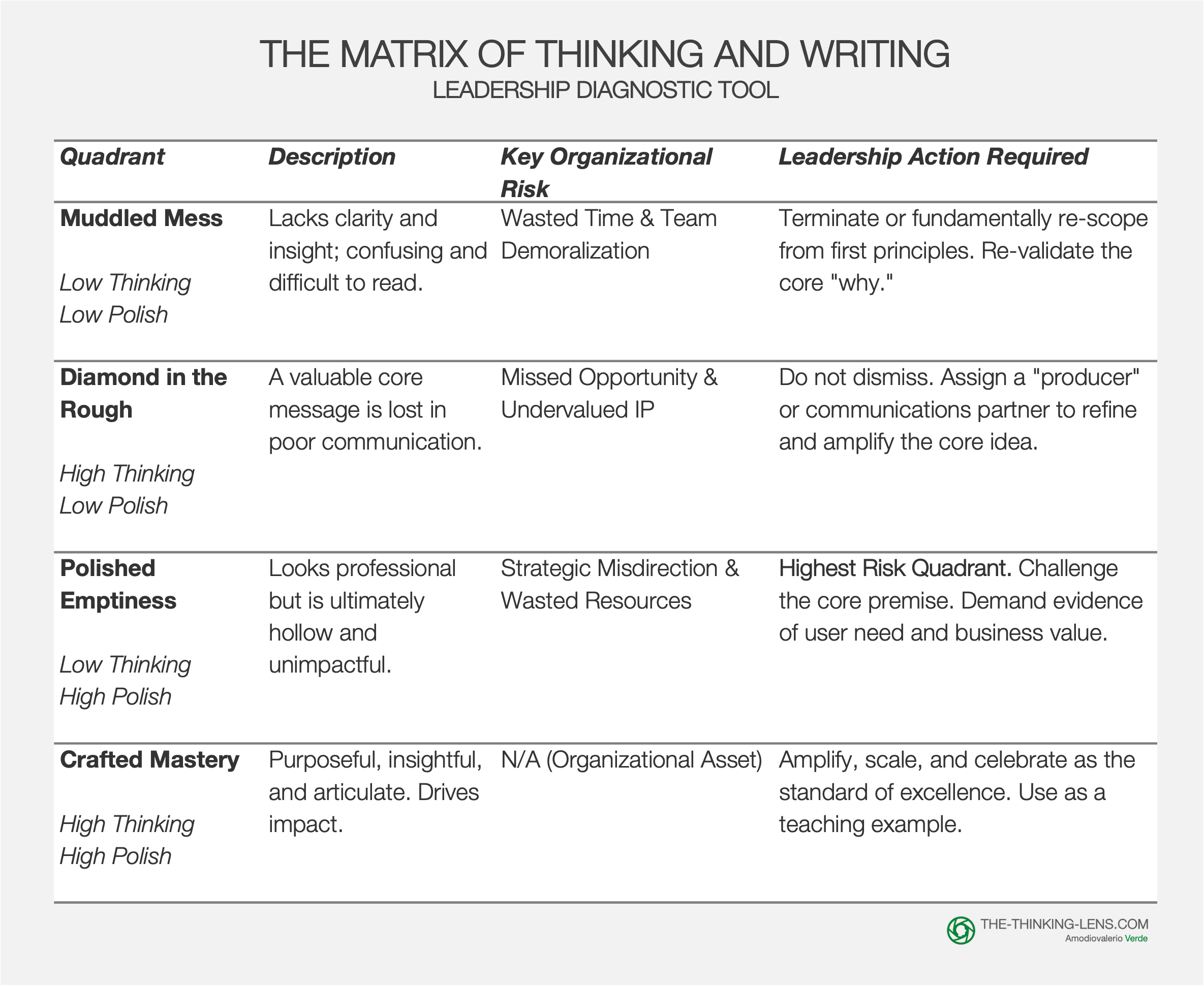
The leadership version applies the same grid at team scale, highlighting the organizational risk in each quadrant and the precise intervention a leader should take.
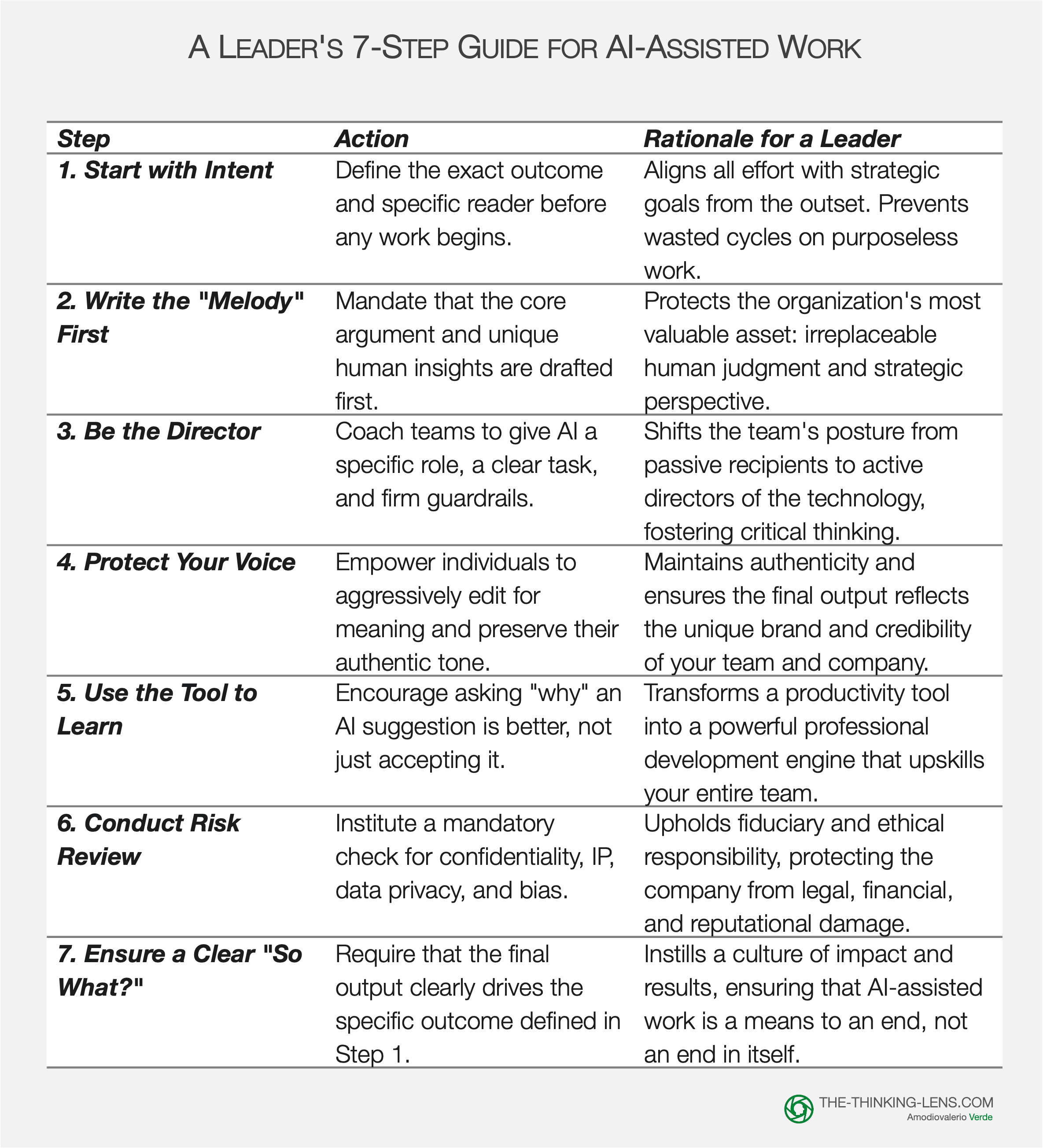
A 7-Step Guide for Leaders
Diagnosing the problem with the "Matrix of Thinking and Writing" is the first step. The next is taking action.
I've developed this 7-step guide for leaders to operationalize these ideas. It's a practical framework to help your teams move beyond "Polished Emptiness" and use AI to amplify thinking, not just polish. It provides clear actions to protect the "melody" and ensure AI serves your strategy – not the other way around.
The Same Pattern in Product and Design
This isn’t just about writing.
The same pattern shows up in product and design – what’s now being called vibe-coding.
Vibe-coding tools let you build sites or apps almost instantly from prompts. Perfect layout, perfect palette, perfect rhythm.
But if the logic, architecture, or user insight behind it isn’t strong, you end up with beautiful emptiness.
It’s the same problem as with writing: focusing on how it looks instead of what it means.
Vibe-coding can replicate the surface – the flow, the motion, the look – but not the intent. It can produce a “vibe,” but it can’t reproduce vision.
In writing, that’s polished nonsense. In product, it’s an elegant dead end.
But the two are deeply connected. 'Polished Emptiness' in a memo, a strategy doc, or a PRD isn't just noise; it’s the symptom of a hollow strategy. It’s the mechanism by which 'beautiful emptiness' gets greenlit.
A team that accepts a well-written but purposeless brief is a team that will build a well-designed but purposeless product.
In enterprise strategy, that's not just an "elegant dead end" – it's millions in wasted resources and a complete failure of leadership.
The pattern is the same:
- Good thinking, bad execution → potential, under-realized.
- Bad thinking, good execution → surface brilliance, hollow inside.
- Good thinking, good execution with AI → leverage – strategy meets craft.
Tools can reproduce patterns, but not purpose.
And that’s the point: whether you’re writing a paragraph or designing a product, AI should never replace the why.
The Shift
We used to call literacy the ability to read and write. Today, literacy means the ability to connect ideas, persuade, and hold attention.
AI isn’t flattening that skill. It’s reintroducing it.
It’s raising the floor of clarity, not lowering the ceiling of creativity.
So when someone says, “That sounds like AI,” they are often just reacting to a lack of typos, a clear structure, or rhetorical forms they don't recognize.
What they’re really saying, without realizing it, is, “That sounds like someone who knows how to write.”
... So when we critique content as merely 'AI-generated,' let's ensure we're targeting a lack of unique perspective or lived insight – the thinking – and not just the absence of typos or the presence of a well-executed structure.
The Takeaway
- Competence isn’t arrogance.
- Polish isn’t artificial.
- And using tools doesn’t make you less human – skipping the thinking step does.
AI isn’t diluting the human voice. It’s reminding us what it sounds like when humans write – and build – well.
PAQs (Probably Asked Questions)
Isn't relying on AI just making writers lazy or creating a crutch?
It absolutely is – for those who don't care about thinking. That's a choice, not an inevitability.
My argument is targeted at those who already see writing as a critical skill.
- For the careless writer, AI will be a crutch that replaces cognition.
- For the intentional writer, it’s a tool to refine expression, like a dictionary or thesaurus.
This article is for the second group. The focus must remain on owning the 'melody' – the core idea.
But won't this lead to homogenous, 'AI-sounding' writing everywhere?
Only if we focus solely on polish and forget perspective.
AI excels at patterns, but judgment, unique experience, and intent are human differentiators.
The risk isn't the tool, but forgetting who holds it.
Are you saying we should embrace AI completely in our writing process?
No. The principle is intentionality.
- Use AI where it amplifies your thinking and expression – for grammar, rhythm, clarity.
- Avoid using it where it replaces the core reasoning or judgment.
It's a tool, not an autopilot.
What's the difference between using AI for refinement and just letting it write for you? Where's the line?
The line is authorship of thought.
- If you provide the core ideas, the structure, the unique perspective, and the strategic intent, and use AI to polish the delivery, you're refining.
- If you give AI a vague prompt and accept the output without deep critical engagement, you're replacing thinking.
If AI is teaching good writing techniques, won't everyone eventually write the same way?
AI might raise the floor for clarity and structure, but it doesn't dictate perspective.
Your unique voice comes from how you think, the connections you make, and your personal judgment. AI can teach the 'how' of rhetoric, but the 'what' and 'why' remain human.
Then your style will depend on your ability to accept or refuse changes, the rhetorical devices you choose (and how often you use them), and your tone of voice.
If you're just accepting all the suggestions, yes, your post will 'look' like all the others. But the thinking might still make the difference.