
The Prioritization Theater
When urgency replaces logic, roadmaps become theater. Frameworks and scores look right, but escalation wins, decisions shift, and PMs broker backlogs. Real prioritization means framing problems, making trade-offs explicit, linking to strategy, and empowering 'not now' with a clear why. Make it real.

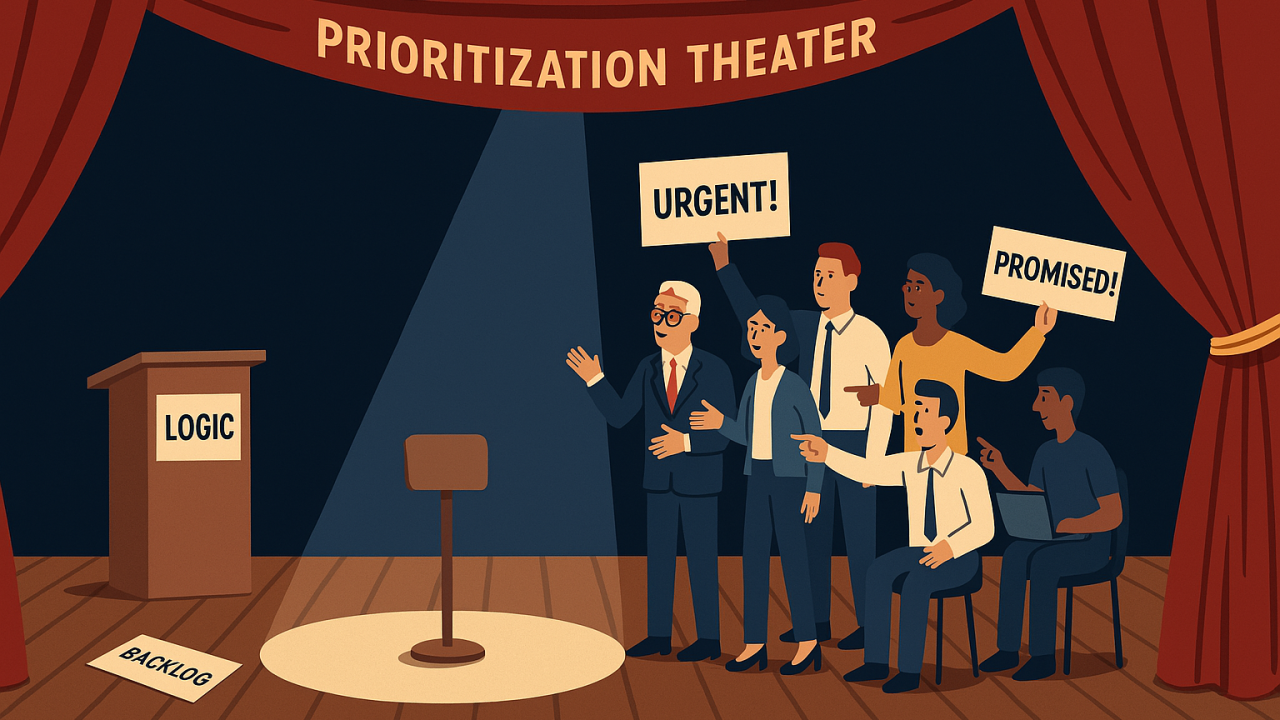
When urgency replaces logic, and decisions become performances.
You’ve got your framework. You’ve got your OKRs. You’ve got your prioritization ritual.
And still — the roadmap changes on a Thursday afternoon. Why?
Because someone escalated. Because a deal is closing. Because “we promised it last quarter.”
This isn’t failure. This is the system doing what it was trained to do: Reward noise. Ignore logic. Perform alignment.
Welcome to Prioritization Theater.
The Show Must Go On
It looks right:
✔ RICE scores
✔ OKR alignment
✔ Planning decks
✔ Rituals that look structured
But under the surface:
- Stakeholders still win by escalation
- Decisions shift weekly
- The team can't explain “Why this, now?”
- Scorecards are reverse-engineered to match what’s already been decided
That’s not prioritization. That’s performance.
The Script Is Familiar
We hear the same lines, quarter after quarter:
“It’s just a quick win.” “The CEO asked for it.” “We committed already.” “We’ll lose the deal.” “It’s already scoped.”
None of these are inherently wrong. But when they become the default argument, your backlog stops reflecting strategy — and starts reflecting pressure.
Why It Happens
Because in most orgs:
- Urgency beats logic
- Escalation is faster than discovery
- Saying “yes” feels easier than defending “no”
- We confuse prioritization tools with prioritization behavior
And when the pressure mounts, even experienced teams slip back into survival mode.
What It Costs
This dysfunction is quiet, but expensive:
- Strategy gets diluted
- Product teams burn out
- Roadmaps become reactive
- Priorities drift — and no one notices until it’s too late
- PMs become backlog brokers, not decision-makers
At scale, it becomes normalized. At some point, we stop asking why things are in the backlog — we just assume there’s a reason.
That’s the problem.
The Fix Isn’t a Framework
You don’t fix this with a better scoring model.
You fix it by changing how the system behaves under pressure.
Here’s what that looks like:
- Frame the problem, not just the solution
- Make trade-offs explicit, not buried
- Connect items to strategy — before you prioritize
- Define what “value” means — as a team, not alone
- Empower PMs to say “not now” — with logic, not ego
Real prioritization is not the art of ranking things. It’s the discipline of saying: this matters more — and here’s why.
Ask Yourself
- Can we explain the top 5 items in our backlog — without looking at a scorecard?
- What trade-offs did we make this quarter? Can we name them?
- Are our priorities stable — or do they shift based on Slack traffic?
- Do our stakeholders trust the process — or work around it?
If the answers feel fuzzy, you're not alone. But that’s also where the redesign starts.
This Is Part of a Bigger Pattern
Most product teams don’t fail because of talent or tooling.
They fail because the thinking system behind the backlog is missing — or misaligned.
This is just one dysfunction. There are more. I’m mapping them out, one by one — to show how product teams can reclaim clarity.