
The “One Prompt” Fallacy: Why Voice, Not Prompts, Wins
Stop chasing magic prompts. The fix is not a template. Define your problem, then train AI on your own writing to build a voice profile. Feed real samples, extract patterns, and revise in your style. Protect your data. Do not copy tone. Engineer sharper thinking, not generic outputs. Your voice wins.

Everyone wants the secret prompt to make AI feel human. Spoiler: it’s not the prompt.
Some are decent jumping-off points. But let’s be honest: most look the same, assume the same context, and follow the same formula. They work, until everyone uses them. Then they don’t.
I never believed in one-size-fits-all approaches. Not in product. Not in life. I’m not about to start now.
The Root Problem: Generate Human-Like Content
“How do I make my AI-generated content feel human?”
Translation: How do I fool people into thinking I didn’t use AI?
Of course, some folks are working on the opposite problem: prompts to detect AI content. Fun.
The Prompt-Template Trap
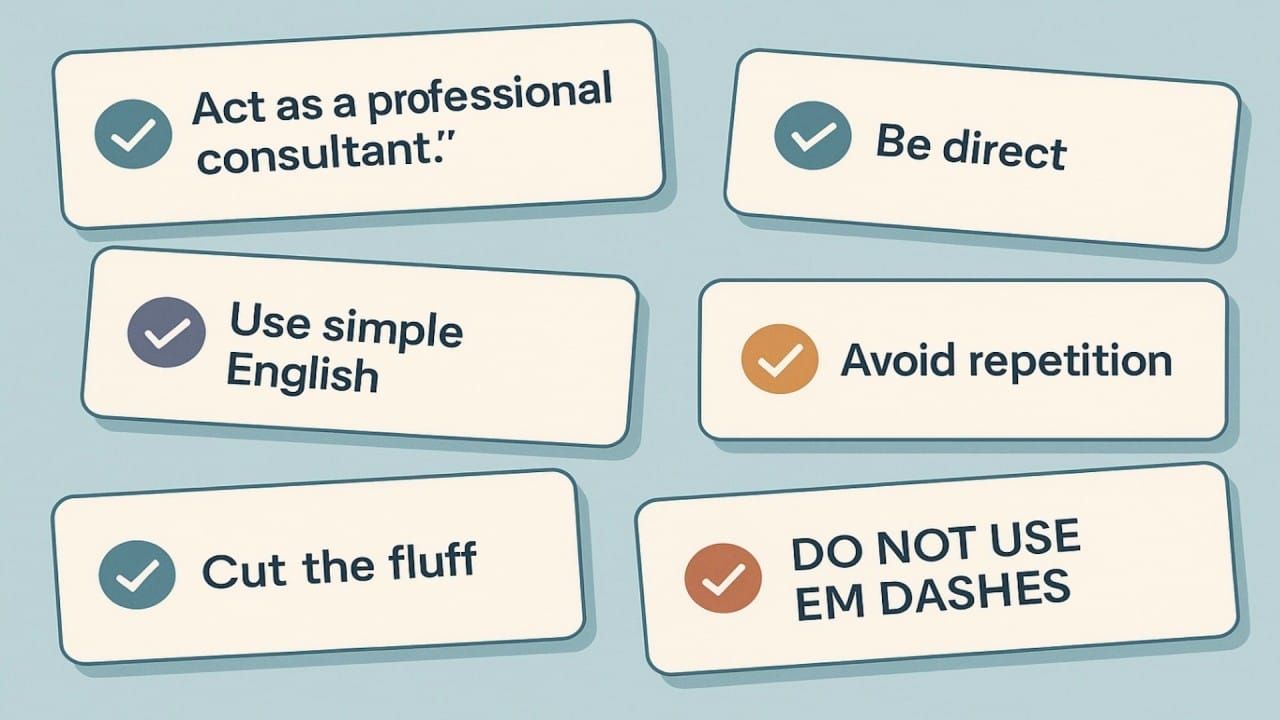
Most prompts follow the same tired pattern:
- “Act as a professional [writer/editor/consultant/critic/whatever].”
- Then comes the laundry list: “Use simple English.” “Be direct.” “Avoid repetition.” “Cut the fluff.”
- And of course: “DO NOT USE EM DASHES.” Prompt paranoia now trumps grammar conventions built over centuries. A grammar rule dies because it 'sounds like AI’? That’s not just irony. That’s a PhD thesis topic.
The result? Legions of AI posts that read like clones:
- Tone: identical
- Insight: wafer-thin
- Confidence: sky-high
- Depth: ankle-deep
That’s Dunning-Kruger in real time: AI hands a megaphone to those least ready to use it. Expect the symptoms to spike.
Here’s the Irony
I’m giving you a prompt too. Call it an anti-prompt.
But I won’t claim it’s the best in the world. You’ll decide that. Use it, and it’ll work. But the outcome will be tailored to your voice.
Still, let’s be honest. Does sharing the prompt solve the problem? No.
AI gives you answers. Some are good. Some aren’t. But it won’t define your problem. That part’s still yours.
So before anything else, define the problem you’re trying to solve. Stop looking for universal, prepackaged solutions.
The Real Fix: Build YOUR Voice Profile
Let’s say your problem is: “I 'occasionally' use GenAI to revise my writing. I want to keep my style and avoid sounding like AI wrote it.”
That’s a real, specific use case.
So the question isn’t: “What prompt should I copy?” Nor: “What does a human-sounding answer look like?”
It’s: “How do I make the AI write like me?”
You train it.
Here’s the method:
- Feed the AI your real writing (emails, posts, docs, the works).
- Ask it to build a voice profile. Describe how you write: tone, structure, vocabulary, habits.
- Use that profile to revise in your style. Prompt with: “Revise this in my voice.”
- Better yet, build a custom GPT. Create your own agent. Welcome to style preservation at scale.
Feeding the AI: What to Use, What to Avoid
The more examples you supply, the richer the profile. Blog posts, articles, speeches, emails, even presentations.
But here’s the catch: if you’re early in your career or haven’t written much yet, the AI won’t have much to learn from. If you’re short on material, don’t chase quantity. Write fresh pieces instead.
Write independently. Don’t wait for perfect tone or phrasing. Just practice. Write messy. Write early. Write with conviction.
There’s nothing more powerful than being able to write without an LLM to revise your writing. Yes, it might have the odd grammar slip or awkward phrasing, but it’ll be you. And that’s exactly what the AI should learn from. Not polished genericism. You.
Bonus: It Teaches You About Your Own Writing
You’ll notice patterns: some helpful, some annoying, some surprising.
And yes, it still needs your brain. Take the output. Review it. Adjust what’s wrong. Keep what’s essential. Drop what doesn’t feel like you. Then you make an output, an outcome.
Because no one wants to sound like AI every day. Some days you’re ironic. Some days you’re not. That’s the point.
⚠️ Final Caution: Your Voice is Personal Data
Be smart about what you share.
My rule: only use public content (blog posts, LinkedIn articles) or sanitized internal documents. Avoid uploading proprietary, internal, or sensitive data. Treat your writing style like any other personal data.
Use This Format to Build Your Own
Ok, I promised a prompt. Here it is:
PROMPT: CREATE A PERSONAL VOICE PROFILE
Objective Analyze my writing and generate a full Voice & Communication Profile that captures how I express ideas across different formats (LinkedIn, internal memos, docs, emails, etc.). Use only the content I provide. Don’t guess or improvise. Extract clear, evidence-based patterns.
Output Format - Voice Profile
1. TONE & ATTITUDE Describe the tone I consistently use when I write or speak. Provide a table of 5–7 traits with a one-line description each. The tone must reflect actual language and delivery style, not personality guesses.
2. STRUCTURE & FLOW Break down how I typically structure ideas. Include how I open, develop, and close. Show both patterns and intent behind them.
3. LANGUAGE & VOCABULARY Detail my word choice, sentence length, tone markers, metaphor usage, recurring concepts, and grammatical habits.
4. FORMATTING & VISUAL STYLE Describe how I format content for clarity, readability, and impact.
5. COMMUNICATION PHILOSOPHY Summarize the mindset that drives my communication style. What do I believe about clarity, leadership, product thinking, and team alignment? Write as bullet points using “You…” to keep it grounded.
Final Instructions
- Base everything on the writing samples I provide.
- Do not infer personality or style beyond the evidence.
- Use precise, professional language; this profile should be ready to share with teams or include in a briefing.
- Return only the voice profile. No summaries or reflections.
If you’ve read this far, congrats. You probably don’t need to copy my anti-prompt. You’ve got the method. Run with it.
Let others chase magic prompts. You’ve got something better: your voice.
Don’t just engineer better prompts. Engineer sharper thinking.