
The Illusion of Progress
Shipping fast isn't progress. Clean backlogs and on-time releases can mask weak impact. When strategy is a slide deck, and success means 'shipped', teams sprint in circles. Progress is learning, behavior change, and clarity. Ask: what are we trying to learn, change, and prove? Then adjust. Not ship.

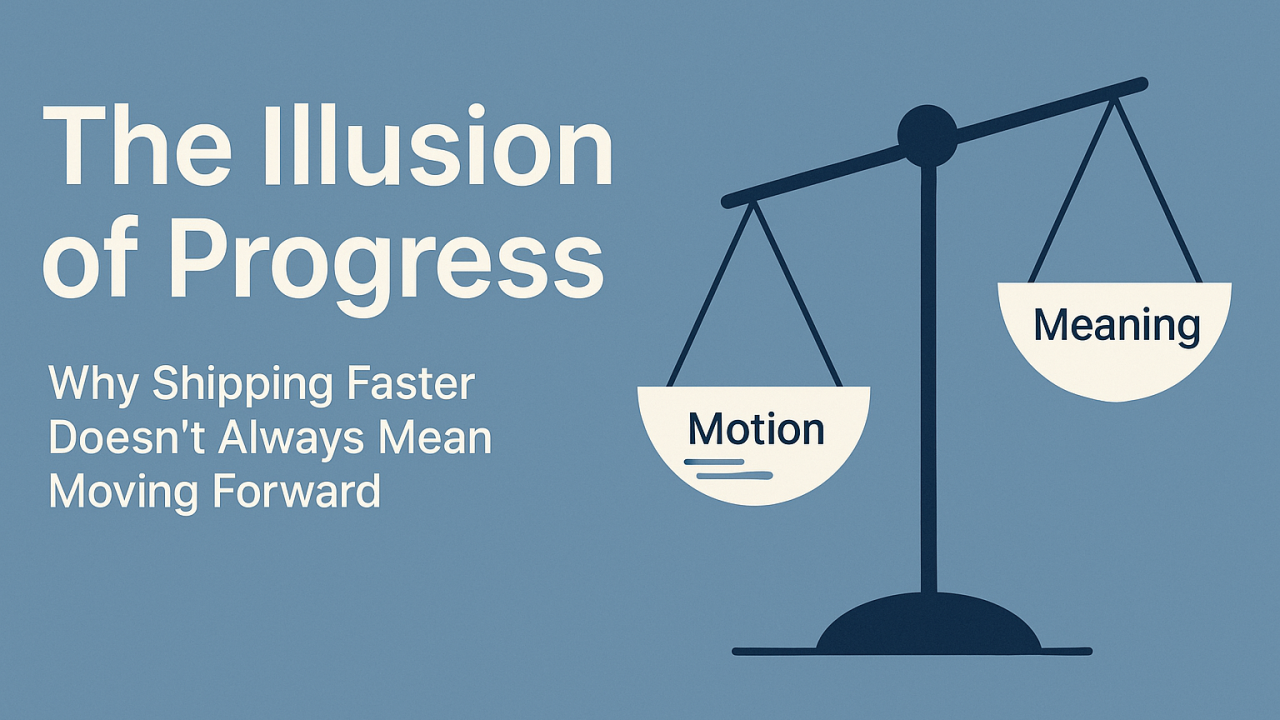
Why Shipping Faster Doesn’t Always Mean Moving Forward
The backlog is clean. Velocity looks good. Features ship on time. And yet — something’s missing.
You’ve seen it.
Deadlines hit, but outcomes unclear. Roadmaps full, customers quiet. Teams busy, business impact blurry.
Welcome to a common trap in modern product orgs: The Illusion of Progress.
We’re Moving Fast. But Where Are We Going?
In many enterprise teams, delivery speed has become the success metric.
- “How many points did we burn?”
- “Did we release that feature?”
- “Are we on track for Q2?”
These are important questions. But they are performance questions, not impact questions. And when they become the only questions, we start mistaking motion for meaning.
Speed is addictive. But speed in the wrong direction? That’s just an efficient way to fall behind.
The Problem Isn’t the Backlog — It’s How We Use It
The backlog should be a tool for coordination — but too often, it becomes a symptom of misalignment. It often becomes a mirror of how disconnected strategy has become from execution.
- Features are framed as tasks, not decisions.
- Discovery insights sit in Notion, Excels, digital whiteboard - disconnected from what gets built.
- “Success” is defined by release, not by outcomes.
We don’t do this because we’re careless. We do it because our systems reward output. They reward done - not learned.
And when strategy becomes a slide deck instead of a system, we end up sprinting in circles.
Symptoms of the Illusion
If you’re living inside the illusion of progress, it usually sounds like this:
- “We shipped it, but no one’s using it.”
- “We’re Agile, but we’re always reacting.”
- “The backlog is full, but we don’t know what matters.”
- “We’re delivering. But are we actually changing anything?”
These aren’t execution failures. They’re signs of a system that confuses delivery with progress. They’re system issues.
And the more we ignore them, the more our teams burn out — sprinting hard, but going nowhere.
From Shipping to Shaping: What Progress Really Looks Like
Real progress is not measured in points, releases, or dashboards.
It’s measured in learning, behavior change, and strategic clarity.
It looks like:
- A backlog that reflects strategic decisions, not noise.
- PBIs framed around problems, not features.
- Discovery that feeds delivery — continuously, not occasionally.
- Metrics that answer “What did we learn?” not just “What did we ship?”
What We Need: A Different Operating Logic
We don’t need another prioritization framework. We need better reasoning.
That’s why more product leaders are shifting from delivery tracking to systems that connect intent → decision → action → learning.
Velocity without clarity is just acceleration toward irrelevance.
✅ Five Executive Questions to Break the Illusion
If you’re leading teams today, start asking different questions:
- What are we trying to learn this sprint?
- What behavior are we hoping to change?
- What assumptions are we testing right now?
- How will we know this made a difference?
- Are we framing work — or just shipping features?
These questions won’t just shift the backlog. They’ll shift the culture.
Final Thought
Progress isn’t how fast you move. It’s how often you realize you’re wrong — and adjust. It’s how deeply your work reflects intent — not just effort.
So if your backlog is busy, but your outcomes are blurry… pause. zoom out. And ask: Are we actually moving forward — or just moving fast?
👉 I’d Love Your Input
Drop a comment or message me — I’d genuinely love to hear what you’re seeing.
Because maybe it’s not a velocity problem. Maybe it’s not a talent gap.
Maybe it’s the illusion we’ve built into the system — where shipping is rewarded, but learning is optional.
And maybe… progress starts when we stop mistaking motion for meaning.