
The Hidden Skill That Unlocks Generative AI
Generative AI’s power is tied to our ability to communicate with clarity; its output reflects the input. I saw this with my 8-year-old daughter: her vague prompt for a unicorn yielded generic results, but a detailed one created what she imagined. AI is a mirror.


Generative AI is reshaping how we work, create, and learn. But its true power doesn't just lie in complex algorithms or vast datasets – it’s deeply tied to a skill we often overlook: the ability to communicate with clarity and precision.
Spot on in highlighting that the effectiveness of generative AI isn't just about the technology itself, but fundamentally about our ability to communicate clearly with it.
GenAI systems – whether it’s ChatGPT, Midjourney, or any other tool – thrive on context and well-defined prompts. These prompts are the seeds. The output, no matter how sophisticated, is always a reflection of the input. As the saying goes, "it’s only as good as the way we ask."
This is why AI literacy is about much more than understanding how the models work. It’s about how we work – how well we can articulate, describe, and frame our needs. It's not just technical; it's deeply human.
A Lesson from My 8-Year-Old
I’ve been exploring this idea in an unexpected setting – with my daughter, who’s nearly 8.
She’s been exposed to AI in a very lateral way. We have Alexa at home, and one day I introduced her to a GenAI image tool. We turned it into a weekly experiment: she describes something she wants to create, and we prompt the AI together. I guide her gently, but the words have to come from her.
In the beginning, it was clumsy. She’d say something like:
A unicorn flying in the sky.
And the result never quite matched what she imagined. Why? Because in her mind, that unicorn and that sky had specific, vivid traits – but they remained unspoken.
Over time, she started refining her prompts:
A pink unicorn that is flying in the sky making colored little farts. The sky is blue, it is sunny, and there are a lot of clouds. Style is like a cartoon or a drawing.
Suddenly, the AI started getting it right – because she was getting better at communicating.
Before:

After:

What’s fascinating is that this clarity carried over into how she spoke to people, too. Her ability to express herself improved. Less ambiguity. More thoughtful phrasing. Better understanding.
And that’s when it hit me: this is what many companies and teams are missing.
The Clarity Gap in Our Organizations
In our work, we often assume we are being clear. But in reality, ambiguity creeps in. Alignment is shallow. Misunderstandings spread. We don’t take the time to frame problems well, articulate goals precisely, or confirm shared understanding.
We use words, but we rarely test how well they land.
In this sense, Generative AI acts like a mirror. It doesn’t just respond to our inputs – it reflects our thinking. If we’re vague, we get vague results. If we’re unclear, the output shows it. And unlike humans, GenAI doesn’t read between the lines unless we teach it how.
That’s why working with AI tools becomes a forcing function for better thinking. It rewards clarity. It pushes us to slow down, break down ideas, and frame them properly. It reveals gaps in our logic or expression that we’ve long ignored.
From Philosophy to Practice
Long before AI, philosopher of language Paul Grice explored the challenges of effective communication. His Cooperative Principle and Maxims of Conversation showed that even between humans, good communication requires shared context, relevance, clarity, and intent.
In today’s AI-powered world, these principles suddenly feel more urgent than ever.
GenAI tools don’t understand intent unless we make it explicit. They don’t read nuance unless we encode it. They respond to what we say, not what we mean.
And maybe, that’s a healthy challenge for us all.
Clarity Is a Journey, Not a Destination
While the ability to articulate our needs with initial precision is paramount, the path to truly effective communication, especially with generative AI, often involves iteration.
Even in human interactions, we rarely achieve perfect understanding on the first try. We ask clarifying questions, rephrase our statements, and adjust our approach based on feedback. Working with GenAI is similar.
For example, prompting a language model:
Write a social media post about our new coffee blend.
The result might be decent, but generic. Iterating:
Write a short, engaging social media post for Instagram about our new single-origin Ethiopian coffee blend. Emphasize its smooth, chocolatey notes and target coffee enthusiasts aged 25–45. Include a call to action to visit our website.
Each iteration sharpens the outcome, and sharpens your thinking.
Balancing Detail with Concise Communication
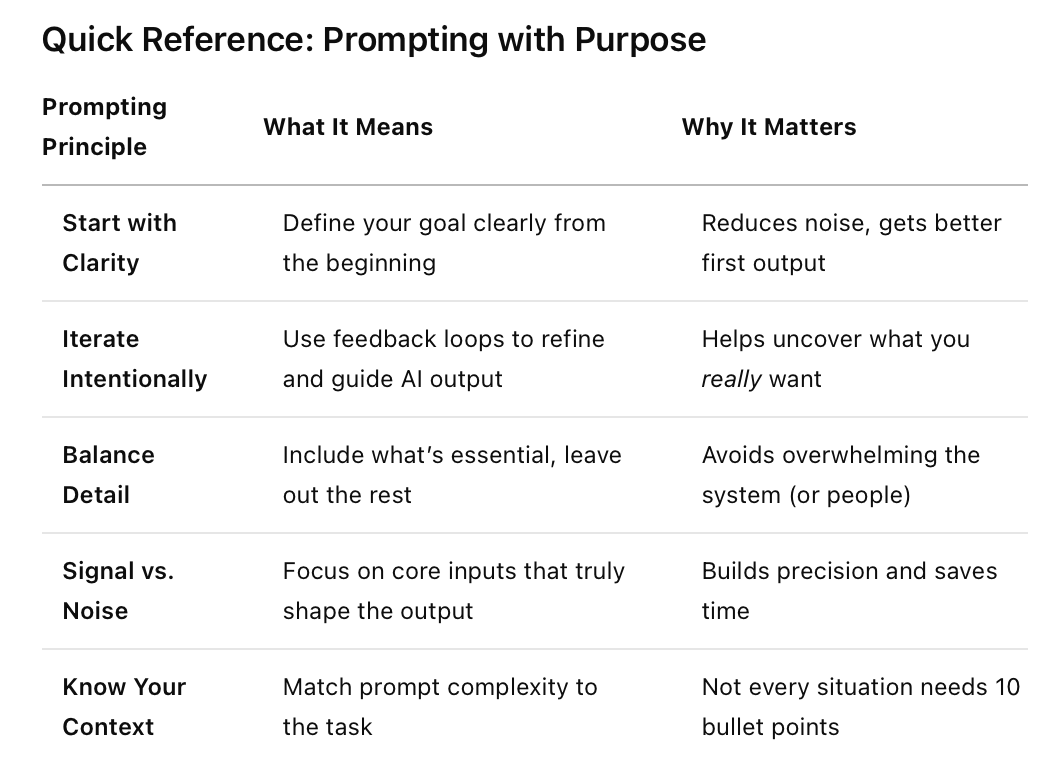
Clarity doesn’t mean overwhelming detail.
Like giving directions, you don’t need to list every tree along the way, just the crucial landmarks.
Similarly, when prompting AI, focus on the key parameters, desired outcomes, and constraints. Avoid overloading with noise. The goal is to strike a balance: enough precision to guide the system, but enough brevity to keep the signal strong.
This signal-to-noise balance is now a core skill in an AI-driven world.
Communication as a Competitive Edge
If there’s one unexpectedly human skill that will define our AI future, it’s this:
The ability to describe with precision what we think, what we want, and what we mean.
This applies to everyone: from product teams writing prompt chains, to leaders aligning stakeholders, to kids bringing their imagination to life. Clear communication is no longer a soft skill. It’s a core capability for the age of intelligent systems.
GenAI is not a silver bullet. It’s a tool. And its power depends entirely on how we use it.
To use it well, we need to become better at a timeless, human skill: the art of clarity.
💬 One Provocative Question:
If a machine struggles to understand your request, how confident are you that your team truly does?