
Harnessing the IKEA Effect for AI-First Products
We love what we build, even when imperfect. That’s the IKEA Effect: effort creates value. In SaaS, let users build: templates, safe drafts, sharing, audit trails, so they feel ownership. Co-create with AI as copilot or constructor. Earn loyalty with portability, not lock-in. Show ownership clearly.


Why We Love What We Build (Even When It’s Imperfect)
In the past 10 years, I’ve moved homes five times. Every time, I said the same thing: “Never again with IKEA furniture.” And yet, I always ended up back in that maze, cart full of boxes, Allen key in hand (or 'brugola' for the Italians).
Why? Because despite the frustration, there’s a strange satisfaction in sitting on something you built yourself. It’s not perfect. But it’s yours. Your effort is in it.
Same with puzzles. As a kid, I remember seeing a giant 10,000-piece world map puzzle framed on the wall of my dentist’s office. I didn’t get it back then. Why go through all that effort just to glue it to a board? Years later, I understood. They built it. That’s what made it worth keeping.
Or LEGO. Taking apart one creation just to reuse the bricks always felt brutal. You weren’t just dismantling plastic. You were undoing something you made, something you cared about. I can see the same pattern with my little one.
Same with mixtapes. Back when music lived on cassette, we spent hours crafting the perfect sequence. It wasn’t just a playlist. It was a message. We gave them to the people we liked most or as a sign of 'crush'. It mattered because it took effort.
We grow attached to what we create because of the time, energy, and emotion we invest in the process. Imperfections don’t reduce the value. In fact, the effort makes it matter more.
So what does this have to do with SaaS? Everything.
That emotional bias, where effort creates value, is known as the IKEA Effect. And if you're building software, especially now with AI in the mix, you need to understand it.
Because users don’t just value what works. They value what they helped build.
The IKEA Effect in SaaS: Why Letting Users Build Drives Loyalty
People value what they help create. That’s the IKEA Effect. First studied by Norton, Mochon, and Ariely in 2011, it explains why users form deeper attachments to things they’ve put effort into building, even if the outcome is imperfect.
In SaaS, this bias shows up every time a user customizes a dashboard, edits a workflow, or writes internal documentation. Their investment changes their relationship with your product.
Why It Matters
When users build inside your product:
- They value it more: It feels like their work, not just your software.
- They stay longer: Leaving means abandoning something they helped create.
- They spend more: Expansion lands when the next module delivers outsized ROI and leverages the user’s existing investment.
- They tolerate more: Minor UX quirks are tolerated if the core workflow is reliable. For critical paths, customisation does not offset the need for rock-solid quality.
- They advocate: People like to share what they’ve built, especially with teammates.
- They stay by choice, not by force: Earn loyalty with effortless data export and clear off-ramps so users know they can leave at any time.
How to Leverage It in Your Product
- Reduce time to first build: Use templates and defaults. Guide users toward their first customization quickly.
- Make ownership visible: Show who built or changed what. Even small signals of authorship increase attachment.
- Make it safe to experiment: Offer draft modes, staging areas, version control. Reduce fear of breakage.
- Promote sharing: Let users share what they’ve built internally and externally. Make it easy to clone and reuse.
Pitfalls & Failure Modes: When Customization Backfires
Leveraging the IKEA Effect is powerful, but it's a double-edged sword. When poorly managed, the same effort that builds loyalty can create resentment and churn. Here are the primary risks to anticipate:
Effort Outweighs Reward
The core principle fails when effort doesn't lead to a satisfying outcome. This happens in two ways:
- Customization Becomes Technical Debt: User-built configurations can degrade over time, creating more problems than they solve.
- Ownership Feels Like Lock-In: There is a fine line between product stickiness and user entrapment. If people feel trapped by their own complex configurations, they will resent the product even if they stay. Offering clear data portability and APIs is the antidote.
Not Everyone Wants to Build
Forcing customization on all users is a mistake. Many users prefer a turnkey solution that works perfectly out of the box. Your product should serve both "builders" and "consumers" by offering guided flows alongside blank slates.
Measuring the Impact
Track:
- Average depth of customization per account
- Retention difference between builders and consumers
- Expansion revenue tied to customization
- Support tickets triggered by broken configurations
The IKEA Effect is not just theory. It’s measurable and monetizable.
The IKEA Effect Meets AI
Generative AI changes the landscape. It lowers the cost of effort and blurs authorship. That creates new risks for the IKEA Effect, but also new opportunities.
Three AI Patterns
- Autopilot: AI builds everything. Users just click “go.” The output feels generic. Engagement is low.
- Copilot: AI drafts, users refine. Ownership stays intact. Users stay in control.
- Constructor: AI provides components. Users assemble the solution. Highest ownership, strongest attachment.
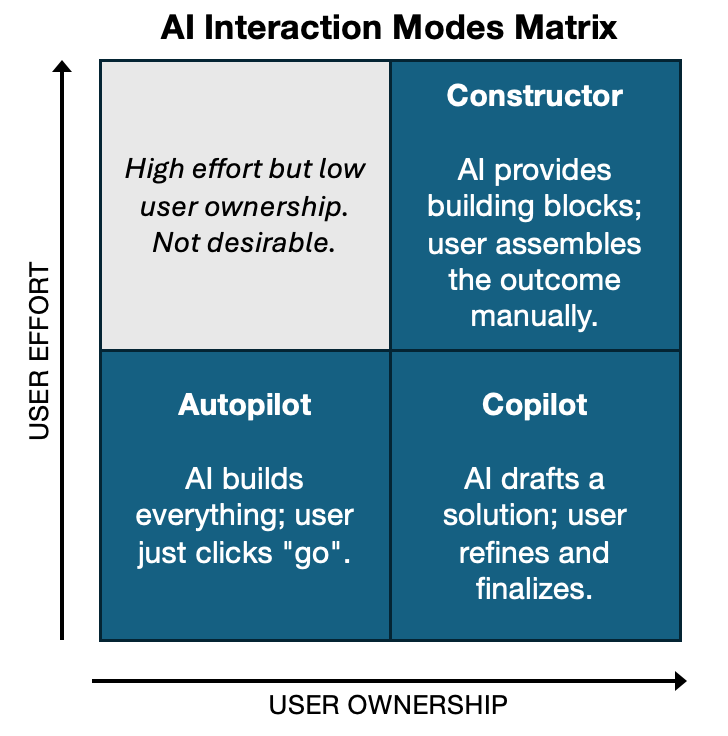
Tool vs. Platform is the real fork in the road. Copilot behaves like a smart tool: it layers intelligence onto a fixed workflow and speeds users up. Constructor turns your product into a platform where people assemble components, extend logic, and feel genuine ownership.
The IKEA Effect survives in AI workflows when users remain in the loop. Co-creation matters. Fast output is not enough.
If you're adding AI to a product used in regulated markets (finance, health, Europe), here’s what needs to be built in:
- Prompt transparency: Users must see and control what is logged. Only with explicit consent and in line with EU AI Act.
- Model usage logging: Track what models are used and when.
- Tenant isolation: AI-generated content must respect access controls and data residency.
- Explainability: Black-box behavior is untenable in regulated workflows.
- Revocability: Users need the ability to undo, audit, or delete AI-generated content including retention-period controls.
How to Design AI to Reinforce Ownership
- Treat prompting as work: Let users save, edit, and share their prompts. Prompts are intellectual assets.
- Insert checkpoints: Require reviews before applying AI changes. Confirmation builds ownership.
- Expose the logic: Show how the AI got to its result. Transparency builds trust.
- Seed and tweak: Start with a draft, but make users complete it. The final edits are where attachment forms.
- Keep an audit trail: Log user and AI actions together. "You + AI built this" makes the process a brag-worthy artifact.
AI Risks to Watch
- Ownership dilution: If results feel prefab, users won’t care. Emphasize their contribution.
- Skill atrophy: If users rely too much on AI, they disengage. Design teachable moments into the flow.
- Homogenized output: AI can flatten user expression. Offer ways to customize tone and style.
- Lack of trust: Black-box outputs create frustration. Show the reasoning and let users preview.
- Compliance and data leakage: Ensure your AI tooling respects data boundaries. Prompt logs, model transparency, and tenant isolation are not optional.
The IKEA Effect Varies by SaaS Segment
This bias doesn’t work the same in every product. You need to design differently based on whether you're serving consumers, businesses, or enterprises.
B2C SaaS
Users are both buyers and builders. They want emotional ownership. The feedback loop is fast. The moment they create something, they feel invested.
What works:
- Lightweight customization
- Instant results
- Personal attribution and sharing
What to avoid:
- High setup friction
- Blank slates without guidance
B2B SaaS
The builder is often not the buyer. Builders care about utility and productivity. Their effort builds internal credibility, not personal expression.
What works:
- Smart defaults and templates
- Internal discoverability
- Tools to showcase and share configurations
What to avoid:
- Poor onboarding for builders
- Complexity without safeguards
Enterprise SaaS
Admins, not users, do most of the building. Customization is expected. It’s part of the sales process. The stakes are high and the tolerance for breakage is low.
What works:
- Governance, permissioning, rollback
- Version history and audit logs
- Configuration safety and control
What to avoid:
- Fragile configurations
- Lack of transparency in AI or automation
- Shallow admin tooling
In enterprise SaaS, the builder is often a delegated admin acting on behalf of legal, security, and operations. Their customization work isn’t just personal investment. It’s institutional accountability. That means your product must support compliance exports, auditability, and formal change management out of the box.
Long-Term Product Risks
The IKEA Effect is powerful, but it cuts both ways. If you don’t manage the complexity, you’ll create friction instead of loyalty.
Not all products benefit from user customization. In workflows where speed, standardization, or compliance matter more than ownership, low-effort, out-of-the-box value is the differentiator.
- Content sprawl: Too many pages, fields, or flows lead to clutter. Clean up needs to be part of the experience.
- Performance degradation: Over-customized products become harder to use and support. Atlassian and Microsoft have both highlighted this.
- Admin overhead: More customization means more support. Treat admin headcount as a cost of product flexibility.
- Regulatory exposure: AI-generated configurations, especially in Europe, fall under new laws. Compliance must be visible in the UI, not buried in legal docs.
What to Do
- Design for the full lifecycle, not just setup.
- Allocate budget for admin roles and platform support.
- Build in cleanup prompts, usage analytics, and archiving rules.
- Make compliance visible and actionable.
- Give builders bragging rights that survive entropy.
Effort can build loyalty or backfire as tech debt. You choose.
Final Thought
Think of AI in SaaS like an exoskeleton, not an escalator.
The exoskeleton amplifies human capability. The user still moves, still controls, still creates. The result feels personal.
The escalator moves the user without effort. And when it stops working, they step off without hesitation.
Keep people in the loop. Help them build. Give them credit. Ownership is the best retention strategy you have.
Done well, the IKEA Effect turns effort into pride and customization into revenue. Done poorly, it becomes overhead, lock-in resentment, and churn.
Your Turn
- What product has made you feel a sense of ownership because you invested effort in customizing it?
- As you integrate AI, are you designing experiences that feel more like Autopilots, Copilots, or Constructors? What trade-offs are you making?
- When have you seen the IKEA Effect backfire, where user customization created more frustration than loyalty?
Further reading:
- Michael Norton, Daniel Mochon, and Dan Ariely. "The IKEA Effect: When Labor Leads to Love." Journal of Consumer Psychology 22, no. 3 (July 2012): 453–460.
- Narragon (2024) “Advancements in Atlassian Cloud and Data Center to Accelerate the Modern Enterprise.” Work Life by Atlassian (blog) https://www.atlassian.com/blog/enterprise/advancements-in-atlassian-cloud-and-data-center
- European Union. (2024) Regulation (EU) 2024/1689 - Artificial Intelligence Act. https://eur-lex.europa.eu/eli/reg/2024/1689/oj/eng
- Daniel Ariely (2012) - What makes us feel good about our work? (TED Talk) https://www.ted.com/talks/dan_ariely_what_makes_us_feel_good_about_our_work
- Nir Eyal - Hooked: How to Build Habit-Forming Products. (2014)