
From “Content Is King” to “Judgment Is the Crown”: Rethinking Authority in the AI Era
Content isn't king anymore. AI makes endless "good" content; trust and judgment are scarce. Your lived experience, context, and perspective are the differentiator. Use AI as leverage, not a crutch. Earn attention by solving sharp problems for real people and building credibility. Own your voice. Go.

TL;DR (for the skimmers)
- It’s time we retire the phrase “Content is King”.
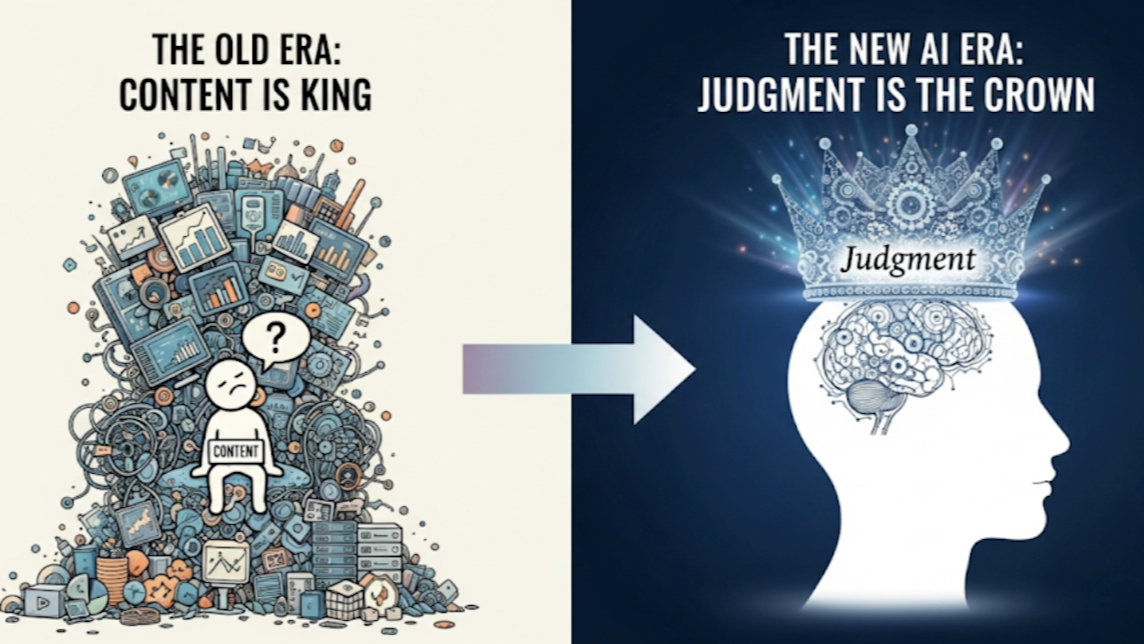
- Content still matters. But in the AI era, it’s no longer king and has become the battlefield. The crown has moved to judgment.
- AI can produce endless “good content.” But it can’t fake scars, context, or judgment.
- The differentiator now is you: your lived experience, perspective, and credibility.
- If your last 3 posts could have been written by anyone’s AI, you’ve got work to do.
- Using AI isn’t cheating. It’s leverage, if you do it properly.
I recently saw a post that once again declared, “Content is King”.
For years, people have debated this mantra, some demoting content to “queen”. But with AI now flooding our feeds with flawless, endless text, I couldn’t shake one question:
"With AI reshaping everything, can we finally retire the 'Content is King' mantra and define what really rules today?"
This very article is my answer to that question.
It didn’t start with a need to create more "content". It started with the critical thought process behind it: Is the message clear? Is it insightful? Is it truly valuable? Because in the new AI era, the final "content" (whether it's this article, a keynote, or a strategic memo) is merely the artifact; the real work lies in the judgment that precedes it.
Let’s be clear: content still matters deeply. But its role has shifted, from being the scarce resource to being the proof of your credibility and judgment.
That question led me back to the source: Bill Gates’s 1996 essay.
The End of a 30-Year Mantra
In 1996, Bill Gates wrote an essay titled "Content is king" with the now-famous line:
“Content is where I expect much of the real money will be made on the Internet, just as it was in broadcasting.”
At the time, he was right. Distribution was the bottleneck. Publishing content online was revolutionary. Suddenly, anyone with a PC and a modem could create and share with the world. Content was scarce. Attention was plentiful.
That was then. Here’s now.
Content is no longer scarce
Back then, content creation required significant resources. Today, AI can generate articles, videos, code, music, and images instantly and at near-zero cost. Scarcity created value; abundance erodes it.
Much content has become commoditized. What’s scarce now is not the ability to publish, but the ability to publish something people trust and remember. This shift from content scarcity to trust scarcity is mirrored by a similar change in how that content reaches an audience.
Distribution is no longer the bottleneck
The original argument for "Content is King" assumed that distribution was the primary challenge. Today, platforms like YouTube, TikTok, and Substack offer potential global reach to anyone. But this democratization of distribution doesn't mean visibility is guaranteed.
It has created the opposite problem: with infinite content available, the true bottleneck is no longer posting, but being chosen.
Human attention is now the most valuable and scarce commodity in the digital economy. The platforms that win are those that master capturing and retaining this focus, not necessarily those that host the most content.
The monetization model has shifted
The original essay focused on subscriptions and small micropayments. That never took off at scale. Instead, the dominant models are:
- Advertising tied to data and targeting.
- Freemium content (free access, upsells later).
- Platforms that own the user relationship, not the content producers.
AI pushes this even further, as synthetic content is cheap and endless.
Value has moved from “content” to “ecosystem and trust”
In an AI-saturated world, value is not in the content itself but in:
- Curation (helping people find what matters).
- Personalization (tailoring content to a user’s context).
- Community (networks where people engage, not just consume).
- Trust and brand (people prefer verified sources over endless AI noise).
AI lowers the barrier but raises the bar
Anyone can generate content with AI, so competition explodes. But audiences demand higher quality, deeper insights, or unique authenticity. Simply publishing more content doesn’t mean making more money anymore.
AI has flipped the equation. Content is now abundant and cheap. Distribution is frictionless. The scarce resource is attention, and more importantly, trust.
Judgment: The Amplifier for Your Signal
In this new era, it’s crucial to understand the two parts of impactful communication. On its own, each is limited.
- Content is the signal. It’s the medium that carries your message, attracts attention, and appears in people’s feeds. AI can generate endless signals. A strong signal that lacks amplification, however, will get lost in the noise.
- Judgment is the amplifier. It provides the context, credibility, and clarity that cut through the noise. But an amplifier with no signal has nothing to broadcast.
Together, they create impact. While AI can accelerate the creation of signals, making content generation cheaper and faster, the true value (the amplifier) comes from the elements it cannot replicate. These are the human attributes that build trust, which remains priceless.
This amplifier is built from:
- Lived experience: This isn't about seniority; it's about authenticity. It’s the scars from a project that went wrong, the lessons from a recent customer interaction, and the unique insights you carry from your specific journey. AI can't replicate this genuine human perspective.
- Contextual judgment: This is more than just general knowledge; it's the domain expertise to understand what is truly important in your field right now. It's the ability to spot unmet needs that AI overlooks and distinguish a forgettable, generic problem from a sharp, painful one that stops the scroll. This judgment allows you to answer the most critical question: "Why does this matter to them right now?" , ensuring your message resonates with a real audience's urgency and frustrations.
- Perspective: This is your unique way of seeing the world that is different from anyone else's. It’s your taste, your contrarian takes, and the unique value proposition you bring that no model can fake. Without a distinct perspective, your voice dissolves into forgettable "background noise". This unique viewpoint is your anchor in the AI storm, the foundation for building long-term authority rather than chasing fleeting approval.
Content is no longer the differentiator; you are. The content you produce is merely the artifact, the proof that you have something valuable to say. The moat is still trust, and only you can amplify your signal with the irreplaceable power of your experience, perspective, and judgment.
Why “Good Enough” Isn’t Enough Anymore
Think, for example, about your LinkedIn feed. You scroll through endless posts that are correct, polished, and utterly forgettable. This is the content equivalent of instant coffee.
It’s like every café suddenly decided to serve the exact same medium-roast coffee. It’s drinkable. You might even finish the cup. But you’ll forget it the second you walk out the door because it has no distinct flavor. When "good enough" becomes the standard, your voice doesn't just get quiet. It dissolves into the background noise.
That’s not a strategy. That’s a race to the middle.
The challenge isn’t publishing more content. It’s creating content that earns attention.
The question has shifted: Not “Can you publish?” but “Why should anyone listen?”
Three Ways to Stay Ahead of the Noise
1. Know a Real Audience, Not Just a Persona
AI can generate personas all day. But it can’t feel. It can’t sit in a PM’s shoes at 10 p.m., staring at a regulator’s email hours before a release.
Your real edge is empathy. Knowing real people. Their frustrations. Their urgency. If you can answer, “Why does this matter to them right now?” you’re already ahead of 90% of the AI noise.
2. Solve a Sharp, Painful Problem
AI is great at summarizing what we already know. It’s terrible at spotting unmet needs.
- Generic: “Product managers need to communicate better.” Valid. But forgettable.
- Sharp: “Busy fintech PMs need a way to detect regulatory risks early before they explode into million-euro fines.”
One is over-broad. The other is narrow.
One is noise. The other stops the scroll.
3. Build a Value Proposition on Human Trust
In a world of synthetic voices, your scars are your moat. Your contrarian takes. Your taste. Your lived experience.
These can’t be prompted.
The question to ask: Why me? What do I bring that no model can fake?
The Trap of Chasing Reach
Chasing algorithmic trends is a losing game. It turns your thought leadership into a weather vane, spinning frantically in whatever direction the wind blows today. You become a DJ playing a generic top-40 playlist, hoping someone, somewhere, will nod along.
That’s the shortcut to invisibility. You’re chasing approval, not building authority.
Long-term reach doesn’t come from tricks. It comes from consistency, patience, and a clear why.
Simon Sinek would call it your reason for showing up. I call it your anchor in the storm in the AI era.
The best way to test if that anchor is holding firm is to look at the evidence.
The Challenge
Look at your last three posts. Could they have been written by anyone’s AI?
If yes, you’ve got an opportunity to bring more of yourself into the conversation.
Because in the AI era, the content we create isn’t king. It’s the artifact of the brain behind it.
And let’s be clear: Using AI isn’t “cheating.” It’s no different from using a translator, a calculator, or a spell‑checker.
If the thinking is yours and if you know your audience and your why, then using LLMs to format, refine, or test alternative framings isn’t a weakness. It’s leverage.
Because the content is only as strong as the thinking behind it, not the tool that produced it.
A Note for Organizations
This shift from chasing volume to cultivating authority doesn't just apply to individuals building a personal brand. In fact, the stakes are even higher for businesses. The corporate ‘brain’ is the company’s collective memory, the repository of hard-won lessons, failed experiments, and unique customer insights. It’s the ship’s logbook, filled with the scars of past voyages.
But in most companies, that knowledge is scattered across siloed slide decks, forgotten wiki pages, and the minds of employees who eventually leave. If a company's brain is just a collection of disconnected artifacts, it’s not a brain. It’s a junk drawer. Content that doesn't draw from this deep, institutional judgment feels hollow. It’s just words, representing the company in name but not in wisdom.
Therefore, the strategic imperative for businesses is not just to produce more content, but to build systems that capture this institutional judgment and empower their internal experts to translate that collective wisdom into public-facing authority.
Takeaway
If you want your voice to matter in the age of AI:
- Lead with lived experience.
- Focus on sharp, real problems your audience faces today.
- Build trust consistently.
- Don’t fear using AI as a tool, as long as the voice, judgment, and purpose are yours.
Because content is the artifact. And trust is the moat.
Platform tactics matter (headlines, formats, posting cadence, …) but they only amplify what’s already there. Without substance, tactics are an echo. With real insight, tactics turn good ideas into impact.
If you want to build trust for the long term, you cannot chase fleeting performance metrics at the expense of consistency. Your anchor is not the algorithm; it is the value and credibility of your thinking. The signal is only as strong as the brain that conceived it.
Closing the Loop with Gates
Nearly 30 years ago, Bill Gates said: “Content is king.” He wasn’t wrong. In 1996, content was the scarce asset.
But in 2025, the crown has moved. Content is no longer the throne, it’s the battlefield.
In the past, content was the scarce resource that defined who thrived online. Today, content is abundant. AI can generate endless articles, videos, code, and ideas at near-zero cost. The real scarcity now is attention, trust, and judgment.
The winners will not be those who publish the most content but those who earn credibility through lived experience, context, and perspective. Platforms may distribute content instantly and globally, but only voices that demonstrate authenticity and insight will cut through the noise.
In the AI era, content is no longer the product. It is the artifact of the person behind it. The differentiator is not volume but the trust, judgment, and perspective you bring to the table.
AI can flood the world with words. But only you can make them mean something.
💬 Your Turn: What’s your sharpest way to make your signal heard above the AI noise?
Probably Asked Questions (PAQs)
Not everything fits neatly into one article. These are questions I expect might come up after reading this piece, and my quick takes on them.
This article claims "Content is king' is dead." Is content truly irrelevant now in the AI era?
Not at all. The article clarifies that "content is no longer scarce" and "is now a commodity" , meaning its scarcity-driven value is dead. Content is still the "signal" that carries your message. The crucial shift is that content alone isn't sufficient; it needs to be amplified by human judgment, lived experience, and trust to genuinely cut through the noise and earn attention.
If "judgment is the crown," how do new creators, or those without decades of experience, build the "scars" and "lived experience" AI can't replicate?
"Lived experience" isn't solely about decades of work. It's about your unique perspective, the specific problems you've genuinely faced or deeply understand, and the lessons you've learned, even from recent projects or particular challenges. The article advises focusing on "sharp, painful problems" that you genuinely connect with and can offer a distinct insight into, rather than generic topics. Authenticity, empathy for your audience's frustrations, and urgency are key.
The article says AI can generate "good content." How can I ensure my content doesn't just blend in with everyone else's AI-generated output?
The core advice is to avoid creating content that "could have been written by anyone’s AI". To differentiate, you must infuse your content with your unique "contextual judgment," "perspective," and insights that come from your personal understanding of your field. Focus on solving "sharp, painful problems" that AI might miss, and "build a value proposition on human trust" that highlights what you uniquely bring to the table.
The article emphasizes that "Attention, not content, is the scarce resource." How can I possibly capture attention when there's an infinite amount of content available?
Capturing attention now requires more than just publishing. It demands content that earns attention by being unique, insightful, and trustworthy. This means "Know a Real Audience" and their urgent needs, not just a persona. It also involves solving "Sharp, Painful Problem[s]" that resonate deeply, and consistently building "human trust". Your "judgment is the amplifier" that helps your "signal" (content) cut through the noise.
Does this mean I shouldn't aim for broad reach with my content anymore? Isn't reach still important?
The article warns against "The Trap of Chasing Reach" by constantly shifting topics, tone, or audience for short-term performance. It clarifies that "Reach doesn’t come from tricks" but from "consistency, patience, and a clear why". The focus shifts from merely getting your content seen by as many people as possible to deeply resonating with the right audience by building trust and demonstrating unique value.
How do I consistently build trust, as suggested in the takeaway?
Building trust consistently involves leading with your "lived experience" , focusing on "sharp, real problems" your audience faces today , and allowing your authentic "voice, judgment, and purpose" to shine through your content. It means being dependable, offering genuine insights, and demonstrating that you understand your audience's struggles and can provide valuable perspectives that AI cannot fake.