
Beyond the Dashboard | Principle 4: Use Frameworks as Filters, not Blueprints
Frameworks focus attention but don’t decide. Used well, they clarify; used poorly, they paralyze. AI multiplies the noise with context-free models. Leadership must choose one lens per decision, declare boundaries, and decide. Tools assist. Judgment creates clarity. Choose focus over complexity now.


TL;DR (For Leaders Scanning Before Their Next Meeting)
- Frameworks don’t make decisions. They focus attention.
- Used well, they sharpen clarity. Used poorly, they paralyze teams.
- AI doesn’t solve the problem. It multiplies it, generating frameworks without judgment or context.
- Leadership isn’t about choosing the cleverest model. It’s about enforcing discipline.
- One decision. One primary framework. To enforce clarity, start with one primary framework per decision. The goal is to choose a single, dominant lens for any given problem.
- Stacking models creates noise. Choosing the right lens for the right problem creates clarity.
- Frameworks are useful. Leadership is mandatory.
Why Teams Love Frameworks (And Why That’s Dangerous)
Frameworks feel safe. And that’s the problem.
They offer structure, shared vocabulary, and the comforting illusion that someone, somewhere, solved the thinking already.
In theory, frameworks simplify decision-making. In practice? They often replace it.
I’ve seen teams burn weeks arguing whether something counts as a Key Result, a North Star Metric, or an Objective needing KPIs.
The language consumes the judgment. Instead of deciding, teams debate definitions.
Instead of focusing, they stack frameworks: OKRs layered over AARRR metrics, mixed with JTBD, topped with HEART for UX. Like a frameworks lasagna. (Spoiler: nobody's hungry for that.)
Result? Pride in process. Paralysis in progress.
This isn’t strategy. It’s Framework Theater, where teams feel productive, but aren’t.
And unless leadership intervenes? Complexity wins.
The Recipe Analogy: Why Frameworks Aren’t Cooking Instructions
A framework is like a recipe. It suggests steps, assumes ingredients, and assumes you know who you’re cooking for.
Would you serve lasagna to someone who’s lactose-intolerant? Hopefully not.
Yet that’s exactly what your teams do every time they apply a startup traction framework to an enterprise platform or a SaaS growth loop to an enterprise sales cycle.
Frameworks assume stable context. Your context shifts. And frameworks don’t notice.
Used without judgment, frameworks fail silently. You won’t realize you’re serving the wrong meal, until nobody’s eating.
The AI Problem: From Stuck to Flooded
Before AI, Framework Theater took months. Endless diagrams. Endless meetings. Endless coffee.
Now? AI does it in minutes. Ask your AI tool for a framework suggestion. It’ll list ten. Ask for guidance. Ten more. Ask for clarity? It’ll shrug and say: “It depends.”
Current AI tools excel at listing frameworks, but they cannot understand your unique context or choose for you. That selection remains a judgment task. For now, AI floods where a leader must filter.
What AI removes is friction, the kind that used to slow your team before it stacked five frameworks together like a bad Jenga tower.
Without leadership discipline, AI doesn’t solve Framework Theater. It accelerates it.
More options. Less clarity. More models. Fewer decisions.
Frameworks as Filters, Not Blueprints
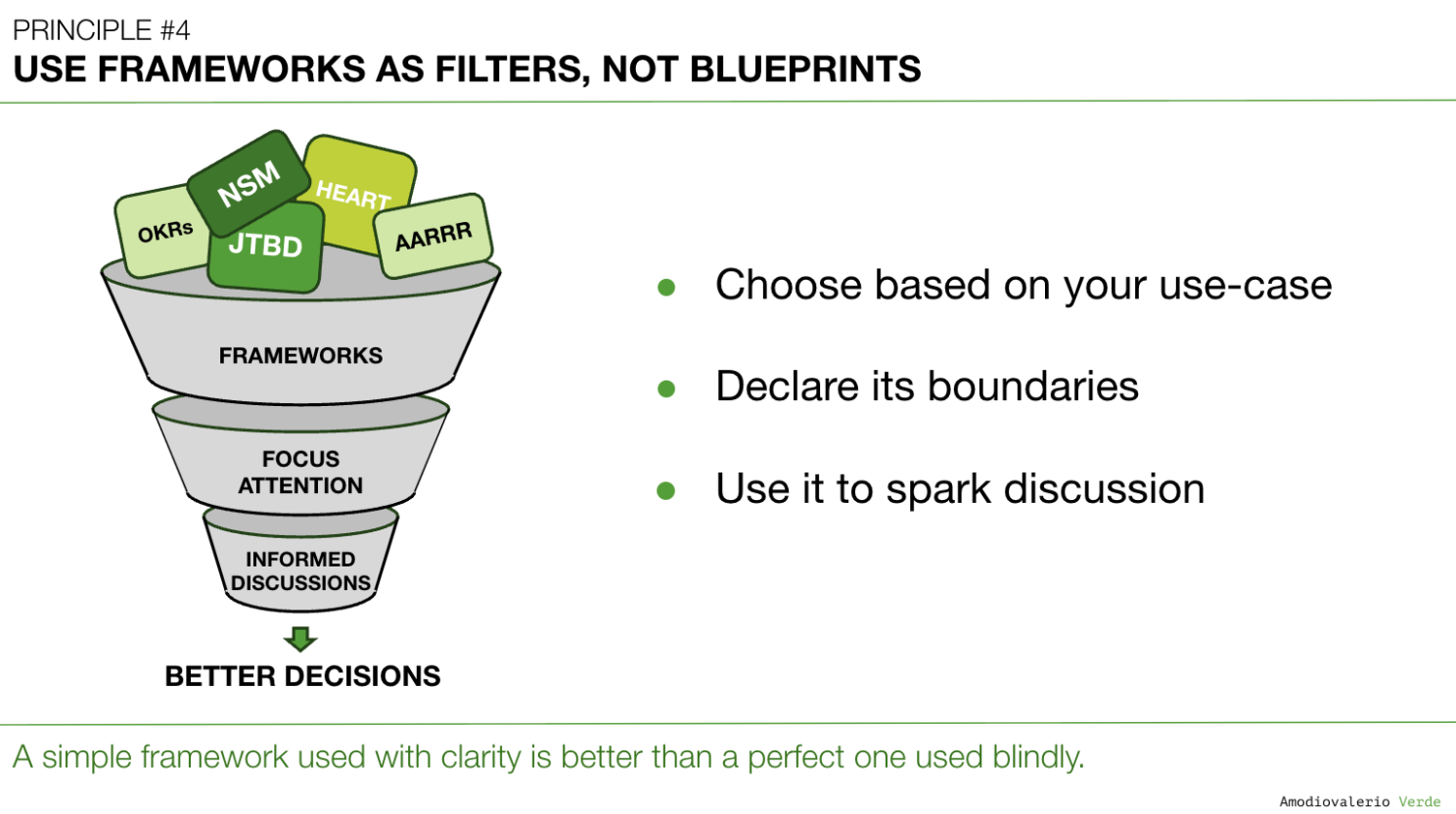
So, how do you avoid this? Treat frameworks as filters, not blueprints.
A framework’s job is simple: Focus attention, highlight signals, and provide a temporary lens for the conversation.
Frameworks aren’t recipes. They’re lenses. When the view distorts, change the lens.
That’s where leadership steps in.
In empowered teams, that leadership can emerge anywhere. But it must emerge.
What Frameworks Actually Do (and Don’t)
Quick refresher:
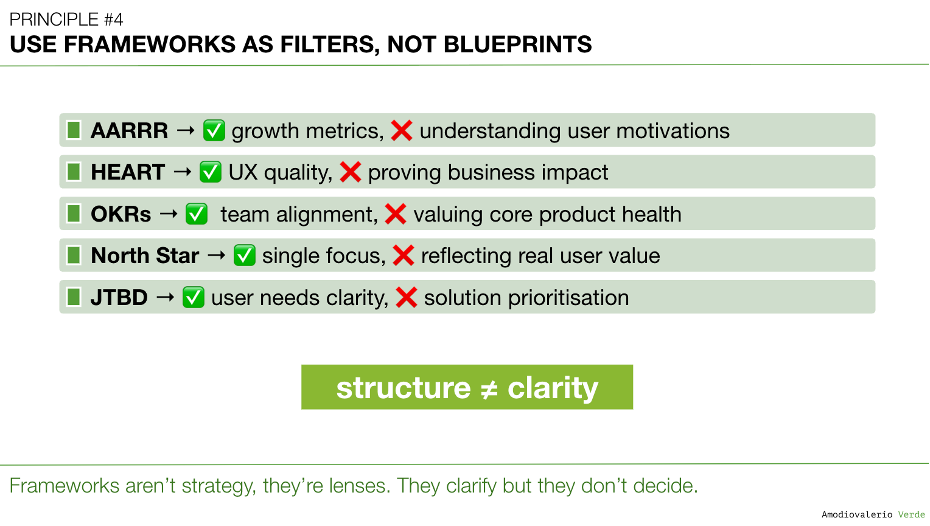
- AARRR? Great for growth loops. Useless in understanding user motivations.
- HEART? Good for UX monitoring. Tells you nothing about business impact.
- OKRs? Align execution. But doesn’t account for core product health.
- North Star Metrics? Focus attention, but can focus you on the wrong thing.
- JTBD? Helps you understand needs, but offers no prioritization.
Every framework has value. But stacking them doesn’t create insight. It creates distortion.
One framework helps you focus.
Five frameworks give you a kaleidoscope
When Teams Try to Be Too Clever
Seen this before? Teams combine OKRs, HEART, AARRR, JTBD, and North Star Metrics into one massive "operating model."
What happens?
- UX obsesses over HEART.
- PMs track AARRR.
- Leaders chase OKRs.
Meetings feel sophisticated. They aren’t. Nobody agrees what matters. Decisions slow. Focus fractures.
Leadership isn’t about tolerating this complexity. It’s about ending it.
The real question isn’t: “Which frameworks should we combine?”
It’s: “Are we optimizing for clarity or for complexity?”
(And yes, complexity wins, unless leadership intervenes.)
The Cost of Framework Addiction
Misusing frameworks doesn’t just waste time. It burns cognitive fuel.
It distracts teams. It replaces decisions with process debates. It creates the illusion of strategy without actual strategy.
Frameworks don’t prevent bad decisions. They just make bad decisions look methodical.
With AI in the mix? You get structured confusion at scale.
The Leader’s Role: Be the Filter. Not the Facilitator.
Framework overload is often a sign of missing focus from leadership.
It’s a leadership failure. Frameworks flood the space where leadership should be.
Without focus from leadership, teams stack models to compensate.
In the AI era, that vacuum grows faster. AI won’t solve your leadership gap. It’ll expose it.
Leadership doesn’t always come from the top. But it must come from somewhere.
Someone must choose focus. That’s leadership.
Note: Framework overload can also stem from an organizational culture that rewards the appearance of process, or from teams that lack the training to use these tools effectively.
Leadership Checklist: How to Use Frameworks Properly
- Choose One Primary Framework Per Decision. For any single objective, select the one framework that frames the problem best.
- Declare the Boundaries. What does this framework ignore? Make it explicit.
- Name the Decision. What choice is this framework helping to make?
- Challenge the Fit. Why this framework? Why now? Default to rejecting it.
- Lead. Frameworks focus. Leaders decide.
If your team can’t answer these questions? The framework’s running the team.
Not the other way around.
On One Primary Framework
This isn’t a ban on frameworks. It’s a ban on confusion.
Mature teams can use different frameworks for different jobs.
Use OKRs for strategic alignment. Use JTBD for user discovery. But don’t stack overlapping frameworks for the same decision.
If you must layer frameworks?
- Ensure they operate at different altitudes (e.g., company-level OKRs vs. UX-level HEART).
- Make handoffs between owners explicit.
- Assign one person accountable for conflicts.
- Retire extra lenses when they stop adding clarity.
One decision. One primary framework.
Everything else? A distraction.
When two frameworks make sense (and when they don’t)
Use one primary framework per decision. Use multiple only when they answer different questions:
- Different layers: JTBD clarifies why; RICE ranks what to build first.
- Different horizons: A narrative vision points to the three‑year hill; quarterly OKRs break the climb into steps.
- Different specialties: Growth tracks AARRR; Design tracks HEART. No overlap, no conflict.
If two frameworks try to rank the same backlog (RICE + MoSCoW + Kano in one meeting), drop the extras.
Litmus test: same question → one lens.
Final Reflection
Frameworks can focus your teams. But only leadership creates clarity.
Your customers don’t care what framework you used. They care what you delivered.
In the AI era, leadership is mandatory.
Now ask yourself:
👉 Is your leadership multiplying clarity or complexity?
👉 What’s one framework you’ve seen misused?
Share in the comments.
What’s Next?
Having explored how frameworks should act as filters, the natural next step in building a robust data-informed system is to understand how delivered features actually create value.
This leads us to: Principle 5: Focus on Adoption, Not Just Delivery
Because shipping is a cost, but adoption is the asset.
Until then:
- Challenge the frameworks your team uses.
- Question if clarity or complexity is winning.
- Lead with judgment, not just models.
PAQs – Potentially Asked Questions
Are frameworks bad?
No. Frameworks are tools.
A knife in the right hands slices complexity. In the wrong hands, someone gets hurt.
Frameworks help focus thinking. But they never replace it.
Why not combine frameworks? Isn’t that more comprehensive?
It sounds clever. It isn’t.
Each framework is a lens. Stacking lenses doesn’t sharpen focus.
It distorts it. Choose one. Focus.
When the view distorts, switch lenses.
Can’t AI help us choose the right framework?
AI can list frameworks.
It cannot choose for you.
Framework selection is not an information task.
It’s a judgment task. AI floods. Leaders filter.
How do I know if my teams are trapped in Framework Theater?
Watch for these signs:
- Meetings debating labels, not outcomes.
- Growing process documentation. Shrinking decisions.
- Endless metric dashboards. No clear strategic priorities.
If yes? Your teams aren’t strategizing. They’re performing.
What’s the smallest intervention to stop Framework Theater?
Next time a framework is proposed, ask:
- What decision will this help us make?
- Why this framework, now?
If the answer isn’t sharp, stop it.
Frameworks aren’t neutral. They shape attention.
Treat them accordingly.
Isn’t the “one framework” rule too rigid, especially for new or cross‑functional teams?
Yes. The mantra is a forcing function, not a law of nature.
For beginners, start with one primary framework per decision so the team learns focus.
As maturity grows, you can layer a second, complementary lens, but only when the overlap and handoffs are explicit and owned.
The goal is disciplined clarity, not artificial scarcity.
You seem anti‑framework. Are frameworks the enemy?
No. The article is antidogma, not antiframework.
Frameworks are valuable tools; the danger is treating them as commandments.
Use them consciously, discard them when they distort.
Each principle in this series builds upon the last to form a coherent system for better decision-making. Here is the full list of principles we are exploring:
Intro: Beyond the Dashboard Series
Principle 1: Avoid the Data Delusion
Principle 2: Adopt a Data-Informed Approach
Principle 3: Choose What to Measure
Principle 4: Use Frameworks as Filters, Not Blueprints
Principle 5: Focus on Adoption, Not Just Delivery
Principle 6: Know Your Tool Stack’s Boundaries
Principle 7: Build Layered Dashboards to Scale Thinking
Principle 8: Manage Multi-Product Portfolios Separately
Principle 9: Reconcile Metric Definitions Before Analysis
Principle 10: Build Thinking Systems, Not Reporting Systems
Principle 11: Turn AI into a Judgment Multiplier