
Beyond the Dashboard | Principle 2: Adopt a Data-Informed Approach
Stop being data driven. It breeds passivity and dashboard worship. Be data informed: start with a question, state a hypothesis, define the stakes, then use data to pressure test. AI is a sous chef, not your strategist. Data informs. Judgment makes the call. Decide the meal before you open the fridge


TL;DR (for people who believe reading full paragraphs is optional)
- Being “data-driven” is a trap. It builds passive teams who wait for numbers to give them permission to think.
- Data-informed teams lead with hypotheses, use data to pressure-test thinking, and leave judgment where it belongs: with humans.
- “What does the data say?” is the wrong question. Start with: “What are we trying to learn?”
- AI doesn’t have opinions. If you don’t have a hypothesis, AI won’t help you; it will overwhelm you.
- Shift your mindset: data is not the answer. It’s the sparring partner. You’re the one supposed to think.
The Omelet and the Fridge
In Principle 1, we discussed the Data Delusion: the dangerous illusion that if you measure everything, you’re learning something. Spoiler: you're often not. In many companies, “data-driven” means shipping the wrong thing more efficiently, backed by excellent-looking dashboards.
So, what’s the fix?
It starts with changing your posture. (Not literal posture, though your slouch in meetings might be contributing.)
Shift from data-driven to data-informed.
You might think this is semantics. Fair. But semantics shape culture. And in this case, the semantics are quietly killing your strategy.
Visualize: Your team is like a person staring blankly into an open fridge. Eggs. Some cheese. Sad vegetables. In a “data-driven” world, they stand there, paralyzed, waiting for the fridge to tell them what to cook, or to serve a ready-to-eat meal.
Here’s the problem: Fridges don’t decide.
A “data-driven” culture operates exactly like this. Without an intent (what meal are we making?), teams default to building whatever is easiest to assemble. Usually some half-satisfying scramble, technically edible but strategically hollow.
Contrast: A data-informed team decides first: “We’re making an omelet.” Then, they open the fridge to check if reality agrees.
- Enough eggs? Good.
- Moldy cheese? Adjust the plan.
- Maybe toss in the mushrooms.
Key point: The data didn’t decide. It informed the plan already framed by human intent.
That’s the shift.
- Data doesn’t drive.
- Data pressure-tests your thinking.
From a Passive Loop to an Active One
This shift from a passive to an active mindset is the difference between being stuck in a reactive loop and driving a structured thinking process.
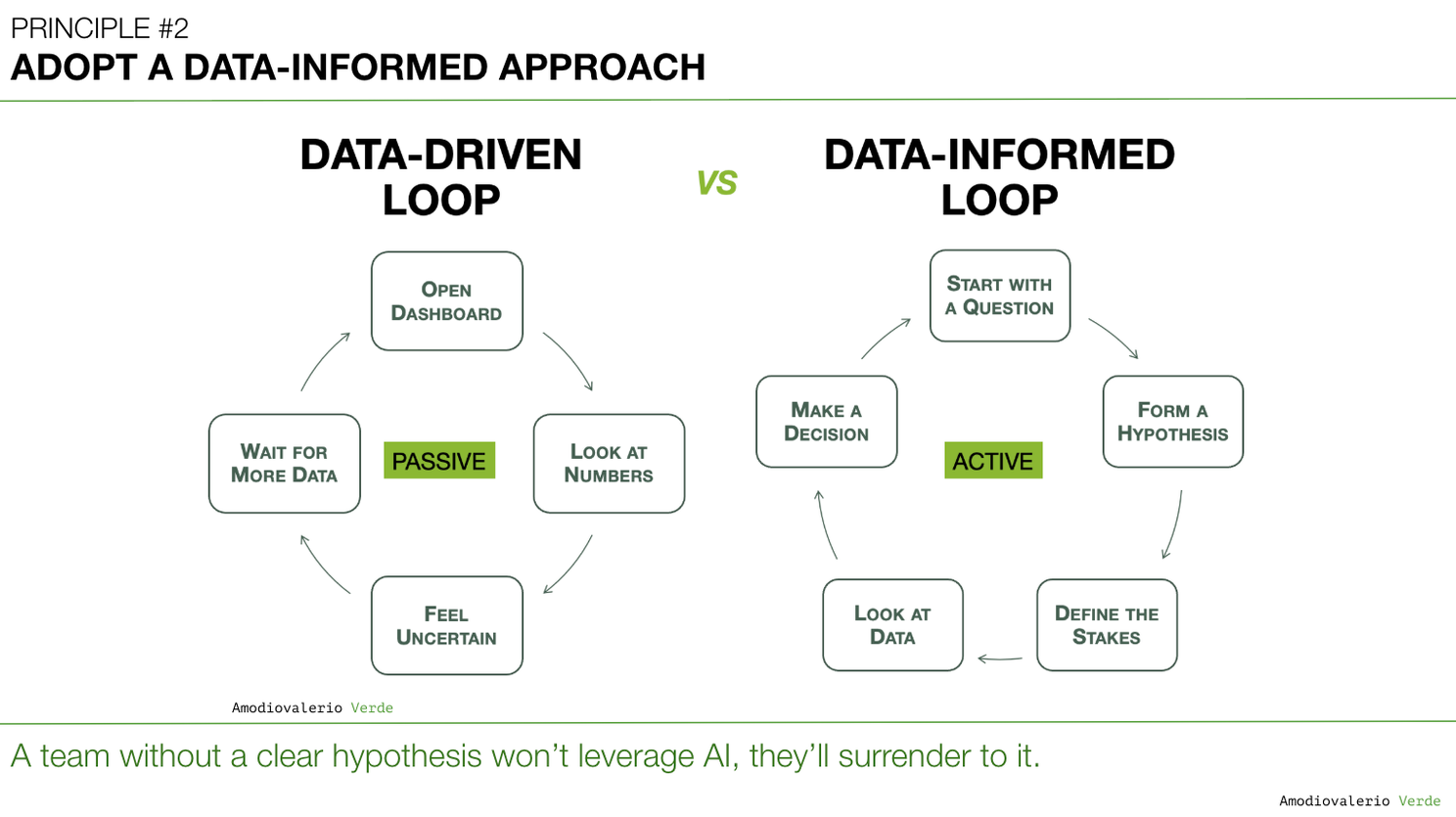
- The data-driven loop is a cycle of paralysis: Teams look at dashboards without intent, feel uncertain, and default to waiting for more data.
- The data-informed loop is active and intentional: Start with framing a clear question and forming a hypothesis before analyzing data. Use data deliberately to test your thinking, define the stakes, and make a confident decision.
This structured reasoning prevents teams from surrendering to AI instead of leveraging it.
Why Being “Data-Driven” Quietly Destroys Strategy
The phrase “we’re data-driven” sounds good on paper. It signals rigor.
In practice, it often signals the opposite: abdication of thought.
Here’s how “data-driven” cultures fail:
- Judgment Atrophies Teams wait for data to decide. Critical thinking dies. People stop forming opinions. Risk avoidance becomes the strategy. Leaders shift from strategists to glorified data reporters: “What’s the dashboard say?” instead of “What problem are we solving?”
- You Optimize for the Obvious Data measures the incremental. It’s terrible at spotting transformational opportunities. Data-driven teams chase 0.2% lifts endlessly, ignoring bigger shifts because “the data didn’t tell us to pivot.”
Reminder: You can’t A/B test your way into a business model shift. - Accountability Evaporates In a data-driven culture, failure is nobody’s fault. “The data told us to do it” becomes a convenient scapegoat. Decisions are owned by dashboards, so there’s no human accountability and no progress.
In contrast, a data-informed culture forces ownership.
A leader says: “I believe X. The data will help me test if I’m wrong.”
- That is real rigor.
- That’s leadership.
The Strategic Price of Staying “Data-Driven”
Staying “data-driven” sounds rigorous. Over time, it reshapes your organization in ways you won’t like.
- Leaders Become Reporters, Not Strategists If your leadership meetings are just chart reviews, you’ve stopped leading. You’re narrating history, not shaping it.
- Teams Learn to Obey, Not Think When data is treated as the answer, curiosity dies. Teams shift from problem-solvers to metric-watchers.
- You Optimize the Present and Lose the Future Data-driven teams get trapped optimizing what’s easy to measure. You end up iterating yourself into irrelevance.
- AI Becomes Your Manager, And It’s a Terrible One AI will analyze faster, surface more correlations, and confidently recommend nonsense. AI isn’t your next strategist. It’s your next source of beautifully structured noise.
In short:
- Data-driven teams optimize noise.
- Data-informed teams build judgment.
One scales analysis. The other scales leadership. Pick carefully.
AI’s Role in a Data-Informed Future
AI doesn’t replace judgment. It multiplies whatever thinking you already have.
- Use it well: It scales your clarity.
- Use it passively: It scales your confusion.
In a data-informed team, AI is a judgment amplifier, not a decision-maker. Treat it as your sous-chef, not your head of strategy.
Here’s how to use AI well:
- Fast-surfacing insights: AI summarizes qualitative data fast. It highlights themes, not conclusions.
- Accelerated assumption testing: Use AI to simulate reactions, generate alternative hypotheses, or run rapid scenario analysis. Goal: speed-to-signal, not certainty.
- Highlighting edge cases: AI finds patterns and outliers humans miss. What it can’t do: decide which ones matter.
- Reducing analysis time: Let AI crunch the data. Your team’s job is to interpret meaning and define next steps.
What AI should not do:
- Set your priorities.
- Define your roadmap.
- Tell you what matters.
Example: AI will tell you that users who click Button A and scroll for exactly 4.3 seconds retain 3.7% better. A passive team redesigns their homepage around Button A. A judgment-led team asks: “Does Button A even matter?”
- AI highlights signals. Humans decide relevance.
In short: AI is your sous-chef. Use it to prep ingredients. But you’re still the one cooking.
The Thinking Loop: A Framework for Action
Shifting from data-driven to data-informed needs a change in process. The Thinking Loop is a simple, three-step framework that installs structured reasoning into your team’s workflow.
It ensures that data is used to pressure-test judgment, not replace it.
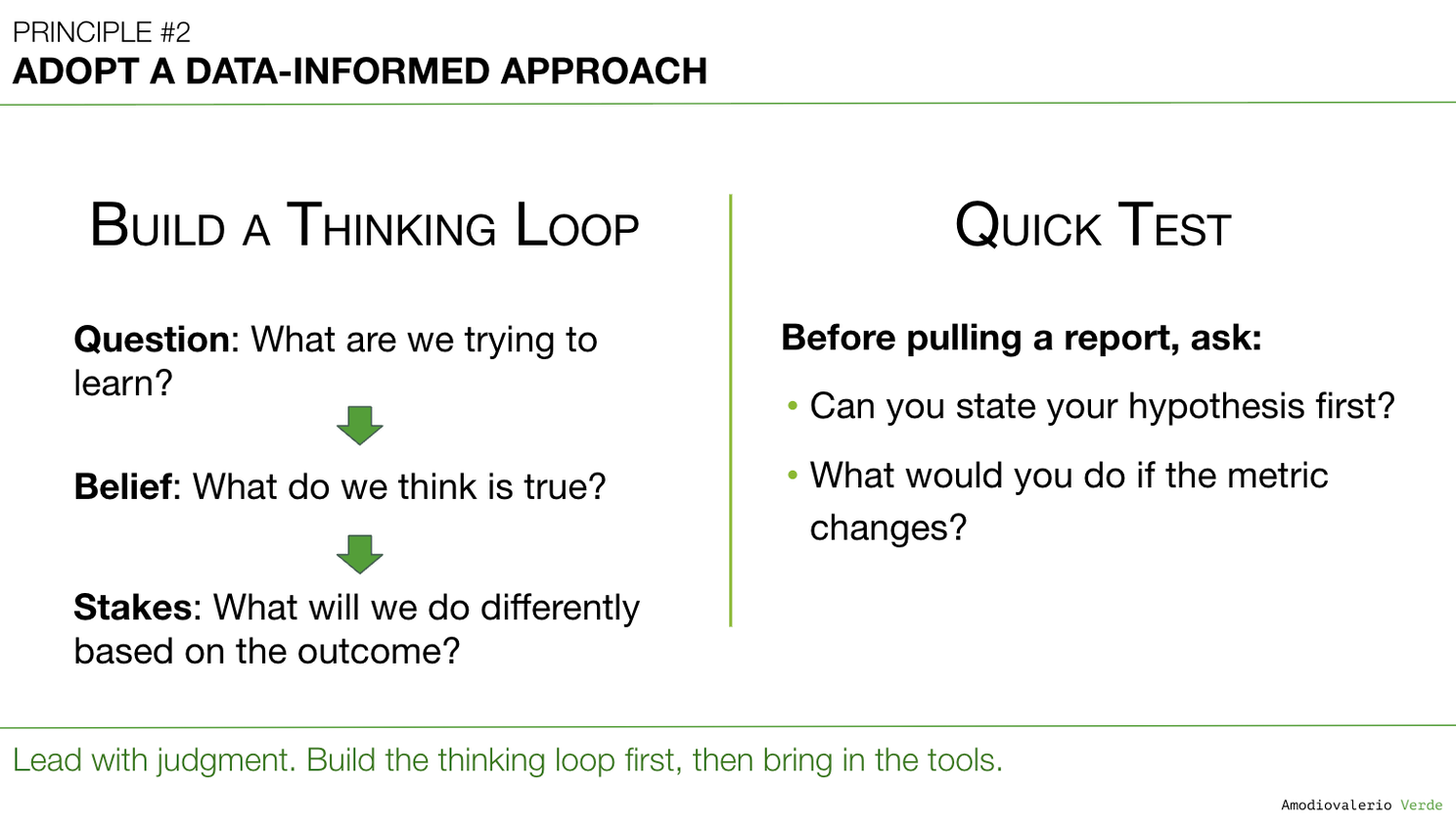
1. Start with a Question: "What are we trying to learn?"
- This is the first and most critical step.
- A data-informed approach doesn't begin with “What does the data say?”
- It begins with a clear question.
- It reframes the work from passive reporting to active learning.
2. Form a Belief: "What do we think is true?"
- State your hypothesis.
- Form an opinion and make it falsifiable.
Example: “I believe showing value earlier in onboarding reduces drop-off.” or “I believe X, and the data will help me test if I’m wrong.”
- This combats intellectual passivity and forces ownership.
3. Define the Stakes: "What will we do differently based on the outcome?"
- Connect analysis to action.
- If the metric goes up, what’s the action?
- If it goes down, what’s the action?
- If the answer is “nothing,” the analysis is just expensive noise.
This loop reframes your team from being data reporters to decision-makers.
As a leader, use the Quick Test.
• Can you state your hypothesis first?
• What would you do if the metric changes?
If they can't answer, they are still reporting, not deciding.
Lead with judgment. Build the thinking loop first. Then bring in the tools.
Final Thought
- “Data-driven” teams look busy.
- “Data-informed” teams make decisions.
- Dashboards track history. Judgment shapes it.
In a world where AI analyzes faster than you can think, human judgment isn’t optional. It’s your last competitive advantage.
- AI will analyze, correlate, and surface insights.
- AI will point you to Button A, tell you who clicked it, and how long they hovered.
But it will never tell you if Button A matters. That’s your job.
In this next era, the teams that win won’t be those with the prettiest dashboards or the largest models. They’ll be the ones that know:
- Data doesn’t make decisions. People do.
- AI won’t replace judgment. It will expose whether you had any.
- Your systems don’t shape strategy. Your thinking does.
Decide the meal before you open the fridge.
And if you’re leading a team? Your job isn’t to narrate what the dashboard says. It’s to ask: “What are we trying to learn?”
Then use data, AI, and human minds together to answer that question, act on it, and learn faster.
What’s Next
The next step in building a data-informed system is to rethink your metrics.
In Principle 3: Choose What to Measure, we’ll dive into how your measurement system shapes your thinking system and why AI will happily scale whatever you measure, whether it matters or not.
Because a metric without a decision isn’t insight. It’s expensive noise.
Until then:
- Audit your dashboards.
- Prune your metrics.
- And lead your teams with questions, not charts.
In Case You Missed the Start of the Series
Join the conversation
If you found this valuable, stay connected.
- Share this with your teams and peers. Many are still trapped in data-driven loops without realizing it.
- Comment with your experience. What’s blocking your shift from reporting to deciding?
Let’s rethink how we build products, teams, and strategies together.
Because in a world of automated answers, clear thinking is the only advantage left.
PAQs – Potentially Asked Questions
Isn't "data-informed" just a convenient excuse for leaders to ignore data they don't like and do whatever they want?
This is the most common and most important critique. The answer is no, it’s the opposite.
A data-informed approach is more rigorous.
Ignoring data is easy. The hard part is stating your belief upfront and declaring, "Here is my hypothesis, and here is the data that would prove me wrong." It forces a leader to make their intuition falsifiable.
It’s not a license to follow a gut feeling; it’s a commitment to stress-test that gut feeling against reality in a structured way.
My team is fairly junior and they seem to crave the certainty of a "data-driven" process. How do I shift them without causing chaos?
Junior teams crave clarity, and "the data says so" feels clear. But it’s a fragile form of clarity.
You shift them by coaching the "thinking loop" as their new process.
Start small. Before they build their next dashboard, ask them to write one sentence: “We believe that X is true, and we will know we are right if we see Y metric move.”
This reframes their job from "visualizing data" to "solving problems." You aren't removing process; you are replacing a passive one with an active one.
This "thinking loop" of forming a hypothesis sounds slow. We're in an agile environment and need to move fast. How does this fit?
It only seems slow if you believe that frantic activity equals progress.
Think about how much time is wasted debating the meaning of a chart or building something based on a flawed interpretation of data.
The thinking loop (Question --> Belief --> Stakes) can be done in ten minutes at a whiteboard.
It doesn't slow down development; it prevents building the wrong thing faster.
It’s a ten-minute investment that can save you a two-sprint mistake.
Speed without direction isn’t velocity; it’s just burning energy.
What's the single smallest step I can take to start moving my team toward being data-informed?
The next time someone on your team brings you a chart, ask them one question before you even look at it:
“What will we do differently if this number goes up versus if it goes down?”
If they can't answer, the chart is just trivia.
This question gently forces them to connect data to a decision.
It’s a micro-habit that, repeated over time, retrains the entire team to see data as a tool for action, not just observation.
What happens when our hypothesis is proven wrong by the data? Doesn't that hurt morale?
Only if your culture celebrates being right instead of celebrating learning.
A data-informed culture must treat a disproven hypothesis as a victory. Why? Because you just saved the company time, money, and resources by not pursuing a bad idea.
The goal of a test isn't to be right; it's to get to the truth faster.
As a leader, you must be the first to say: "Excellent. My hypothesis was wrong. This is a fantastic result because now we know what not to do. What's our next hypothesis?"
How does the role of a Data Analyst or Scientist change in a data-informed model?
Their role becomes more powerful and more strategic.
In a passive "data-driven" world, analysts are often treated like vending machines: you put in a query, you get out a chart.
In a data-informed world, they become strategic partners. They move from being report-builders to being hypothesis-testers.
They help product managers refine their questions, design better experiments, and interpret results with nuance.
They are no longer just providing the "what"; they are helping the team understand the "so what."
Isn’t ‘Data-Informed’ just rebranded intuition?
No.
Data-informed doesn’t mean “go with your gut.” It means declaring your belief upfront, making it falsifiable, and using data to pressure-test your thinking.
Data-informed teams don’t ignore data — they frame it.
- Intuition drives the hypothesis.
- Data challenges it.
The rigor comes from the structured loop of belief, test, and action.
Leaders who skip that loop aren’t being data-informed, they’re being opinion-driven.
How do we avoid analysis paralysis if we stop being purely data-driven?
Paradoxically, being data-driven often causes more paralysis and teams stare at dashboards waiting for a ‘signal’ clear enough to act.
Data-informed teams avoid this by anchoring every analysis to a decision.
Before any report is pulled, the question is framed: "What will we decide based on this?"
That prevents analysis for its own sake.
Data is no longer a source of permission; it’s a tool for validation.
The Thinking Loop provides speed by focusing attention where it matters.
Each principle in this series builds upon the last to form a coherent system for better decision-making. Here is the full list of principles we are exploring:
Intro: Beyond the Dashboard Series
Principle 1: Avoid the Data Delusion
Principle 2: Adopt a Data-Informed Approach
Principle 3: Choose What to Measure
Principle 4: Use Frameworks as Filters, Not Blueprints
Principle 5: Focus on Adoption, Not Just Delivery
Principle 6: Know Your Tool Stack’s Boundaries
Principle 7: Build Layered Dashboards to Scale Thinking
Principle 8: Manage Multi-Product Portfolios Separately
Principle 9: Reconcile Metric Definitions Before Analysis
Principle 10: Build Thinking Systems, Not Reporting Systems
Principle 11: Turn AI into a Judgment Multiplier