
Beyond the Dashboard | Intro: Why Your Beautiful Dashboards Might Be Making You Dumber
We’re obsessed with data, but our dashboards often make us dumber. We track everything yet decide nothing. More data, less judgment. This isn't a tooling issue, it's a thinking one. This 11-principle series shares ideas on how to build judgment in an AI era that demands it.

TL;DR (for bullet-point enthusiasts)
- Dashboards are not decisions.
- AI won’t replace judgment – it exposes it.
- This is the intro to an 11-principle series on data, decisions, and AI.
- Yes, it’s long. Clarity is worth your time.
- Slides coming later for your team debates.
The Illusion of Clarity
We live in an era obsessed with data.
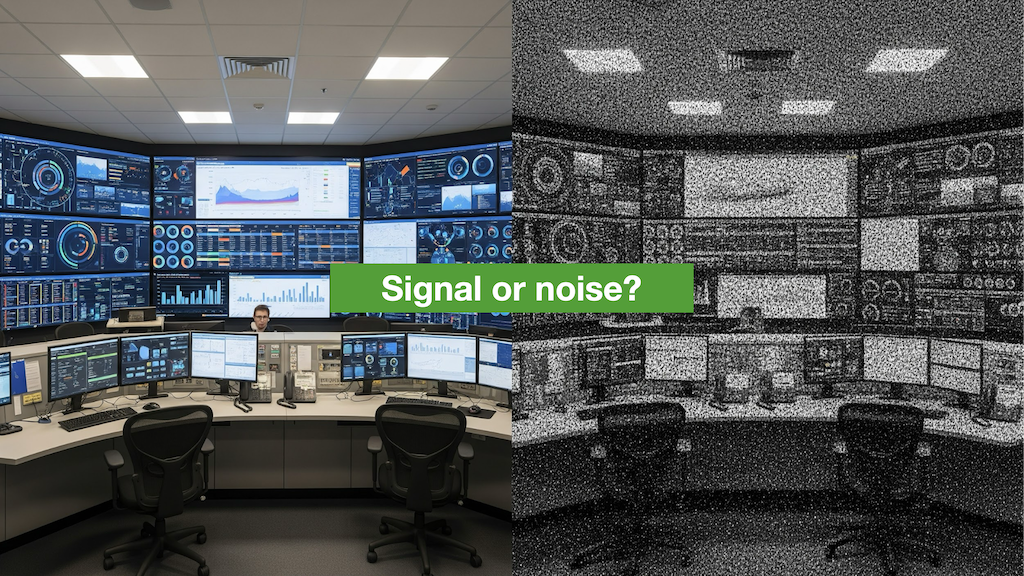
Dashboards everywhere, promising clarity and control. Clean visuals. Colourful funnels. Product, marketing, sales, ops – everyone has a wall of dashboards. It feels like a modern control room.
But here’s what I’ve seen:
- We track everything and decide nothing.
- Features shipped, no one used them.
- Metrics moved, no one knew why.
- Roadmaps full. Strategy hollow.
We’ve built beautiful dashboards that feed the eyes – but starve the mind.
More data than ever. Less judgment.
And this isn’t a tooling problem. It’s a thinking problem.
A few days ago, I gave a closing keynote at a product conference.
Last slot of the day. The only thing separating people from a well-deserved drink was… me.
Unofficial talk title: “Why your beautiful dashboards are probably making you dumber, and how to fix it before your new AI assistant judges you.”
My goal: keep them awake, make them think.
Apparently, it worked. Many told me afterwards:
“This was the talk that made me rethink how we use data entirely.”
But this series isn’t about me or my keynote. It’s about sharing ideas you can apply with your teams, question assumptions, and build judgment muscles in an AI era that demands it.
Why a series?
Since that day, many asked for the slides.
But slides without thinking are like IKEA instructions without the Allen Key. Technically useful and practically useless.
A slidedeck won’t foster conversation. It won’t spark debate. It won’t create the healthy collision of perspectives that actually improves our practice.
Creating those spaces for perspectives to collide – constructively – is something I believe in deeply.
So I decided to write this as a series:
- long-form
- depth over brevity
- thought-provoking, not just summarising
Because clarity requires depth. Reducing complex concepts to short sayings kills nuance. The sentence becomes a saying, and we learn nothing.
Thinking and judgment suffer when we simplify to emptiness.
Each principle in this series builds upon the last to form a coherent system for better decision-making. Here is the full list of principles we are exploring:
Intro: Beyond the Dashboard Series – Intro to the series.
Principle 1: Avoid the Data Delusion – Statistically significant. Strategically irrelevant. That’s the trap.
Principle 2: Adopt a Data-Informed Approach – Being data-driven is like staring into the fridge hoping a meal appears.
Principle 3: Choose What to Measure – A metric without a decision is expensive noise.
Principle 4: Use Frameworks as Filters, Not Blueprints – Frameworks don’t decide for you. They stop you from staring into the void.
Principle 5: Focus on Adoption, Not Just Delivery – Shipping is a cost. Adoption is the asset.
Principle 6: Know Your Tool Stack’s Boundaries – You don’t have one truth. You have a stack of partial truths.
Principle 7: Build Layered Dashboards to Scale Thinking – One-size-fits-all dashboards fit no one. Especially your executives.
Principle 8: Manage Multi-Product Portfolios Separately – Blended metrics create Franken-metrics. Useful to no one.
Principle 9: Reconcile Metric Definitions Before Analysis – If teams argue about numbers, they’re arguing about definitions.
Principle 10: Build Thinking Systems, Not Reporting Systems – Dashboards aren’t the goal. Better decisions are.
Principle 11: Turn AI into a Judgment Multiplier – AI multiplies judgment. Without judgment, there’s nothing to multiply.
Why does this matter?
Because AI isn’t coming to replace your judgment. It’s coming to expose it.
Perfect data won’t fix a flawed strategy. AI won’t fill a judgment gap – it will reveal it faster, at scale.
Teams waiting for AI to tell them what to do will be replaced by teams using AI to think better.
What to expect?
Each article will:
- Go deep into one principle
- Share practical team questions
- Include keynote slides
- Reference past reflections
- Anticipate PAQs (Probably Asked Questions) to address what usually comes up – or should
- Stimulate good conversation – and for that, I need your help.
PAQs – Potentially Asked Questions
Will this be relevant if I’m not in Product?
Yes. If you use data to decide anything (which you do), this is relevant. Judgment is a human skill.
How long are these posts going to be?
Long. Verbose. Intentional. Espresso shots for your thinking, not TikTok for your brain.
Why verbose?
Because clarity demands depth. Brevity without substance becomes bullet-point wisdom that forgets the why.
Why publish them individually?
Thinking takes time. Each principle deserves its moment.
Are you anti-data?
No. I’m anti-passivity. Data sharpens thinking. It doesn’t replace it.
You said “AI will expose your judgment.” How?
AI amplifies your thinking system. Clear judgment scales clarity. Vague judgment scales vagueness.
Final thought (for today)
👉 If this resonates, follow along. Engage. Debate. Tag your team. Forward to a friend. Share how these reflections land with your teams. Fostering the conversation is the real value of a post.
Because dashboards don’t make decisions. You do.
And AI will only multiply the quality of those decisions.
Next up: Principle #1 - Avoid the Data Delusion
Because statistically significant but strategically irrelevant is not where you want your team to end up.
👉 Question for you: Are your dashboards helping you decide, or just helping you avoid deciding? Drop your honest answer below.