
Backlog as Mirror: Why Product Teams Get Stuck
Shipping continues but outcomes stall. The backlog records motion without meaning. When strategic reasoning fades, dysfunction shows up: contextless items, reactive prioritization, discovery without decisions. In healthy teams, the backlog is a reasoning space that links work, trade-offs, and goals.


“We’re shipping, but it doesn’t feel like progress.” “The roadmap looks clean, but the team feels lost.” “We’re doing agile - but it’s not working.”
I’ve heard versions of this across companies, stages, and team types. And in most cases, the root issue isn’t tools, frameworks, or talent.
It’s something deeper: the product system stops reasoning clearly.
As strategic thinking fades, the backlog quietly captures the resulting motion without meaning.
Delivery continues, but outcomes stall. Discovery happens, but doesn’t inform the roadmap. Everyone’s busy, but strategy feels disconnected. The backlog is full - but no one is confident in what to do next.
My Thesis: The Backlog Reflects System Thinking
Most product dysfunction shows up in the backlog. And more importantly: The backlog can be a powerful diagnostic tool.
When systemic reasoning breaks down, it shows up in the backlog.
Not just as messy tickets or vague tasks - but as real signs of dysfunction:
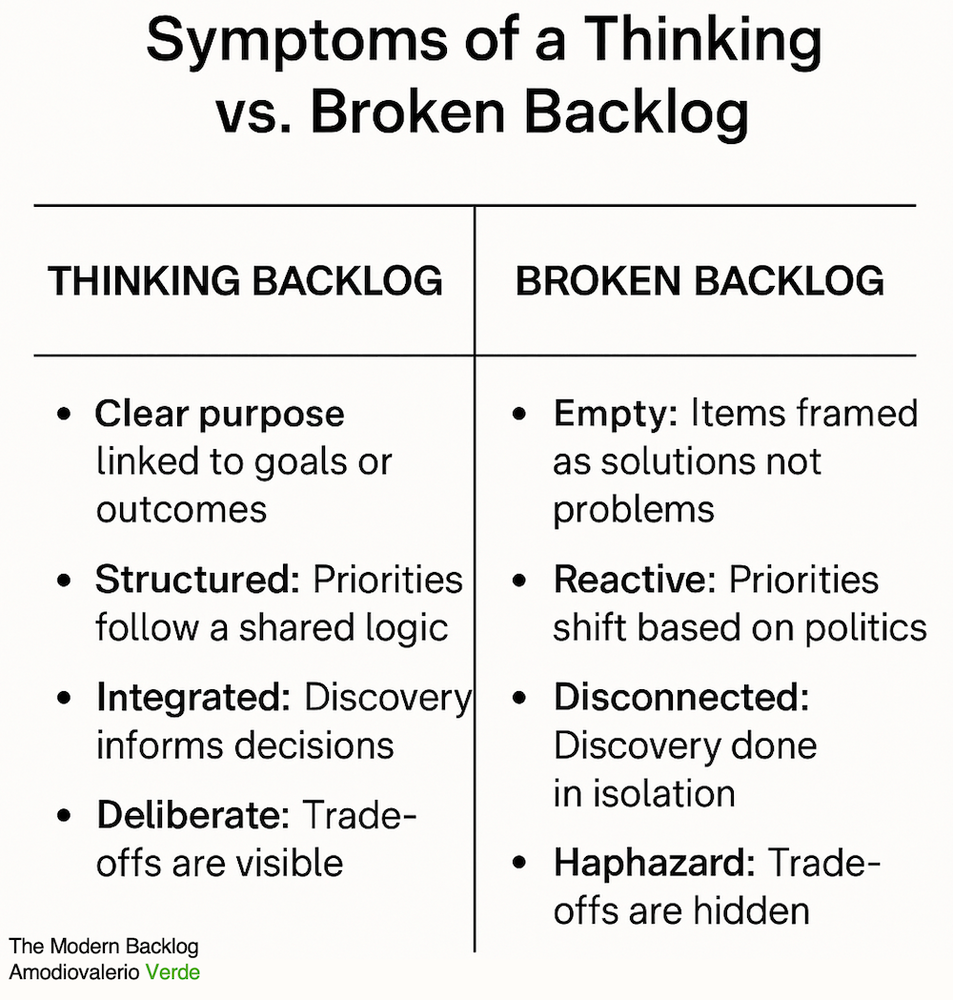
- Items lack context or purpose (“just build X”)
- Prioritization becomes reactive or political
- Discovery yields documents, not decisions.
- Outcomes are forgotten in favor of output
- The backlog becomes a dumping ground, not a decision tool
In this sense, the backlog isn’t just a list — it reflects how the system thinks, or fails to. And that’s why it becomes such a useful diagnostic tool.
When the System Thinks, the Backlog Works
In healthy teams, the backlog isn't just a plan - it's an active reasoning space. It helps teams connect ideas to outcomes, decisions to goals.
You can tell when the system is thinking:
- Each item connects to goals, not just features.
- Prioritization follows logic, not influence
- Discovery leads to clear trade-offs and action
- Strategy lives in the backlog - not just the slide deck
- The team uses the backlog to reason, not just to track
Opening It Up
This is the lens I’ve been working with lately. But I know others see this from different angles - and often, deeper ones.
So I’d love to hear from you:
- Have you used the backlog as a diagnostic tool?
- What are the hidden signals of dysfunction you look for?
- What helps teams reconnect strategy, reasoning, and delivery?
Let’s challenge and sharpen this thinking together.